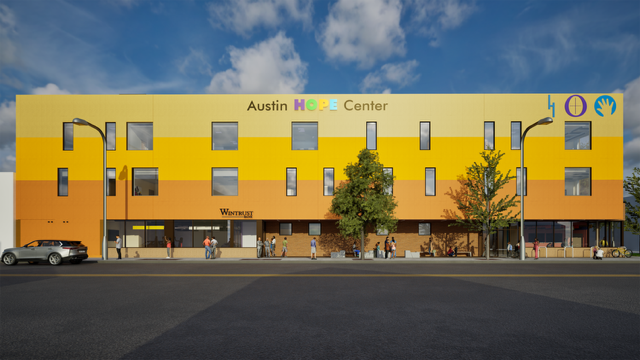
In a powerful symbol of community renewal and resilience, residents, civic leaders, and partners gathered Nov. 17 to celebrate the beam raising for the Austin HOPE Center in Chicago’s Austin neighborhood.
The $22 million 25,000-square-foot, three-story health and wellness facility at 5036 W. Chicago Ave. will bring affordable, high-quality pediatric specialty and behavioral health care directly to Chicago’s West Side.
Once complete in late summer 2026, the Austin HOPE Center will become the first permanent, stand-alone pediatric specialty and behavioral health facility on Chicago’s West Side—expanding access to high-quality care in a community where life expectancy is nearly seven years lower than the citywide average.
“The HOPE Center will be a promise kept to the Austin community and Chicago’s West Side that every child deserves access to exceptional care, no matter their ZIP code,” said Dr. Tom Shanley, President and CEO, Ann & Robert H. Lurie Children’s Hospital of Chicago. “This project reflects the power of partnership and our commitment to ensuring that health equity isn’t an aspiration—it’s a reality.”
For decades, Austin and other West Side neighborhoods have endured the cumulative effects of systemic disinvestment, limited access to preventive care, and high rates of chronic illness. According to the Chicago Department of Public Health, hospitalizations for preventable conditions are more than twice as high in communities like Austin compared to more affluent neighborhoods. Chicago residents living in neighborhoods with limited health infrastructure often spend 30–50% more on emergency care than those with consistent access to primary and behavioral health services, according to Health System Tracker.
“Today we are raising more than steel—we are raising hope,” said Pastor Contrell Jenkins, CEO of Stone Community Development Corporation. “The Austin HOPE Center will stand as an anchor of possibility, proving that when faith, partnership, and purpose come together, transformation can happen right where it’s needed most,” added Pastor Jenkins.
The disparities drive not only poorer health outcomes, but also the higher health care costs that have kept families trapped in cycles of financial insecurity and stress. The HOPE Center—developed through a partnership of the Austin community, Chicago Neighborhood Initiatives (CNI), Lurie Children’s Hospital, and Stone Community Development Corporation, with strong support from the City of Chicago and philanthropic partners – is working to reverse these trends.
“CNI is proud to be among the community partners developing the Austin HOPE Center because it creates additional opportunities and ensures that long-overdue access to healthcare is no longer a barrier to building healthy lives and a vital community,” said David Doig, President, CNI.
The Austin HOPE Center will serve families throughout the West Side and provide:
- Pediatric specialty care services from Lurie Children’s Hospital, bringing expert-level care closer to home for West Side families.
- Adolescent medicine, behavioral health, and specialty clinics addressing chronic conditions such as asthma, high blood pressure, sickle cell disease, weight management, and fatty liver disease.
- Administrative offices supporting Thresholds’ community-based mental health services for adults, with staff teams serving clients throughout the West Side.
- Community wellness spaces, educational programs, and family resources designed to support long-term physical and emotional health.
- A full-service Wintrust Bank branch to expand economic opportunities, offering financial education and accessible banking services
- A locally Black-owned design and construction team, including UJAMAA Construction, Gregory Ramon Design Studio, and TnS Studio – ensuring community benefit through jobs and hiring that invests back in the community.
“When you invest in access to care, you reduce the costs of crisis,” said 37th Ward Alderwoman Emma Mitts. “For too long, Austin residents have paid more—financially and emotionally—for the same basic health services others take for granted. The HOPE Center will represent fairness, dignity, and a new chapter of community investment.”