For years, Chicago’s industrial market was defined by how fast developers could build. Heading into 2026, it is increasingly defined by how many projects cannot move forward. Demand isn’t lacking; instead land, power and execution have become gating factors.
After an unprecedented surge in industrial demand reshaped Chicago’s logistics landscape, the coming year is less about acceleration and more about discipline. Leasing activity has shown renewed momentum, vacancy remains within historically healthy ranges and capital is available. What has changed is not the presence of demand or capital, but the conditions required to deploy them.
“One underappreciated aspect of Chicago’s industrial market is how diverse and resilient it is,” said Steve Schnur, Chief Operating Officer of CRG. “We’re not just an e-commerce or logistics story – we have manufacturing, food processing, transportation, tech, and more all thriving here.”
Chicago’s diverse industrial base has helped steady tenant demand even as decision-making slowed. Several market participants point to delayed expansions rather than canceled plans, a dynamic that could support improved absorption as projects move from planning to execution in 2026.
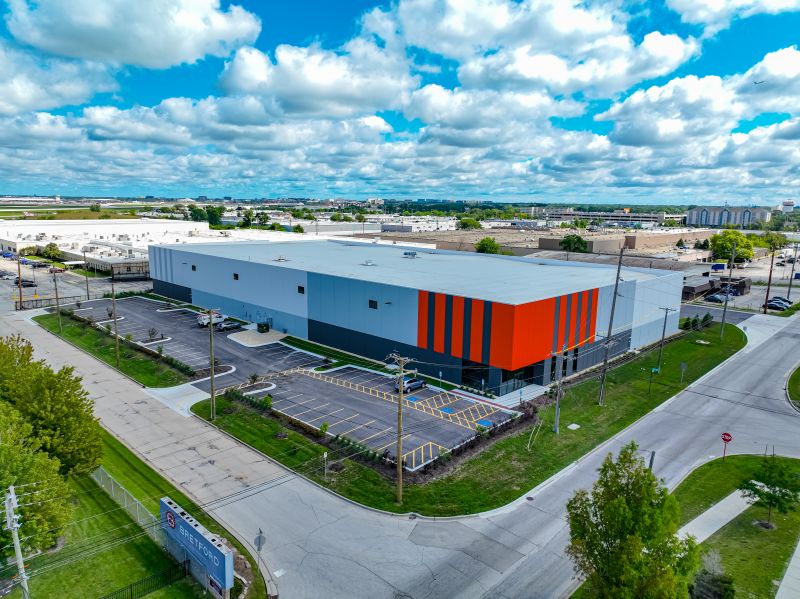
Those demand patterns are increasingly shaping development decisions within the city, where infill sites and specialized logistics uses are being prioritized. As tenant demand becomes more targeted, development strategies have followed suit. CRG is advancing multiple projects that align with those constraints, including The Cubes at Roosevelt & Kostner, a two-building, 364,102-square-foot industrial campus under construction on a 20.8-acre site in Chicago’s North Lawndale neighborhood. Co-developed with Related Midwest and 548 Development, the project includes a 182,051-square-foot Class A facility with 36-foot clear heights designed to serve a range of modern industrial users.
Near O’Hare International Airport, CRG recently completed The Cubes at ORD, a 66,552-square-foot facility leased by World Flight Services for global air cargo logistics and ground handling operations. Together, the projects illustrate how location and infrastructure adjacency are increasingly central to underwriting decisions, underscoring continued demand for well-located, logistics-oriented space.
“The market metrics are in place for a strong market, even though we’ve had a lackluster amount of tenant velocity,” said Joshua T. Hearne, Principal at Cawley. “I think that’s going to change in 2026 and we’ll squeeze vacancy rates down more.”
That expected shift in tenant activity is occurring alongside a more selective development environment. While demand fundamentals remain intact, development activity has become the market’s primary filter. Rising construction costs, tighter capital underwriting and infrastructure constraints have slowed speculative starts, a shift many developers view as a necessary recalibration rather than a downturn.
“The idea that the industrial cycle is ending or that the market is entering bubble territory” is overdue for a serious rethink, according to Matthias Trizna, Vice President of Development and Sales for Northern Builders.
“What we are actually seeing is a normalization after an unprecedented demand surge, not a collapse,” Trizna said. “In the Chicago market specifically, fundamentals remain strong.”
Vacancy has risen modestly from historic lows but remains in the mid-single digits across most submarkets, providing room for tenant movement without undermining pricing power. Rather than signaling weakness, that balance has reinforced a more disciplined approach to new supply. At the same time, speculative development has slowed as interest rates, construction costs and capital selectivity converge to limit new starts.
As development becomes more selective, execution has taken precedence over volume. Land quality, infrastructure readiness and entitlement certainty are now central to underwriting decisions, particularly in a capital-sensitive environment.
“We are intentionally focusing our efforts on our most irreplaceable land positions,” Trizna said. “Asking capital to ‘stretch’ on location, basis, or execution risk has become extremely difficult.”
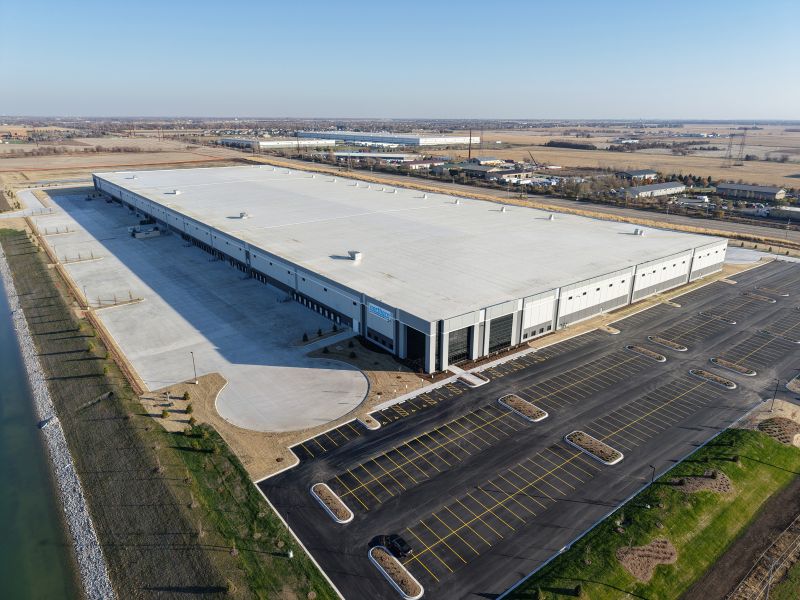
Northern Builders’ recent activity reflects that approach. The firm recently completed two speculative projects within Cherry Hill Business Park in Joliet and New Lenox that are now available for lease and purchase. The developments include an 802,000-square-foot cross-dock facility with expansion capacity up to 1.2 million square feet, as well as a 183,000-square-foot single-load building with spec office space already constructed. Both projects are located in logistics-driven submarkets along the I-80 corridor and were designed to meet institutional standards while prioritizing long-term demand and execution certainty.
Even with disciplined site selection, another constraint has moved to the forefront. Power availability, in particular, has emerged as a decisive factor in whether projects can advance.
“Power availability has become one of the most critical constraints in the Chicago industrial market,” Trizna said. “Whether it is advanced manufacturing, cold storage, or data intensive uses, electrical capacity is increasingly the gating factor in whether a project can move forward.”
That reality is reinforcing the value of existing assets with durable functionality. As new development faces higher barriers, capital is increasingly drawn to buildings that already meet operational requirements.
“The building does not need to be Class A new construction to be institutional,” said Robin Stolberg, Executive Director of Acquisitions for Clear Height Properties. “A-located, B-quality multi-tenant buildings with durable functionality drive strong tenant retention & consistent new tenant demand. These assets provide downside protection via faster lease-up, lower turnover costs, as well as more predictable exit assumptions than new construction.”
That emphasis on durability has shaped acquisition strategies heading into 2026. In a market where development risk is harder to justify, replacement cost has become a key reference point.
“The one thing we should talk about more is that right now is a great time to buy an industrial building in the Chicago market,” said Brian Quigley, Executive Vice President of Conor Commercial Real Estate. “In many cases buyers of industrial buildings can get in at or below current replacement cost allowing investors to forgo development and lease up risk.”
Taken together, these perspectives point to 2026 as a sorting year for Chicago’s industrial market. Demand remains intact and capital is available, but the margin for error has narrowed. Developers, owners and investors who can execute within infrastructure limits, control risk and prioritize fundamentals are likely to outperform. Those who rely on momentum alone may find fewer paths forward.