Construction’s top leaders give us one clear message about the industry: merit is earned, and loyalty is essential.
More than a quarter of the CEOs leading companies in the Top 400 Contractors ranking (ENR) have occupied the position for at least 21 years. Almost three-quarters were promoted internally and, among those internal appointees, 70% had already spent more than a decade with the company.
After extensive research into the leadership of our biggest contractors, the conclusion is clear: Construction remains an industry where company knowledge and operational credibility carry weight in CEO appointments. The most common route to the top begins inside the business working your way to the top.
This approach has produced an unusually stable leadership population. It also places significant responsibility on contractors to identify future leaders early enough to give them the breadth of experience required to run the entire company.
Two distinct leadership cycles exist
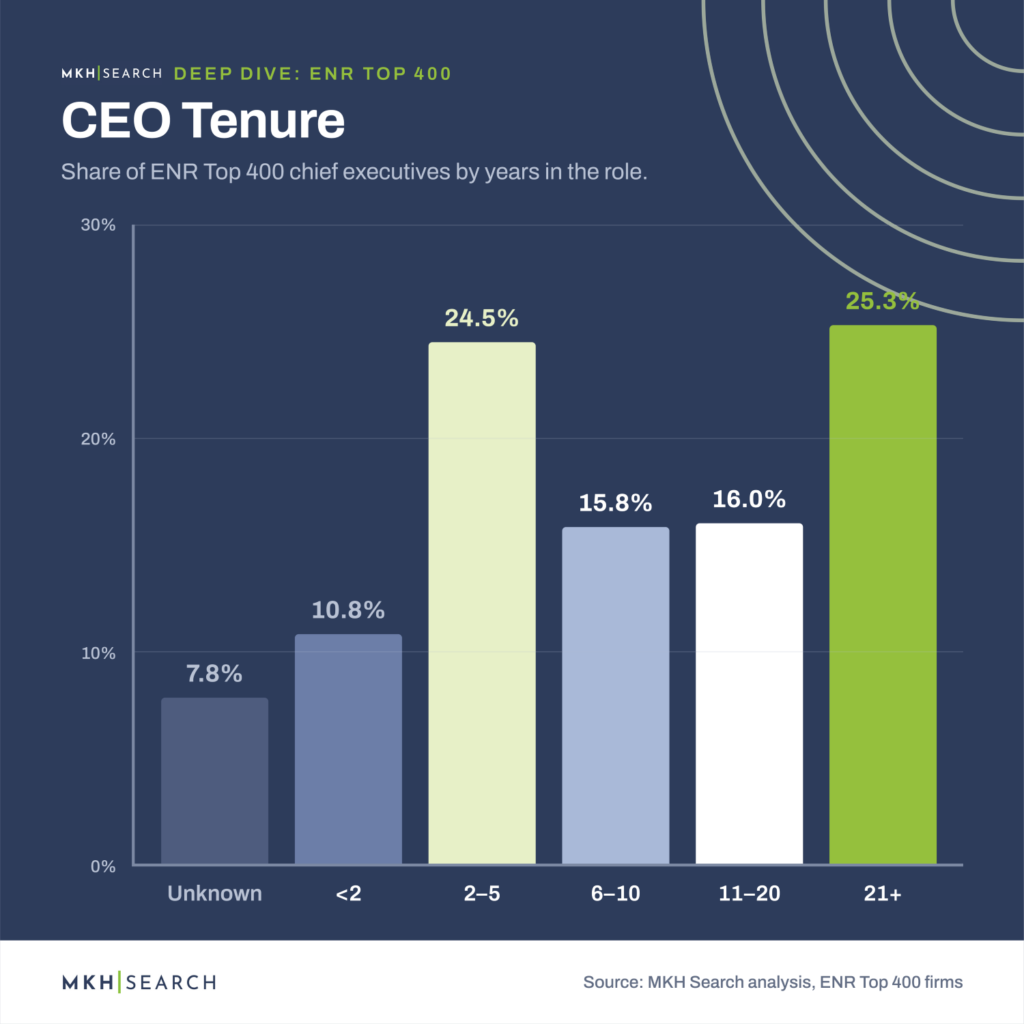
While 25.3% of Top 400 CEOs have served for at least 21 years, 35.3% have been appointed within the past five.
These figures reveal two substantial leadership populations within the ranking. Around 100 of America’s largest contractors continue to be led by a CEO with more than two decades in the role. At the same time, more than one-third of the sector has entered a relatively recent leadership cycle.
This matters because a CEO change within a major contractor can influence far more than the reporting structure. Long-serving leaders often have a deep influence on how the company approaches risk and project selection. Their judgment has been formed through repeated exposure to market cycles and the consequences of major operational decisions.
Newer CEOs inherit that history, but they also take responsibility for deciding which parts of it should change. And understanding the conditions required for sectors to thrive is key – Commercial Contracting Corp climbed the ranking on 69% manufacturing exposure in 2023–24, then fell from #115 to #235 this year, the largest single drop on the list. Performance Contractors slipped from #47 to #67 on 86% industrial and petrochemical work. Market position can reverse in as little as a year.
Internal credibility remains the dominant route to the top
Our analysis found that 73.5% of Top 400 CEOs were promoted from within their organization. External appointments accounted for 15.5%, while 8% of companies remain led by a founder.
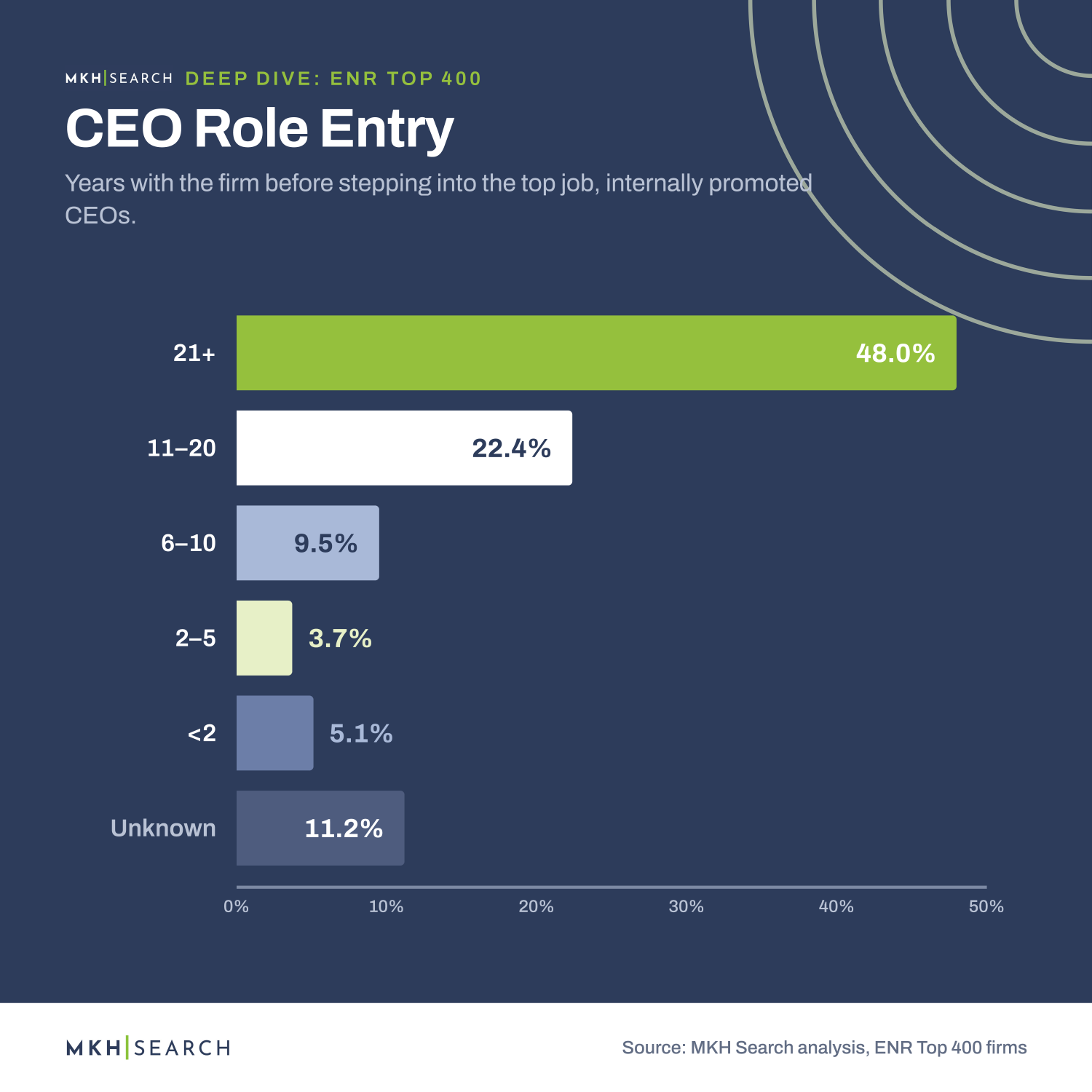
The length of service among internal appointees reinforces the importance placed on company experience. Almost half had worked for the contractor for at least 21 years before becoming CEO. A further 22.4% had spent between 11 and 20 years there.
Only 8.8% of internally promoted CEOs reached the position within five years of joining the company.
There are practical reasons for this pattern. Construction leadership demands a detailed understanding of how decisions made at head office affect delivery on site. It requires credibility with operational leaders and confidence from clients placing enormous investments in the company’s hands.
Those qualities don’t come overnight. An executive who has progressed through the business has usually worked alongside the people responsible for delivery and experienced the company’s response when projects become difficult. They understand where authority sits and how the organization behaves under pressure.
External leaders can bring valuable experience, especially when a contractor is entering new markets or changing its operating model. Yet the data shows that major contractors favor a familiar face who has already been established within the company.
Long tenure makes early succession planning essential
The average age of CEOs whose age could be established or reasonably estimated was 57. Among that group, approximately one in five was 65 or older.
The research also examined the executive below the CEO. The average vice president age was 50.8, a difference of just over six years between the seniority levels.
For contractors with a CEO who has served for 20 years or more, succession planning has to begin well before a departure is expected. The company needs time to observe possible successors across a broader range of decisions and determine whether an internal candidate is equipped for the full scope and weight of being CEO.
Waiting until a transition is imminent limits the flexibility. It can leave a board choosing between executives who know the company back to front but haven’t been tested enough, or external candidates who bring great experience without the same internal backing.
Ownership strengthens the connection between leadership and culture
The ownership profile of the Top 400 helps explain why leadership continuity carries so much weight.
Privately held companies account for 68.25% of the ranking. Employee-owned businesses represent another 26.75%, leaving publicly listed companies at only 5%.
Despite the dominance of private ownership, just 8% of Top 400 companies remain founder-led. Most have already completed at least one transition from their original founder to a professional leadership structure. T5 Data Centers began in 2008 when four people left Staubach, and seventeen years later debuted at #80 on $1.67B of data center work. Level 10 was founded in Sunnyvale in 2011 by eight industry veterans with no outside capital and now ranks #210 at $649M. This begs the question is your company still awaiting the right leadership transition?
In a privately held contractor, the identity of the CEO can become closely connected to the identity of the company. In an employee-owned business, leadership decisions also affect a workforce with a direct financial interest in long-term performance.
These structures reward leaders who understand the organization beyond its balance sheet. Culture and internal trust can become important parts of the CEO’s authority, particularly when employees have worked with that individual for many years.
This helps explain why internal progression remains so prevalent even after the founder has stepped away. The company may have professionalized its leadership while retaining a strong preference for continuity.
A narrow pipeline produces narrow outcomes
Women currently hold 5% of Top 400 CEO positions. At VP level, female representation increases to 12.3% of identified leaders.
Because internal promotion is the dominant route to CEO, representation at the top will be determined largely by decisions made further down the organization.
Future CEO candidates are shaped by who is trusted with major projects and who gains meaningful exposure to different parts of the business. If those opportunities are distributed narrowly, the future CEO won’t have all the tools they need to make the calls.
Companies seeking a broader leadership population should therefore focus on the experiences that create credible internal candidates. Representation at CEO level is the final outcome of development decisions made over many years.
Continuity works best when it creates more leaders
The leadership model used by America’s largest contractors has clear strengths. Internal promotion preserves company knowledge and rewards executives who have built credibility through delivery. Long CEO tenure can provide consistency across difficult market cycles. However, the real measure of a long-serving leader is the strength of the organization they eventually leave behind.
A CEO who has held the position for more than 20 years will have shaped the company profoundly. Their most important long-term contribution may be ensuring that leadership capability lives on.
The Top 400 data shows that construction continues to develop CEOs from within. The responsibility for today’s leaders is to make sure the next generation receives the experience and scrutiny required to continue that tradition.
MKH Search analyzed companies included in the ENR 2026 Top 400 Contractors ranking using publicly available company websites, executive biographies and LinkedIn career information. Unknown information was retained as a separate category. The ENR Top 400 ranking and underlying contractor revenue data were produced by Engineering News-Record. The leadership research was conducted independently by MKH Search.