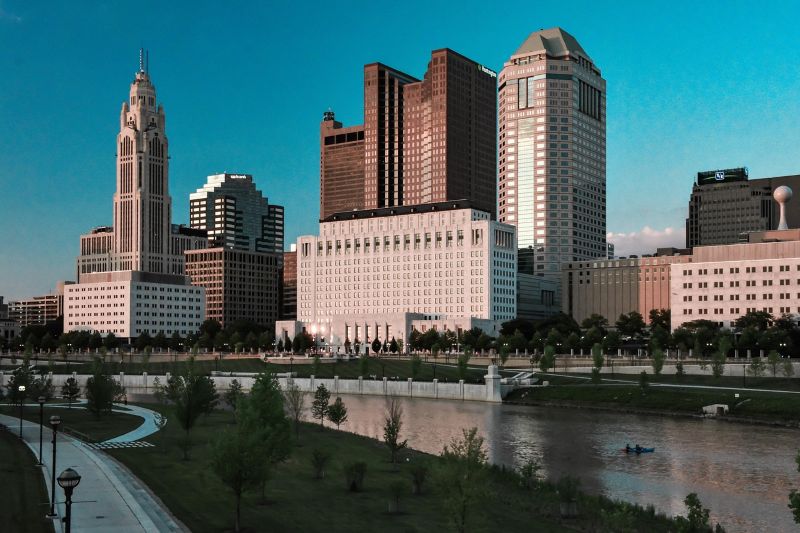
A pro-business climate and strong population growth continue to boost the commercial real estate market in Columbus, Ohio. That’s a good thing: These positives are helping the local market survive a sometimes-tumultuous economy and weather an office sector that remains in flux.
We spoke with Jason Krug, senior managing director with Berkadia, about the enduring strength and resiliency of the Columbus CRE market. Here is what he had to say.
Are you still seeing a strong demand for new commercial real estate development in the Columbus market? Why or why not?
Jason Krug: We are seeing very strong demand for new commercial real estate developments in the Columbus market across most asset classes. Higher interest rates have posed challenges for developers, but Columbus’ pro-business environment mixed with strong population growth (over 30,000 annually) shows just how resilient the Columbus market and economy really are.
The pro-business climate and ongoing population growth continue to attract employers and provide forward-looking developers the confidence and vision for new projects.

Jason Krug, Senior Managing Director, Berkadia
Are there any projects currently in development in the Columbus market that you are most excited about?
Krug: There are many new projects in the Columbus development pipeline to get excited about including Nationwide Chidren’s Hospital’s expansion, Bridge Park’s expansion in Dublin, the new terminal at the John Glenn Airport and Anduril’s Arsenal-1 campus.
Anduril’s Arsenal-1 is particularly exciting as it will showcase the employment base in Columbus on both the manufacturing and the technology front. Additionally, the site will support 4,000 high-paying jobs that will have a direct effect on other CRE asset classes such as retail, office and most notably multifamily.
Columbus has long had a reputation as a being a consistent, conservative CRE market. How has that helped the local CRE market through challenging economic times?
Krug: The Midwest is largely known for slow growth and is often overlooked by some investors. However, the conservative Midwest approach in Columbus has not only led it to be a consistent performer but is now garnering our market a reputation as an outperformer.
Which commercial sectors are performing especially well today in the Columbus market? What are the reasons for this strong performance?
Krug: Class-A office, industrial/logistics and multifamily are on the list for sectors performing especially well. Multifamily is performing particularly well given the record number of deliveries. There are pockets with short-term softness with new deliveries in lease-up; however, despite the record number of deliveries over 5,500 units have been absorbed over the last 12 months while rents continue to grow.
Multifamily stands out with resilient absorption outpacing historical averages, setting up for stronger rent growth as 2026 deliveries are projected to drop 40-50% from 2025 peaks.
A moderate cost-of-living, the pro-business environment, positive population growth and strong employment growth all position Columbus as one of the most attractive markets nationally for multifamily as well as other CRE classes.
Are there any commercial sectors that are struggling today in the market?
Krug: This will not come as a surprise to most commercial real estate professionals, but the office sector is struggling today in the market. Not all office, but the B/C class in older submarkets as well as the CBD is showing the most weakness. This is not a Columbus-centric trend but something we are seeing nationally. Although vacancies in office are around 25%, the trend is heading in the right direction with many employers looking to bring people back to offices.
What draws companies to the Columbus market? Why are so many companies opening headquarters or satellite locations in this market?
Krug: Population growth, business friendly incentives and a deep talent pool anchored by Ohio State University are all major drivers for companies opening headquarters or satellite locations to the Columbus MSA.
The 2025 Global Groundwork Index ranked Columbus as the #1 most attractive market, highlighting the pro-business environment, strong talent pool and central location as support for the ranking. Since 2021, there have been 195 companies that have chosen Columbus for expansion, creating around 27,000 jobs. The momentum seems to be contagious, with the outlook for the future even better.
I know it’s difficult to predict, but are there any trends you expect to see as far as commercial real estate leasing and building activity in the coming months?
Krug: Higher interest rates will moderate some development, but the overall picture looks very bright for the Columbus MSA. Industrial/logistics will continue strong performance metrics and office vacancy likely continues to decline. I don’t think office occupancy will be in the low 90% range we saw in the late 2010s but should continue to recover.
Multifamily will continue to draw both institutional and private capital for both new development and investment sales. New developments such as Arsenal-1, Google’s data centers and hospital expansions (Nationwide Children’s Hospital, OSU Wexner, Mount Carmel Dublin) all show strong indicators for the economic future and will continue to attract outside capital looking to invest in CRE.
With deliveries slowing sharply in 2026 and absorption projected to outpace supply for the first time since 2021, Columbus multifamily is well-positioned to continue its historic rise. My prediction is Columbus multifamily will not only be a rising star on the rankings of most attractive markets, but it will be a mainstay top-five market nationwide.