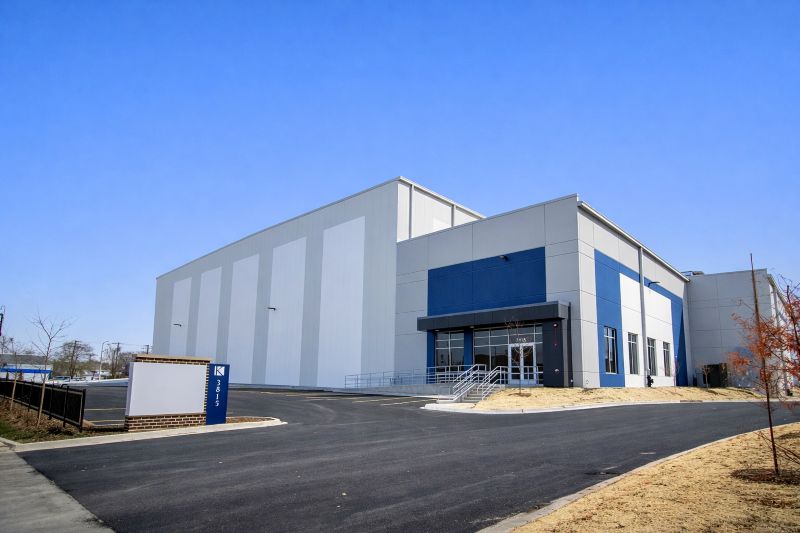
On the literal ground of America’s old meatpacking capital, a 15,580-pallet-position freezer is rising with 50-foot clear heights and 14 exterior docks. Karis Stockyards, developed by Karis Industrial, sits embedded in Chicago’s food ecosystem in a way that newer suburban product simply cannot replicate. The project is one piece of a larger story playing out across Chicagoland: a cold storage market in the middle of a structural reset where modern purpose-built facilities are pulling away from an aging inventory that has dominated the landscape for decades.
The numbers tell part of the story. According to research from NAI Hiffman Director of Research Denes Juhasz, Chicagoland cold storage vacancy climbed to 7.6% in the first quarter of 2026, up from roughly 3% a year earlier, while construction activity pulled back nearly 65% to just 589,000 square feet underway. On the surface, the sector looks like it is cooling. The reality on the ground is considerably more nuanced.
“Cold storage is at a fascinating inflection point — moving from a niche industrial category to something more akin to essential infrastructure, on par with other core asset classes,” said Bryn Feller, Managing Director of Investment Sales at Northmarq. “But that graduation doesn’t make it simpler. It raises the bar for what investors need to truly understand before they allocate capital.”
According to Peter Shaplin, Chief Investment Officer at Becknell Industrial, Chicago is now the largest cold storage market in the United States, with vacancy below 1% for modern product and an aging inventory averaging more than 40 years old. That gap between rising headline vacancy and tight conditions for purpose-built space is the central tension shaping the market in 2026.
“Users today want truly modern facilities …”
The performance gap between older facilities and modern, purpose-built product explains why two seemingly contradictory data sets can both be true. Net absorption over the trailing 12 months reached 253,000 square feet, up nearly 48% from the prior period, suggesting that tenant demand has not disappeared, according to Juhasz’s research. Occupancy across the broader market still held at 92.4%, reinforcing the essential nature of refrigerated logistics in the region.
“Cold storage rental rates in Chicago are relatively stagnant right now, driven more by operator economics than real estate fundamentals,” said John Basile, Executive Vice President of Industrial Services at NAI Hiffman.
What is happening is a sorting process. Tenants with sophisticated requirements are migrating toward facilities that can support automation, compliance demands, and faster distribution windows, while older inventory absorbs more of the available vacancy.
“The existing inventory that has long dominated the landscape is aging, and food and grocery logistics have become dramatically more sophisticated,” Feller said. “Users today want truly modern facilities: automation-ready, compliance-forward, energy-efficient, and capable of supporting faster distribution windows.”
The refrigerated 3PL market continues to face pricing pressure, and an oversupply of pallet positions has pushed monthly storage rates down, limiting operators’ ability to absorb higher rents.
“Capital still has a strong appetite …”
Despite the near-term turbulence, Chicago’s structural advantages remain intact. Jason Lev, Executive Vice President at CBRE, said the market sits firmly in Tier 1 territory because of fundamentals that competing markets cannot easily replicate.
“What makes Chicago different from markets like Dallas or Atlanta is the supply side,” Lev said. “There are real constraints here — limited available land, zoning hurdles, and power infrastructure challenges, which make new cold development harder to execute. That’s very different from Sunbelt markets where development is easier and land is more plentiful.”
Lev added that California’s Inland Empire is increasingly dealing with regulatory pressure and power availability issues that have slowed new cold storage development there as well. The combination of durable demand drivers and limited new supply continues to make Chicago one of the most attractive and defensible cold storage markets in the country.
The Illinois tax environment remains the asterisk on that thesis. Feller estimates the state’s structural drag adds somewhere between $1 and $3 per square foot of additional occupancy cost compared with neighboring markets, helping fuel growth across Northwest Indiana and Southeast Wisconsin. For most users, however, the proximity advantages outweigh the friction.
Institutional capital has taken notice. Lev said investor appetite remains strong because cold storage tenants tend to stay put once they are operational, with relocation both costly and disruptive, which has pushed much of the recent capital toward build-to-suit opportunities backed by long-term, credit-quality leases.
“Capital still has a strong appetite for cold storage, largely because the tenant base tends to be very sticky,” Lev said. “Relocation options are limited, leases are typically long term, and once a tenant is operational in a facility, moving is both costly and disruptive.”
“Operational efficiency and reliability matter …”
Cold storage development costs run two to three times conventional industrial, according to Ken Verne, Vice President of Asset Management for Karis, which means underwriting has tightened considerably. The deals getting done are infill, power-served and freezer-to-cooler convertible, with credit operators and durable rents anchoring the capital stack.
“Three years ago this was a grocery-distribution story,” Verne said. “Today our Chicago pipeline is food manufacturers, regional 3PLs and protein processors hunting production-adjacent space with 50-foot clear and freezer-to-cooler flex.”
Conversions of older dry industrial buildings into full cold storage have largely fallen out of favor. Lev said the economics no longer work for larger blocks of space because modern cold storage is built around maximizing pallet positions, which depends on clear heights that older buildings simply do not have. Targeted partial conversions still happen in the city, typically in buildings under 50,000 square feet where a tenant needs a smaller cooler or freezer footprint complemented by dry storage.
Geographically, much of the new development activity has migrated to regional submarkets. Basile said his team’s most recent transactions have landed in Joliet and Northwest Indiana, where land economics, site scale and entitlement flexibility better support modern cold storage requirements. Many of those projects have been self-developed or completed with strategic partners, giving occupiers more control over costs and specifications.
Infill plays like Karis Stockyards represent the exception, where embedded ecosystem advantages justify the premium. Shaplin said Becknell’s pipeline has concentrated near the I-55 and I-80 corridors and key food-distribution arteries with more than 3 million square feet of cold storage currently under construction across the region.
“We focus on tenant credit strength, lease duration, energy performance and total lifecycle costs,” Shaplin said. “We prioritize purpose-built, pre-leased projects and deep tenant engagement early in the design process, recognizing that operational efficiency and reliability matter more than initial construction cost in this asset class.”
“The next phase of this market …”
The forward-looking demand story increasingly points toward onshored food production rather than traditional grocery distribution. Manufacturers need readily available convertible space inside major metros and Chicago’s combination of population density, freight infrastructure and food processing depth positions it well for that next cycle.
“While leasing timelines have extended and vacancy may remain elevated in the short term, fundamentals suggest Chicagoland will remain one of the country’s most important — and resilient — cold storage hubs as 2026 progresses,” Juhasz said.
Supply pressure should ease as demand catches up to recent additions.
“Chicago’s long-term cold storage story is genuinely strong,” Feller said. “But the next phase of this market is going to be considerably more selective than what we saw coming out of the pandemic. Precision will matter more than momentum.”