Chicago’s construction market is living in two realities at once. Developers are chasing some of the biggest adaptive reuse and infrastructure projects the city has seen in years while also struggling to get deals financed in an era of high interest rates and volatile costs. Optimism is there, but it comes with caveats.
“Our opportunities in 2025 compared to 2024 are up about 50 percent,” said Damian Eallonardo, regional president of W.E. O’Neil’s Chicago and Texas divisions. “We’re pretty bullish on opportunities in Chicago compared to last year.”
Not everyone is quite as upbeat.
“Commercial construction in recent years has been robust and we enjoyed the benefits of the growth in construction, but recently due to interest rates and the uncertainty of taxes, tariffs and the economy things slowed down drastically,” said Sandya Dandamudi, president of GI Stone. “Currently we are still on a hold pattern, but things seem to be loosening up a bit.”
While office construction remains “pretty dead,” according to Eallonardo, other asset classes are carrying the market.
“Multifamily, retail and industrial are all seeing robust activity,” he said. “The most robust area we’re seeing right now is adaptive reuse: the redevelopment of existing building inventory in Chicago.”
Hospitality upgrades and office-to-residential conversions are top drivers.
“What’s driving this is need,” Dandamudi said. “Hotels need to update and there is still a strong demand for residential units. I believe the current vacancy rate is 1.5 percent, which is one of the lowest in recent times.”
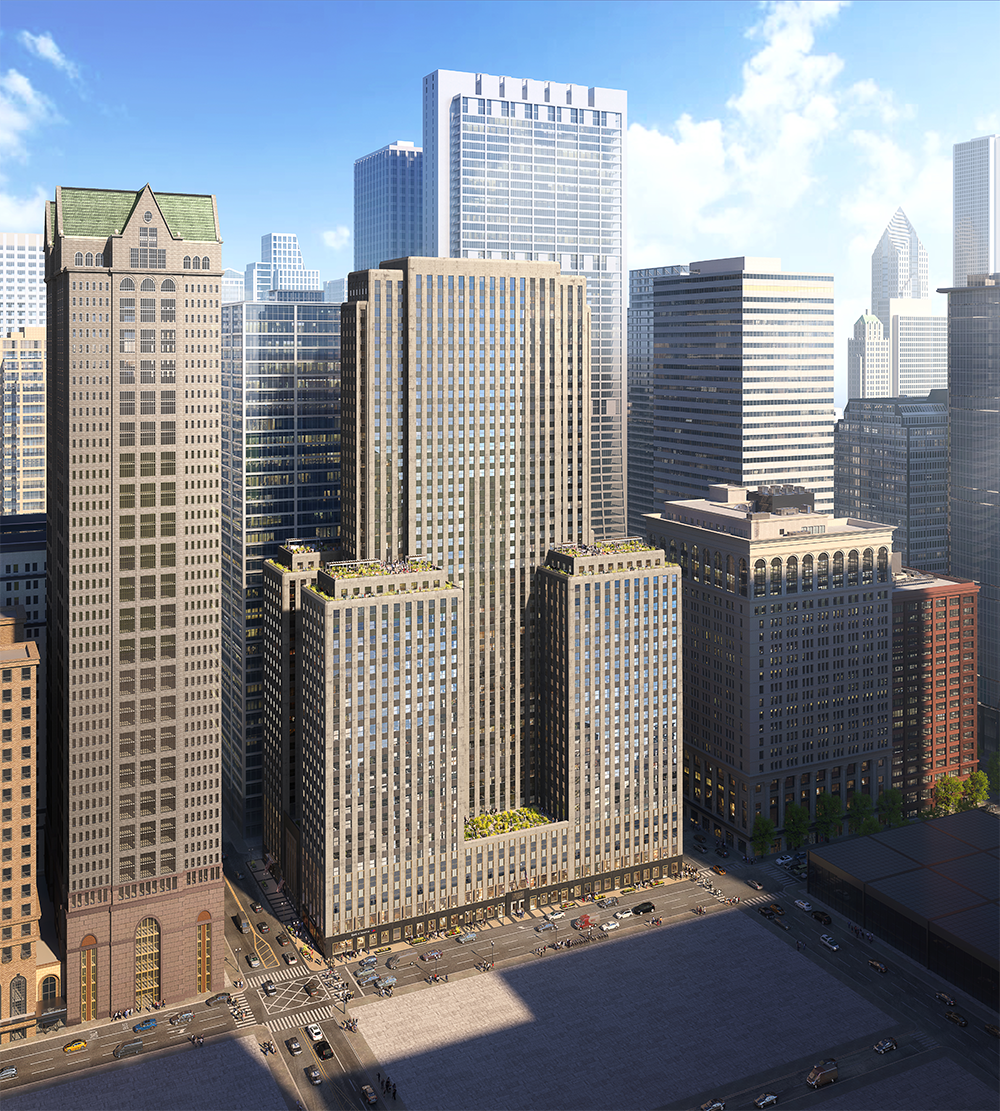
Major projects show the momentum. W.E. O’Neil in a joint venture with GMA Construction is working with the development team of Riverside Investment & Development, Amtrust Realty and DL3 Realty to renovate 135 South LaSalle, also known as the Field Building, in a conversion that will deliver more than 700,000 square feet of residential space, both market-rate and affordable. The firm is also teaming with Clark Construction on a three-year overhaul of O’Hare International Airport’s Terminal 3.
On the horizon for GI Stone are projects like The 78, new stadiums for the Chicago Fire and Bears, Bally’s Casino, and expansions tied to Moody Bible Institute, the South Side, Fulton Market and River North.
Opportunities may be growing, but translating them into groundbreakings is tougher than ever.
“Interest rates, financial conditions and rising construction costs are affecting project feasibility as these pro formas are done a couple of years ahead of project commencement and that’s how loans are secured, so rising costs that are out of normal margins means financing is lost and it’s back to the drawing board,” Dandamudi said.
“Union wages in Chicago make the cost of labor predictable, which is not the case in some other regions,” added Eallonardo. “The real challenge here is capital and financing.”
Dandamudi noted that the uncertainty itself may be the bigger risk. Tariffs in particular have an outsized impact on specialty contractors like GI Stone.
“It is difficult to bid projects when the needle keeps moving,” Dandamudi said. “We recently lost a project because additional 25 percent tariffs were imposed on the very day we were prepared to make a deal and that fell through.”
The volatility creates opportunities for bad actors.
“When there is uncertainty and chaos there is also predatory pricing,” Dandamudi said. “I caution our industry to be more mindful of these concerns.”
Public incentives are playing a bigger role in getting projects off the ground, according to Eallonardo, who pointed out that even complex deals can pencil out when city support is in play.
“When the city inserts funding or guarantees, it changes everything,” Eallonardo said. “That’s what allows developers to get their head around deals and make them work.”
Contractors are also leaning on innovation to keep projects feasible.
“We can’t be caught sleeping at the wheel,” Dandamudi said. “For example, we can pair stone with other materials – lower cost stones or manmade materials – to achieve the desired aesthetic at a lower price point. Creative solutions like this can help to alleviate some of the hit we’re taking with new tariffs.”
Despite the challenges, Dandamudi and Eallonardo agree that the fundamentals of the market remain strong.
“It’s certainly slowed down a little bit, but it’s better than it was — and that’s a positive,” Eallonardo said.
Dandamudi argued that the city’s story is less about fundamentals and more about how it markets itself to investors.
“Chicago is a stable market and while I believe that Chicago needs to change its narrative to attract outside money, we have the demand and we have the skills,” she said. “Unless something crazy happens we will soon be building robustly again.”
For now, Chicago’s construction scene is defined by tension: projects are ready, but financing remains tight and costs unpredictable. Firms that can adapt through creativity, incentives and careful risk management will be the ones still standing when the cycle turns.