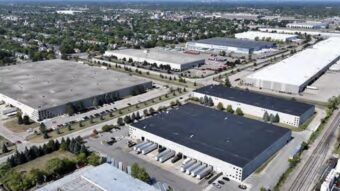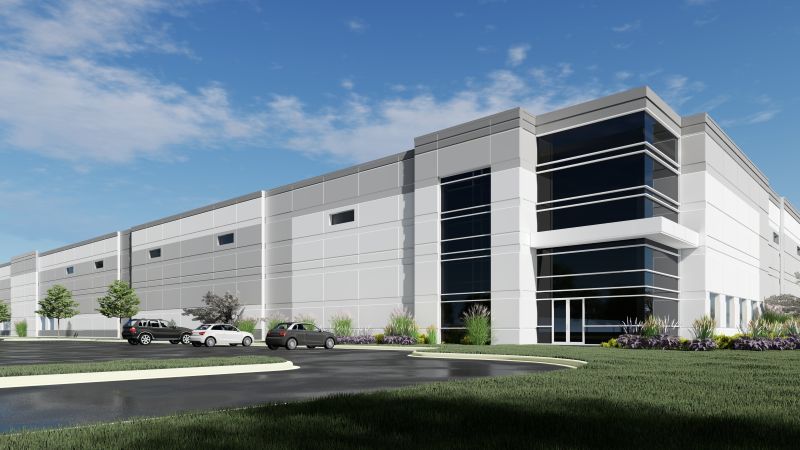
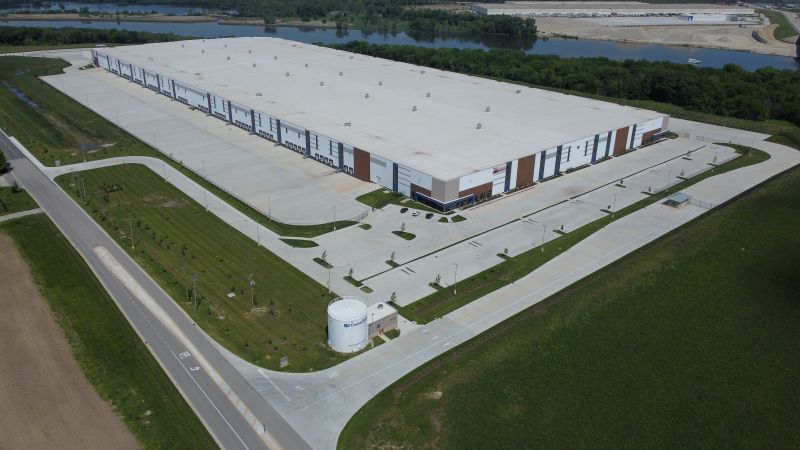
Chicago’s industrial market is no stranger to cycles, but the current one has a defining feature: distribution centers have become the market’s battleground. As construction volumes ease and financing tightens, developers are homing in on the product type that remains most resilient — logistics hubs that tie tenants directly to highways, airports and dense population clusters.
The result is not a slowdown so much as a recalibration. According to NAI Hiffman’s Q2 2025 Construction Report, speculative projects now make up nearly 70% of new construction in the metro, a dramatic shift from the pandemic era when build-to-suit dominated. Developers are wagering that distribution centers in proven submarkets can draw tenants even without pre-leasing commitments.
That confidence is not unfounded. While overall absorption has slowed, demand for strategically located space has persisted. Infill parcels and corridors around O’Hare and I-55 remain magnets for logistics users. Smaller, midsized facilities are also outperforming, catering to regional distributors and third-party logistics firms that need space fast.
Hiffman’s Industrial Market Report underscored the point: leasing velocity in sub-200,000-square-foot buildings is holding up better than in the bulk sector. Vacancy across the metro stands near 6%, well below national averages, and distribution centers continue to anchor much of the activity.
Examples from active developers show how these trends are translating into deals.
CenterPoint Properties recently leased a newly constructed distribution center to a Chicagoland-based third-party logistics provider. The lease highlights one of the cycle’s defining themes: logistics firms are still expanding, but they are choosier than before. The fact that the project was delivered speculatively and leased quickly shows that tenant appetite remains intact in the right locations.
“We were confident in the functionality, location and aesthetics of this building,” said Brian McKiernan, CenterPoint’s Senior Vice President of Development for the Central Region. “We set a high bar and challenged our team as well as our construction and brokerage partners and they exceeded expectations on the CIC’s flagship development and lease-up.”
Logistics Property Company (LPC) has doubled down on the airport-adjacent strategy. In March, it announced the acquisition of a development site near O’Hare International Airport, already one of the most competitive submarkets in the country.
“We are excited to break ground on our newest development in the O’Hare market,” said Aaron Martell, LPC’s Executive Vice President for the Central Region. “It’s a great location that will be very attractive to users in the market.”
By June, LPC had followed with six additional land deals totaling nearly 2.5 million square feet of planned distribution center development. The scale of that bet reflects enduring confidence in O’Hare’s role as a logistics hub — and the willingness of developers to compete aggressively for scarce land near it.
ML Realty Partners has demonstrated another angle on the DC story: broad-based absorption across suburban corridors. Over the past year, the firm completed nearly 685,000 square feet of leases across the metro.
“These transactions underscore ML Realty Partners’ continued commitment to providing functional, long-term industrial solutions to a diverse range of companies and industries,” said Matt Novak, Leasing Director of ML Realty Partners.
Among its deals was a 132,892-square-foot distribution center, delivered speculatively and quickly secured by a tenant. For ML, midsized facilities in accessible submarkets have provided a consistent stream of leasing, underscoring that tenant needs extend beyond the largest bulk facilities.
Together, these examples reveal a clear pattern. Distribution centers are where developers are concentrating their risk. With financing harder to secure and capital partners more selective, the projects that move forward tend to be those tied to logistics demand.
Amazon’s reentry into the market is also shaping the competitive landscape. After pulling back in 2022 and 2023, the company is again active in leasing, which Hiffman labeled an “industrial comeback.” For developers, even modest moves by Amazon ripple outward, influencing both speculative planning and tenant confidence. Distribution centers remain the backbone of e-commerce logistics, and Amazon’s activity serves as a barometer for the sector’s strength.
The geography of demand is telling. The O’Hare submarket is the most obvious battleground, with land scarcity pushing values higher and fueling competition among developers. The I-55 corridor continues to attract big-box users who value highway connectivity, while infill sites closer to the city are being snapped up for last-mile distribution. The Southwest suburbs, long a secondary option, are also gaining ground as developers chase sites with both available land and strong tenant pipelines.
For tenants, the environment has produced more optionality in some size ranges. Speculative distribution centers allow occupiers to move in faster than build-to-suit timelines would allow, which is particularly attractive to 3PLs under pressure to expand quickly for client contracts. For developers, however, the calculus is unforgiving. Without the tailwind of cheap capital, projects must line up on fundamentals — transportation access, power availability and flexible configurations — to earn financing.
That selectivity is forcing precision in design. Developers are not just building boxes; they are tailoring distribution centers with higher clear heights, more trailer parking and expansion capacity. Even power availability is a differentiator, especially as logistics and light manufacturing tenants demand greater automation capacity.
The long-term view is that distribution centers will remain the heartbeat of Chicago’s industrial market. While manufacturing projects, cold storage and smaller infill assets all have their niches, the consistent absorption of logistics hubs gives developers reason to keep sharpening their focus. What changes is not whether DCs are built, but how carefully each new project is chosen and executed.
If the last cycle was about volume, this one is about positioning. Developers like CenterPoint, LPC and ML Realty are demonstrating that the projects which move forward are those most closely aligned with logistics infrastructure and tenant certainty. For a metro as vast and interconnected as Chicago, that means distribution centers have become the sector’s most contested ground — and the clearest signal of how industrial real estate will evolve in the years ahead.