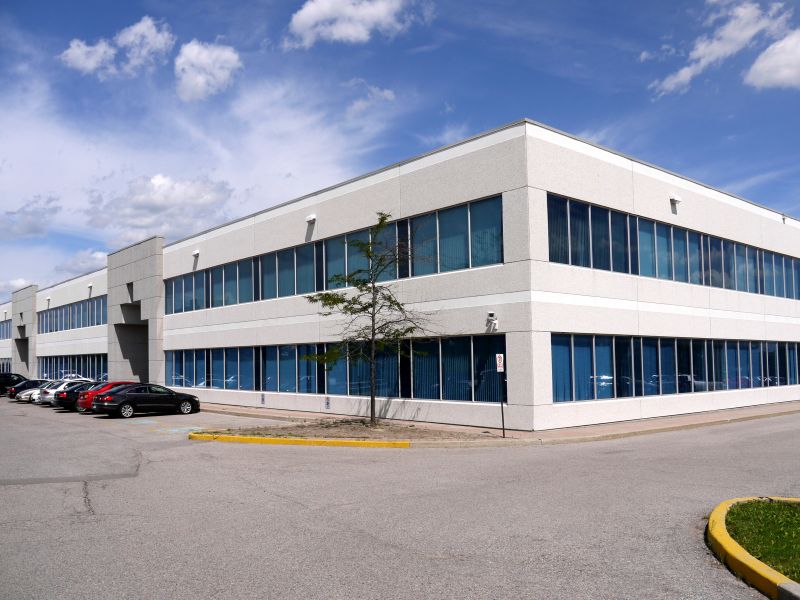
Three years ago, aging office campuses in Chicago’s northwest suburbs had a ready exit. Compass Datacenters paid $194 million for the former Sears headquarters in Hoffman Estates. Aligned Data Centers assembled a row of office buildings along Elk Grove Village’s Northwest Point Boulevard to clear for a data center campus.
This fall, Illinois Real Estate Journal asked a handful of brokers, developers and attorneys who regularly weigh in on the suburban market where the region’s remaining empty office buildings go now. None agreed to comment for this story.
With the state’s data center incentives paused, power in short supply and neighbors pushing back, the question has few easy answers and fewer people willing to offer one publicly. Glen Cole, Assistant City Manager and Community Development Director for the City of Rolling Meadows, is the exception and his numbers show why a city can’t wait for the market to sort itself out.
Rolling Meadows’ office properties have lost about 25% of their combined assessed value since before the pandemic, Cole said, and nearly all of that share of the tax base has shifted to residential real estate.
“That matters because, in Cook County, every dollar of lost office value takes about $2.50 of home value to replace,” Cole said.
The ratio reflects Cook County’s classification system, which assesses commercial property at 25% of market value and residential property at 10%. Cole said the city has still cut its corporate portion of the tax rate by 25% over the past five years despite the erosion.
“More broadly, the economic model of suburbs in northwest Cook County was built on people driving to office campuses,” Cole said.
Office managers report far fewer employees on site, Cole said, with most coming in only Tuesday through Thursday. Adjusted for inflation, the city’s annual general merchandise sales were $8 million lower in 2025 than in 2019 and eating and drinking sales were about $10 million lower. Cole said many factors drove the decline, but the city considers the change in office attendance the most consequential.
Rolling Meadows sits in the hardest-hit corner of the suburban office market. Cushman & Wakefield put second-quarter vacancy across its Northwest submarkets at 29.8% against 24.2% for the suburbs overall with the Central Northwest submarket reaching 33.1%. Class B vacancy rose 330 basis points year over year, the steepest increase of any building class, and sale prices reflect the weakness. In the second quarter, 40 Shuman Blvd. in Naperville sold for $36 per square foot and 1200 Jorie Blvd. in Oak Brook sold for $34.
For the best-located of those buildings, data centers offered the most lucrative way out. Over the past year, that route has narrowed on three fronts.
In June, Gov. J.B. Pritzker paused new agreements under the state’s Data Center Investment Program effective July 1 after the spring legislative session ended without action on his push to make data centers pay more for electricity. Existing agreements will be honored and Pritzker plans to revisit the issue during the November veto session.
Power is scarce as well. CBRE has reported that many new data center projects in ComEd’s service territory face power delivery delays until 2031 or later. Neighbors are pushing back too. Early this year, the Naperville City Council denied a proposed 36-megawatt data center and Brennan Investment Group dropped plans for a $2 billion campus in Barrington Hills after residents objected.
JLL’s midyear data center report citing Gallup and Reuters data found that 79% of Americans support U.S. leadership in artificial intelligence, while only 14% support data center development in their own community. Frontier markets now account for 77% of North American capacity under construction, according to the report. Northern Indiana totals 1,206 megawatts of existing capacity, closing in on Chicago’s 1,352.
Rolling Meadows has its own test case. In 2022, the 485,000-square-foot Atrium Corporate Center at 3800 Golf Road landed a 115,937-square-foot lease for the Federal Aviation Administration’s Great Lakes regional headquarters. The agency terminated the lease in February 2023 after a foreclosure suit against the building’s then-owner, CoStar reported. Brennan acquired the property two months later with plans to demolish it for a roughly 600,000-square-foot industrial park, naming data centers among its target users. More than three years later, the building still stands and listings show about 186,000 square feet available for sublease. Brennan declined to comment.
Rolling Meadows is planning around the options still on the table. Cole said the city’s strategy is to support redevelopment of Class B and C properties, reducing excess supply to shore up occupancy and rents at the best office buildings. Working site by site, the city has identified replacement uses: commercial redevelopment on major corridors, new residential where sites back up to existing multifamily and light industrial on more remote sites with good connectivity.
That last category has momentum. Chicago’s industrial market rebounded in the second quarter with CBRE reporting 6.1 million square feet of net absorption, up from 1.1 million in the first quarter, and asking rents up 7.4% year over year.
“We have been proactive in establishing TIF districts to support the extraordinary costs that these redevelopments will need to overcome in order to be successful,” Cole said.
In May, the Rolling Meadows City Council unanimously designated the Algonquin Road/Keystone Court Redevelopment Project Area and approved its redevelopment plan.
“These are well-located sites with great transportation access and strong surrounding neighborhoods,” Cole said. “They will be valuable again and it’s our job to minimize the time they spend empty.”