The site had been a symbol of the unrest that hit Minneapolis after the murder of George Floyd in 2020: Riots burned down the former Wells Fargo branch at 3030 Nicollet Ave. in South Minneapolis following the killing.
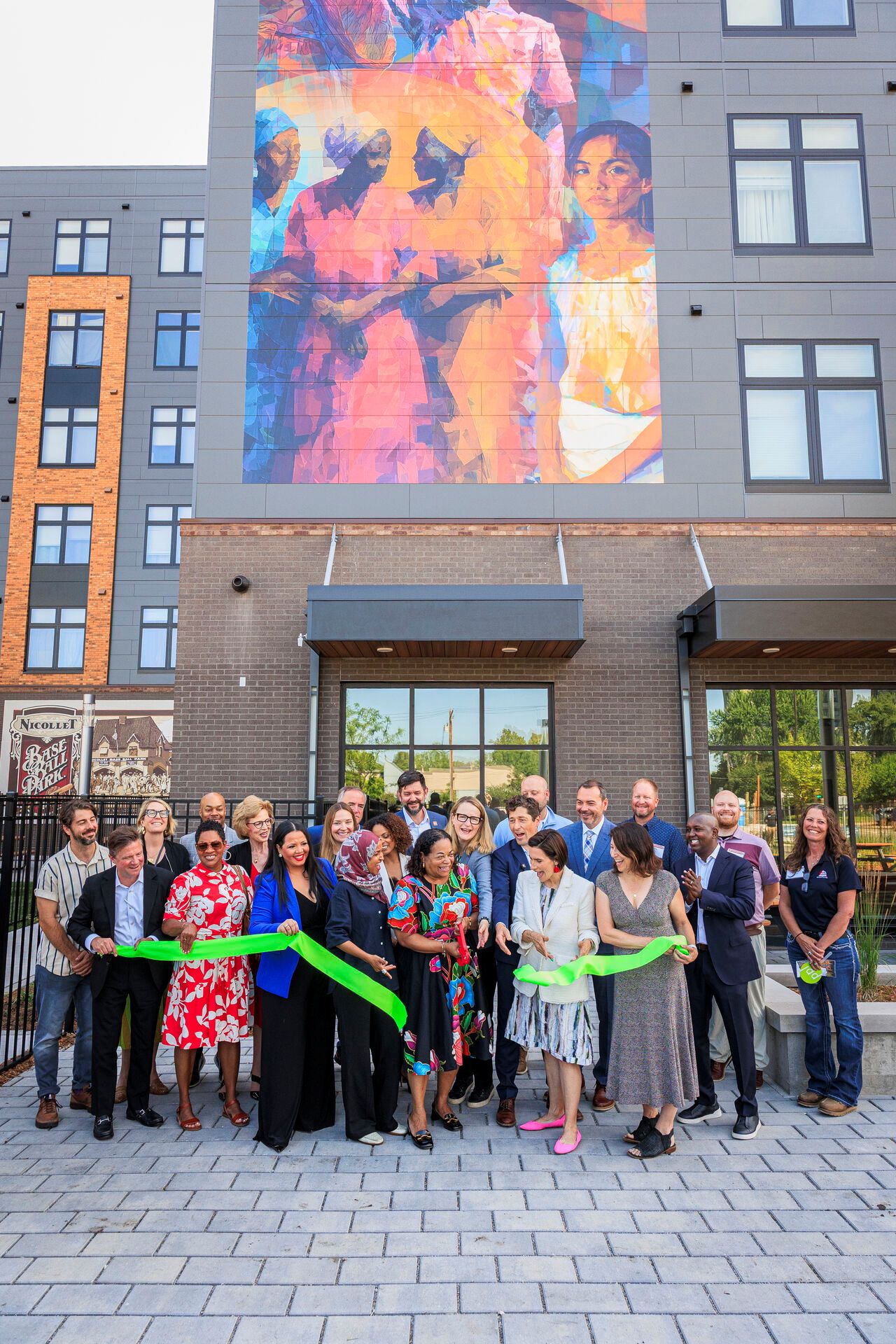
Today? That land is now home to Opportunity Crossing, a six-story, 110-unit affordable-housing project developed by Minneapolis’ Project for Pride in Living.
Opportunity Crossing, which opened in July, ranks as one of the largest affordable-housing developments in Minneapolis and is the largest in Project for Pride in Living’s history. The property also boasts first-floor retail, including a new Wells Fargo branch. As evidence of how high demand is for quality affordable housing, Opportunity Crossing is already fully leased.
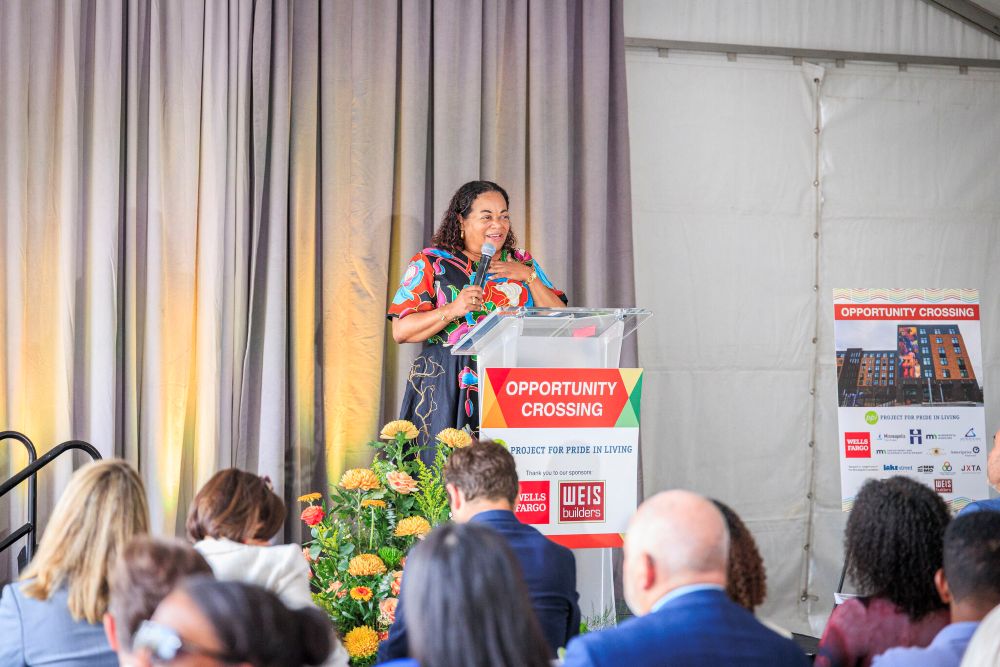
We spoke to Karla Henderson, president and chief executive officer of Project for Pride in Living, about the challenges and rewards of bringing Opportunity Crossing to life. Here is what she had to say.
Can you talk a bit about the need for more affordable housing in the Minneapolis market? How important is it today to provide more affordable options for renters?
Karla Henderson: There is an urgent need for more affordable housing across the Twin Cities. As a housing stability nonprofit that also focuses on career readiness and financial empowerment, Project for Pride in Living (PPL) sees this need daily through our work with individuals and families, many of whom are searching for a stable home they can afford.
At its core, this is a supply-and-demand problem. There isn’t enough affordable housing in Minneapolis or the wider region, and demand continues to outpace supply. The harder question is why supply is so difficult to add. Affordable housing carries regulatory requirements that market-rate housing doesn’t, and those requirements add cost. Today it is often cheaper to build market-rate housing than affordable housing.
The challenge doesn’t end at the ribbon cutting. Rents in affordable housing are regulated, but the costs of operating it are not. Insurance, maintenance, security and utilities keep rising, while rents stay tied to what residents earn. Long-term affordability is the right goal, but without the flexibility to adjust as costs change, too often the industry is incentivized to build buildings that cannot be sustained.
That has real consequences for people. A stable, affordable home is foundational to a person’s well-being and long-term success, yet nearly half of Minnesota renter households are cost burdened, spending more than 30% of their income on housing, according to Minnesota Housing Partnership.
Abundant affordable housing is a must-have, not a nice-to-have. Building more of it, and keeping what we build affordable and well maintained for decades, is essential to the economic health of families and the Twin Cities as a whole.
What is the symbolic value of Opportunity Crossing being built on the former site of the destroyed Wells Fargo Branch? What does it say about the efforts that Minneapolis and the downtown area in particular are taking to rebound from the social unrest and COVID-area challenges?
Henderson: Opportunity Crossing represents a transformative new chapter for the Lake Street community and everyone who calls it home by creating more much-needed deeply affordable housing and economic opportunity while fostering overall neighborhood vitality.
This project is many things: The largest in PPL’s more than 54-year history, one of the largest in the City of Minneapolis, innovative in the ways it prioritized sustainability features and worked with dozens of cross-sector partners over a five-year span. Most importantly, Opportunity Crossing is thought to be one of the most deliberative and collaborative community investments ever made in city history, guided by PPL’s usual approach to equitable development, which focuses on centering the voices of communities most impacted by housing disparities by promoting diverse, active participation in any new project.
Every inch of the space was informed by community through extensive feedback from local residents, small business owners and neighborhood stakeholders, grounded in equity and collaboration. What resulted was a transformative building that offers 110 affordable units that support both individual and multi-generational family living, 8,400 square feet of commercial space for local entrepreneurs to own and operate, a new, full-service Wells Fargo branch, community-focused building amenities like a playground and plaza, and so much more.
We’re really proud of this project. It was built on a site that was burned down in the unrest following the murder of George Floyd, and it is the most significant financial investment in that neighborhood since before that time. It serves as a model for other efforts being made across the city to rebuild and reinvest in disinvested neighborhoods in ways that promote equity, stability and long-term resilience, instead of displacement.
Are you surprised at all by the fact that the project has been leased-up so quickly? How does the quick lease-up emphasize the need for even more affordable housing in the area?
Henderson: I wasn’t at all surprised to see how quickly Opportunity Crossing leased up, especially given how we consistently engaged community from the inception of the project all the way through. As Operation Metro Surge created a fear, disruption and instability that continues to deeply impact many of the people and communities that PPL proudly serves, we had to quickly pivot how we engaged residents and the community to accommodate requests and safety concerns, working alongside them in a deeply frightening time. That’s the PPL way.
The demand for affordable housing is great in Minneapolis and Saint Paul generally, given how cost-burdened families have become by having to spend an unsustainable share of their income on housing. There’s a particularly urgent need for the resource in neighborhoods that need it most, specifically, communities that have been historically economically neglected or disinvested in.
What are some of the amenities and features of Opportunity Crossing that you think sets it apart from other affordable housing developments?
Henderson: Designed by Damaris Melo-Gyasi of Design by Melo, Opportunity Crossing was shaped through extensive community engagement to reflect the aspirations and strengths of the Lake Street corridor. From the outset, PPL intentionally sought partners whose values aligned with the project’s commitment to equitable development, and Damaris was selected not only for her design talent, but for her community-centered approach and belief that development should create opportunity for the people it serves.
What sets Opportunity Crossing apart is its holistic approach to community building, combining affordable housing, public art, community space, and commercial condominiums that create ownership opportunities for local entrepreneurs. Damaris was an extraordinary partner throughout the process, helping translate community voices into a development that reflects the neighborhood’s vision and expands opportunity for residents and business owners alike
The project approaches its 110 affordable living units differently than other developments by offering one to four-bedroom units, including studios, spread across all six stories. This arrangement aims to support both individuals and families at multiple life stages, as well as multigenerational living, as 77% of the units feature multiple bedrooms.
The building amenities encourage community connection and feature your typical residential development features, like a fitness room, co-working space, community room, and access to public transit. Other thoughtful amenities include an outdoor plaza and playground for children, accented by a beautiful, building-size mural designed after a nationwide search for an artist that led to Dr. Nettrice Gaskins and painted by the Minneapolis-based national arts nonprofit Juxtaposition Arts. There is also an indoor play area and in-unit laundry capabilities.
Perhaps one of the most unique features about Opportunity Crossing is how it provides much-needed affordable housing while simultaneously advancing economic opportunity. The four new commercial spaces that anchor the building’s ground floor alongside the new Wells Fargo branch are truly innovative.
One of the most common refrains we heard from community during the engagement period was that they wanted to own something. So, the purpose behind this design decision was to create opportunities for local entrepreneurs who call Lake Street and south Minneapolis home to own their own business space instead of simply renting it. This is a rare and innovative model to take real steps in providing opportunities to build generational wealth
Lastly, Opportunity Crossing is built to be long-lasting and affordable with its sustainability features. From underground parking with EV charging docks to geothermal heating and cooling capabilities, Opportunity Crossing is a shining example of how quality affordable housing and sustainability are not mutually exclusive.
How important were the partnerships between public, private and nonprofit partners to bringing this project to life?
Henderson: After its Lake Street branch was destroyed in 2020, Wells Fargo decided not to rebuild and own the site itself. Instead, it invited proposals to purchase and redevelop the property. PPL applied with a proposal built on one commitment: The community would define what came next. Wells Fargo selected us, and from that point forward Opportunity Crossing was PPL’s project to lead. We purchased the land. We led the community engagement process that shaped the design, the housing and the commercial ownership model. And we carried the project as owner and developer through six years of work, with Wells Fargo alongside us as a partner throughout.
The partnerships were essential to the financing. Opportunity Crossing was anchored by Wells Fargo and the City of Minneapolis and made possible by roughly 30 funding sources, about a third of them from the city. Dozens of public, private and nonprofit partners contributed. What made that collaboration work was a clear, community-driven vision and a single organization accountable for carrying it through.
How we build matters as much as what we build. A site marked by loss is now a place that expands housing stability and small business ownership, shaped by the community it serves.
What are some of the biggest challenges developers face when trying to build new affordable housing? Is it necessary to receive financial support from government and other agencies to make the numbers work?
Henderson: A project of this magnitude and impact takes incredible partnerships and resources. It requires immense flexibility in everything from planning and design to funding and construction.
One of the biggest challenges we experienced in bringing Opportunity Crossing to life that I believe other developers face in bringing more affordable housing online was the intricate funding sources. Each funding source brought its own requirements, timelines, and closing conditions, requiring extensive coordination to align approvals and financing commitments and ultimately bring the project to fruition. For this project, it took more than 30 different funding partners across the public, private and philanthropic sectors to ensure the vision could be made a reality. You can see a full list of funding partners here.
Aside from the complexities of funding new projects, the affordable housing field does continue to face other interconnected challenges: demand outpacing supply, public funding not keeping pace with need, and the growing costs of developing, maintaining, and operating affordable housing.
Can you talk about the sustainability features of the project?
Henderson: Yes. Opportunity Crossing brings renewable energy and water-saving features to affordable housing in ways that are still uncommon in the sector. It is the first affordable housing development in Minneapolis with geothermal heating and cooling, and it also includes rooftop solar, stormwater recycling and EV charging stations in the underground parking for residents.
Features like these are hard to prioritize in any new build, and harder still in affordable housing, where every dollar has to stretch to keep a project on track and on budget. At Opportunity Crossing, they were designed in from the start to reduce energy and utility costs over the long term. That was possible through close collaboration with general contractor Weis Construction and the City of Minneapolis Department of Community Planning and Economic Development.