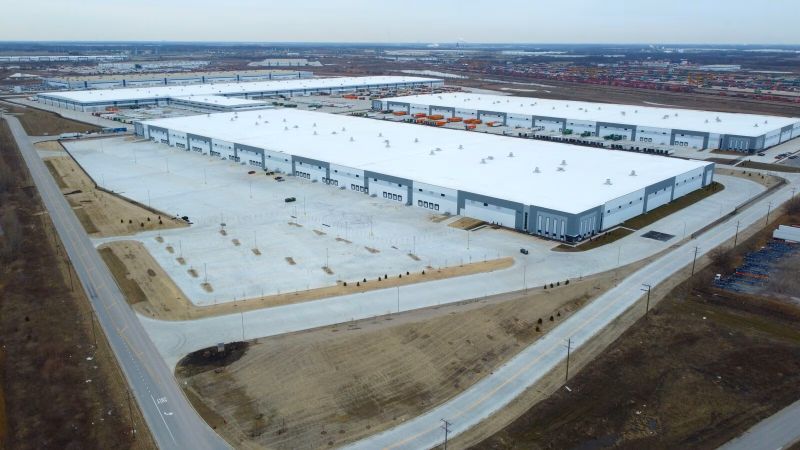
Everyone is talking about rising industrial demand heading into 2026, but that’s not the story developers are living. Their real bottlenecks sit deeper in the system: power access, build-to-suit complexity, lender scrutiny and capital partners that now expect sustainability baked into every inch of design. For most developers that reality is a drag. For CenterPoint Properties, it has become a competitive advantage.
Chicago’s industrial market is heading into 2026 with an unusual mix of momentum and restraint. Leasing activity has rebounded sharply, hitting 35.9 million square feet through Q3 according to Avison Young’s latest market data, and big-box commitments have returned with force. Yet development has throttled back. Only 12.9 million square feet are under construction across the metro, down 55 percent from the peak two years ago (AY Q3 report, page 2). This tightening pipeline has reshaped not just what gets built, but who is positioned to build it.
CenterPoint spent 2025 doubling down on the fundamentals that many others treated as secondary during the frothier development years. Entitled land, resilient infrastructure and capital discipline shaped its pipeline more than any single macro variable. Rather than chasing the cycle, CenterPoint positioned itself to benefit when the cycle turned. That shift arrived earlier than many expected, and it has reshaped the conversation about what gets built next.
“Timing became everything as speculative development slowed and capital markets tightened,” said Carmine Bottigliero, Vice President of Development at CenterPoint. “Successful projects were those positioned in markets with resilient demand and infrastructure.”
The data supports that recalibration. After years of record deliveries, developers are putting fewer chips on the table. Mid-range bulk construction between 500,000 and 749,000 square feet has disappeared entirely, according to the Avison Young report, while large-scale projects that do move ahead are either highly specialized or build-to-suit. The result is a market where users are active but choices are limited. And while brokers have spent much of 2025 talking about decision-making delays, the development community has been adapting to a tighter landscape.
That landscape plays directly to CenterPoint’s strengths. The Intermodal Center at Joliet and Elwood, its flagship, 6,500-acre logistics ecosystem, sits at the confluence of Class I rail, interstate access and labor density. Large format sites with direct intermodal connectivity are scarce and many competitors are grappling with rising utility requirements and entitlement headwinds. The infrastructure advantage that the firm secured years ago is becoming harder for the rest of the market to replicate.
“Land strategy shifted toward securing strategic parcels early, especially those that are entitled and in power-constrained regions, while maintaining flexibility in design,” Bottigliero said.
Developers across the market felt those constraints in 2025. Even though debt availability improved late in the year, lenders were more selective and capital partners demanded tighter alignment on ESG, sustainability credentials and municipal coordination. Those requirements slowed speculative projects, but gave a lift to developers with established entitlements and relationships. The gap between “shovel-ready” and “shovel-possible” has not been this wide in years.
That gap is shaping occupier behavior too. Build-to-suit demand rose across Chicago as tenants sought speed, customization and access to labor, even as they wrestled with rising operating costs. The Avison Young report shows big-box leasing over 750,000 square feet is one of the few sectors accelerating and it has done so in a submarket ecosystem where new supply has thinned out.
“Build-to-suit inquiries have surged, signaling occupiers’ desire for speed and customization,” Bottigliero said.
CenterPoint’s upcoming 1.1 million square foot Class A facility at the Intermodal Center fits squarely into this market direction. Scheduled to break ground in spring 2026, the project draws on pre-entitled land, multimodal connectivity and a submarket that continues to outperform on leasing velocity. More importantly, it reflects the shift toward sites that can solve infrastructure challenges first, speculative risk second.
Labor dynamics sit just behind those infrastructure challenges and Bottigliero sees them as the quiet variable that will shape next year’s feasibility math. While vacancy remains a healthy 6.2 percent across the metro, several submarkets — particularly those with strong labor footprints — have tightened faster than others. Developers are beginning to triangulate around these locations, weighing workforce reliability as heavily as land cost and utility capacity.
“Persistent talent shortages and rising labor and transportation costs will influence construction timelines and operational strategies,” Bottigliero said.
That pressure adds another layer of discipline to a market already grappling with capital tightening. Rising insurance costs, conservative underwriting and higher operating expenses have forced developers to scrutinize every assumption in their models. CenterPoint’s approach has been to build flexibility into design and delivery, avoiding product types that risk oversupply while focusing on assets with long-term tenant relevance. As more developers chase mid-bay or small-bay opportunities, the firm continues to prioritize infrastructure-heavy big-box formats where user demand is the most consistent.
Foreign capital has noticed that discipline. International investors have reentered the Midwest with renewed urgency, and Chicago with its multimodal network, deep labor pool, and relative affordability has risen on the list of preferred U.S. industrial markets. Developers that can demonstrate entitlement certainty and infrastructure access have captured the most attention.
“Foreign capital — particularly from Asia — continues to target U.S. industrial assets, with the Midwest, specifically Chicago, emerging as a preferred region,” Bottigliero said.
The story heading into 2026 is not one of runaway development or speculative exuberance. It is a market defined by constraints — of land, of capital, of power, of labor — and by the developers who anticipated those constraints early enough to turn them into opportunities. CenterPoint’s bet on timing and strategic positioning reflects the shift from an era of scale to an era of selectivity. With entitled land, resilient infrastructure and a pipeline aligned with occupier demand, the firm enters the next cycle with a level of clarity many developers are still searching for.