Despite challenges, the industrial sector continues to be one of leaders in the commercial real estate property recovery, with values rising faster than those of most major property sectors even as higher borrowing costs threaten to slow the momentum.
That’s one of the major findings from Green Street its September 2026 Commercial Property Price Index.
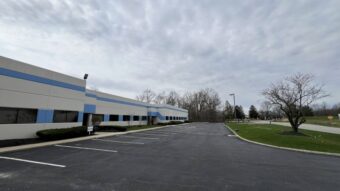
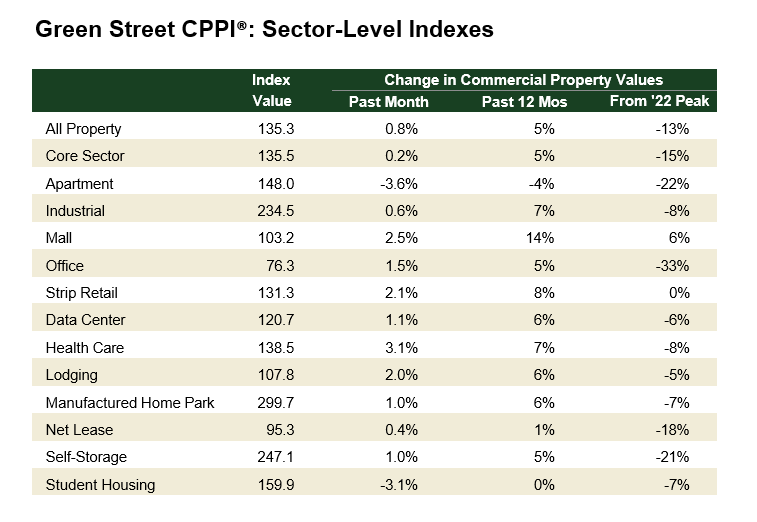
Industrial property values rose 0.6% in August and 7% over the past 12 months, according to Green Street’s price index. The sector remains one of the strongest performers in commercial real estate, with values now just 8% below their 2022 peak.
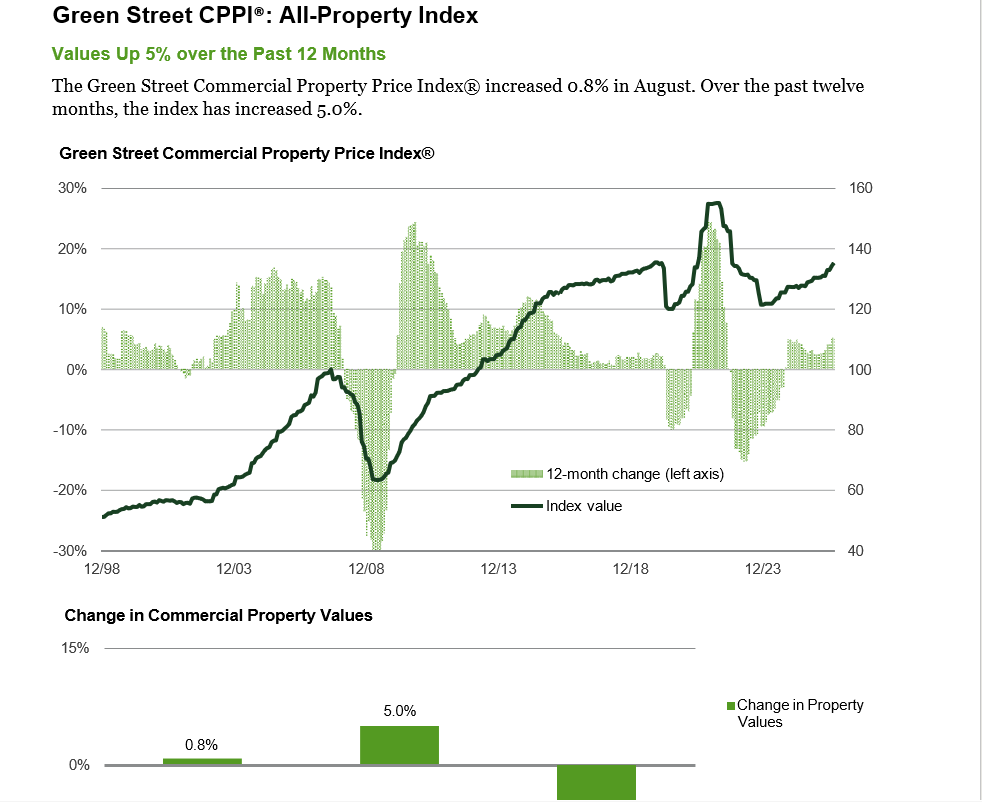
That compares favorably with the overall market. Green Street’s all-property index increased 0.8% in August and 5% over the past year. Overall commercial property values remain 13% below their 2022 peak, a slightly worse performance than industrial specifically.
The latest numbers show that commercial real estate values are continuing to recover from the sharp declines that followed the Federal Reserve’s interest-rate increases. But that recovery could face a new headwind.
“It’s been a nice run for property prices, but I expect things will cool off,” said Peter Rothemund, Co-Head of Strategic Research at Green Street, in a written statement. “The rise in Treasury yields over the past several months, and its impact on borrowing costs, is likely to cause buyers to rethink what they’re willing to pay.”
That could be particularly important for investors weighing the next phase of the industrial market. The sector has benefited from strong tenant demand and years of rent growth, but higher financing costs could make it more difficult for buyers to justify spending too much on these properties.
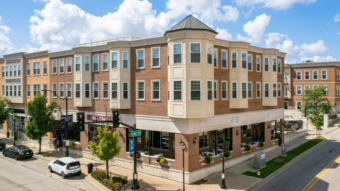
Green Street reported that the industrial sector isn’t the only one posting gains. Retail has emerged as another bright spot in Green Street’s latest figures. Mall property values increased 2.5% in August and 14% over the past 12 months. In fact, mall values are now 6% above their 2022 peak.
Strip retail has performed almost as well. Values climbed 2.1% in August and 8% over the past year. Strip retail values are essentially back to their 2022 peak, sitting just 0.4% below that level.
The retail recovery is notable given the challenges the sector faced earlier in the decade. The Green Street data suggests that investors have become increasingly comfortable with high-quality retail properties and the income streams they can generate.
Healthcare real estate is also showing strong momentum. Values rose 3.1% in August and 7% over the past year, although they remain 8% below their 2022 peak. Green Street’s healthcare category includes medical office, senior housing operating properties, senior housing net-leased properties, skilled nursing and life science assets.
Data centers, meanwhile, continue to benefit from the growing importance of digital infrastructure. Values increased 1.1% in August and 6% over the past 12 months. The sector remains 6% below its 2022 peak.
Office and apartments continue to be the notable laggards. Office values increased 1.5% in August and 5% over the past year. Yet the sector remains 33% below its 2022 peak, by far the largest decline among the major property types tracked by Green Street.
The numbers reflect the continuing challenges facing office owners and investors, including elevated vacancy, changing workplace patterns and the cost of repositioning older buildings.
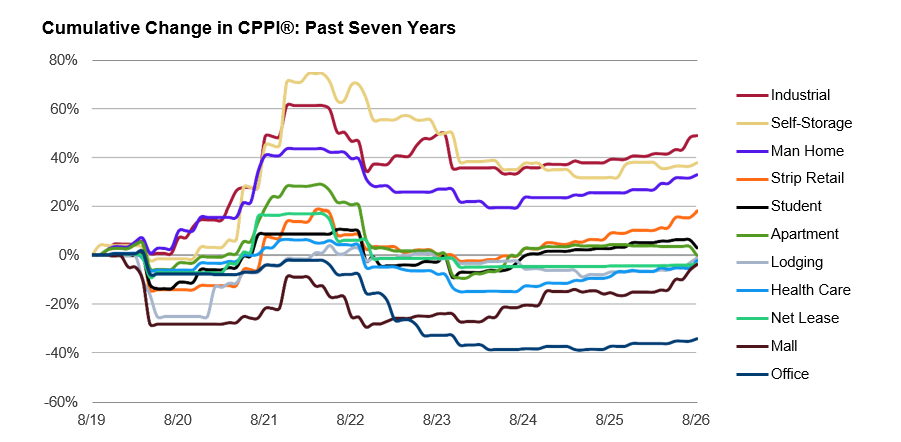
Apartments are also struggling to regain their former values. Green Street’s apartment index fell 3.6% in August and declined 4% over the past year. Apartment values remain 22% below their 2022 peak.
Green Street’s Commercial Property Price Index highlights the prices at which commercial properties are currently being negotiated and contracted. The index emphasizes high-quality, institutional properties and is based primarily on Green Street’s estimates of price appreciation for property portfolios owned by REITs in its U.S. coverage universe.
For now, the broader trend remains positive. But with Treasury yields climbing and borrowing costs moving higher, the next phase of the commercial real estate recovery could be more challenging.
As Rothemund’s warning makes clear, the market may be approaching a point where investors become less willing to stretch on price, even for the property types that have performed best.