Healthcare is moving increasingly toward outpatient settings, but the real estate needed to support that shift isn’t keeping pace.
Medical outpatient building completions are projected to reach their lowest level in more than a decade in 2026, according to CBRE. It’s an unfortunate disconnect for an industry facing growing demand for accessible, community-based care.
The reasons make sense. Healthcare executives are navigating rising operating expenses, reimbursement pressures, workforce challenges and competing capital priorities. Many recognize the need to expand their ambulatory footprints but struggle to make the numbers work.

Unfortunately, postponing development carries its own financial and operational risks. And for healthcare leaders waiting for construction costs to return to previous levels, the reality is they probably won’t.
The cost of waiting
Historically, construction costs don’t decline significantly. They may stabilize, but development economics have fundamentally changed since the pandemic.
We’ve seen projects shelved before COVID-19 return to the market at costs more than 40% higher in some cases. Meanwhile, reimbursement pressures continue to squeeze operating margins, making it difficult to justify new investments.
This creates a difficult choice for healthcare executives – either commit limited capital to expansion today or risk paying even more tomorrow. But construction costs are just part of the equation.
Demand for healthcare services will continue to grow as our population ages. Health systems that delay outpatient expansion risk losing market share to competitors investing in new locations and reaching patients closer to home.
They also risk perpetuating a less efficient care model. Patients who don’t require high-acuity services can often be treated more cost-effectively in outpatient settings, preserving inpatient resources for those who need them most.
The longer executives postpone these investments, the greater the potential consequences for their finances, competitive position and communities.
A different approach to development
The solution is to approach development more strategically, not necessarily to build more at any cost, and that begins with recognizing traditional ground-up construction and conventional financing aren’t the only options available.
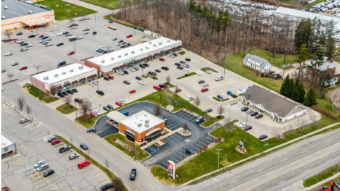
Vacant retail properties, including former pharmacies and other well-located commercial spaces, present opportunities for healthcare organizations to establish neighborhood clinics without the expense of new buildings. For specialized facilities, such as cancer centers, ground-up construction may still be the most financially practical option.
Alternative financing structures are also gaining traction. Nonprofit ownership models, sale-leaseback arrangements and partnerships with real estate investors can help healthcare organizations access capital, manage risk and preserve resources for clinical operations.
For organizations planning multiple facilities, programmatic development and prototypical design can help achieve economies of scale. Health systems can reduce costs and improve efficiency with each subsequent project by establishing a repeatable design that can be adapted across locations and service lines.
We’ve seen the benefits firsthand. Through a programmatic partnership involving a hospital system and real estate investment trust, we helped establish a financing structure that maintained stable return requirements despite significant increases in Treasury rates. The result was a more cost-effective approach to delivering multiple projects.
These strategies require creativity, but more importantly, they require collaboration.
Real estate belongs in the conversation
Healthcare organizations too often approach real estate development as a downstream function. Leadership establishes growth priorities, finance evaluates available capital and facilities teams determine how to execute. Those conversations need to happen together, and much earlier.
Organizations can evaluate opportunities more comprehensively, identify alternative financing structures and make better-informed investment decisions when strategy, finance and real estate leaders collaborate from the beginning.
External development partners can also bring perspectives internal teams may not have considered, from navigating complex transactions to identifying opportunities for adaptive reuse or more efficient project delivery methods.
Over the next several years, I expect continued consolidation among health systems, increased competition for strategically located properties and greater emphasis on specialized outpatient facilities. Organizations that approach real estate proactively will be better positioned to navigate those changes.
Healthcare executives will always face competing priorities. Not every project should move forward, and not every market justifies expansion. But delaying a necessary investment just because today’s economics are challenging isn’t a long-term strategy and only compounds the problem.
The demand for outpatient care continues to increase at a rapid pace. Construction isn’t getting cheaper. Competitors aren’t standing still. The question for healthcare leaders isn’t whether they can afford to expand. It’s whether they can afford to wait.
Matt Bremner is President and Partner at Bremner Healthcare Real Estate.