Landscape architects play a powerful role in branding and revitalizing historic industrial sites, transforming them into meaningful, memorable places that honor the past while engaging contemporary audiences.
Developing the brand for an adaptive reuse project involves more than just designing a logo and color palette—on a higher level it includes crafting the structure’s distinct identity through the use of landscaping and design to communicate a site’s former purpose and place in time.
Lawrence Group embarked on a four-year, $230 million project to transform the 15-acre former Federal-Mogul foundry site in St. Louis’ growing Midtown neighborhood into a 21st century mixed use development that celebrates creative concepts in food, commerce and entrepreneurship.
The first phase of the City Foundry STL (www.cityfoundrystl.com) development, opened in August 2021, included a food hall, creative office space, retail space and parking garage. Additional amenities consisted of public plaza spaces, bike sharing, dedicated ridesharing drop-off and future connection to the Great Rivers Greenway trail system. One Foundry Way, Phase Two of the development completed in December 2025, included a new, eight-level luxury apartment building with ground level retail at the base of its six-story parking structure.
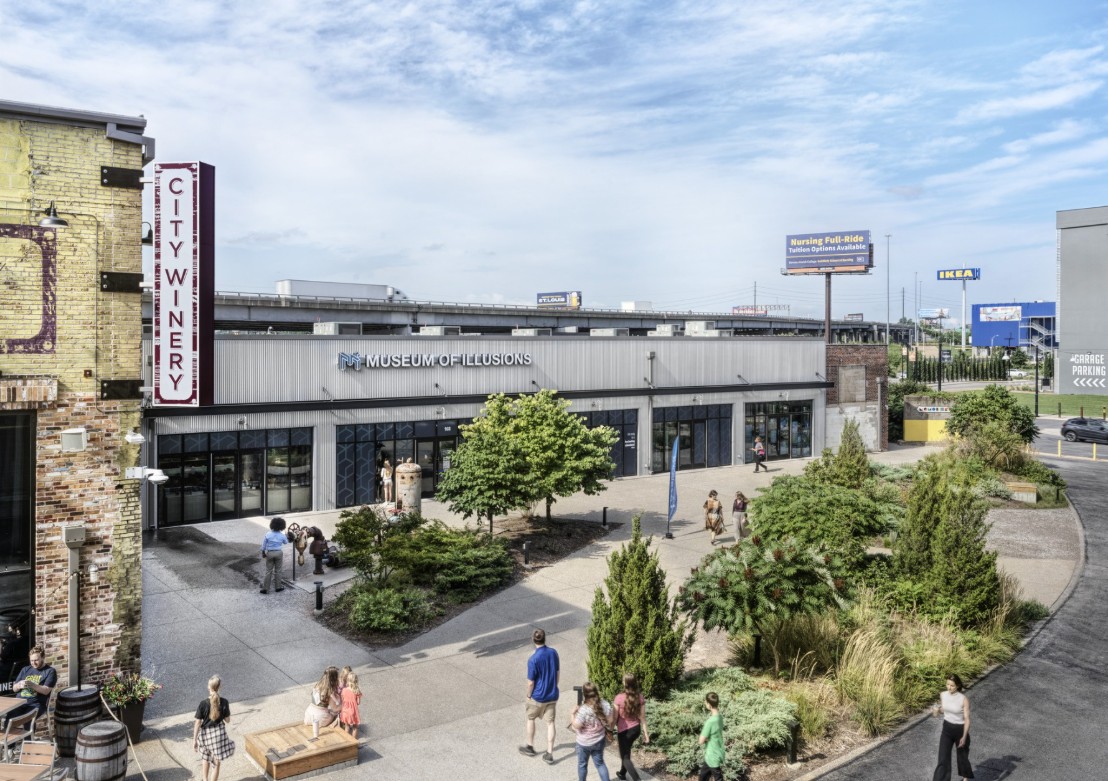
Lawrence Group’s landscape architects played a pivotal role in establishing City Foundry’s modern-industrial brand through thoughtfully curated vegetation, hardscapes and repurposed relics of the former foundry.
“To understand City Foundry’s current branding, you have to understand the property’s back story. The dilapidated site, which had been vacant for several years, was originally scheduled to be demolished and replaced with a big box store development. The property was overgrown with native vegetation that had survived with little to no care over the years, other than what nature had provided it. We wanted to pay homage to the site’s history by embracing its weathered appearance in the landscape design,” said Lawrence Group Landscape Architect John Iffrig, PLA, ASLA.
The landscape group started the project by documenting all existing plant material found on the site, which included native vines and perennials that had grown wild over time, Sycamore trees growing out of cracks in the foundation, and Goldenrod thriving on the side of the foundry’s former rail spur.
Due to contamination on the site from the former foundry, over 20 feet of soil, including the plant material, had to be removed and replaced with new topsoil. Pavement for new parking lots, patios and roads cover much of the site, but landscape designers were able to carve out areas of the pavement to incorporate the resilient, native plants that thrived naturally in the harsh urban setting.
“We didn’t want to completely lay out everything so that it looked overly formal or planned out,” said Lawrence Group Landscape Architect Jordan Wilkinson, PLA, ASLA of the new foliage. “We intentionally wanted to have kind of a wild massing of vegetation that was controlled and very intentional, but also kind of loose on the layout so that all the plants would mingle together and look like they’ve just grown up naturally. We also selected yellow-toned foliage and flowers to reinforce City Foundry’s new yellow-branded graphics.”
The landscape architects took great care in carrying that modern-industrial branding through to the hardscapes as well, with the design of purposely distressed concrete, seating with rust-textured finishes, lighting with natural patina, and plans for a future walking path that follows the curves of the site’s original railway spur.
“You can see some of the pre-existing elements in the new landscaping that were repurposed into interactive sculptures such as a water fountain made from repurposed piping and fittings,” said Wilkinson. “So, whether it’s that over 25-foot-tall trommel acting as a landmark at the entrance or something found that gets repurposed into a seating surface or bench, we tried to reuse whatever made sense to the brand and encouraged users to interact with the space.”
City Foundry STL saw the extensive rehabilitation of the Federal Mogul Foundry building, revitalizing a once derelict factory into a regional center for innovation, creativity, and community. The variety of tenants and activities draws a diverse customer base while supporting entrepreneurs and small businesses, creating an economic catalyst for typically underserved communities while encouraging positive public relations. Extensive community-oriented programming, such as partnerships with the local Tower Grove Farmers Market and Pedal the Cause charity bike ride, further cement City Foundry’s role as a key community space. More than just a St. Louis destination, City Foundry STL is an engine for change within the booming Midtown neighborhood, and within Missouri at large.