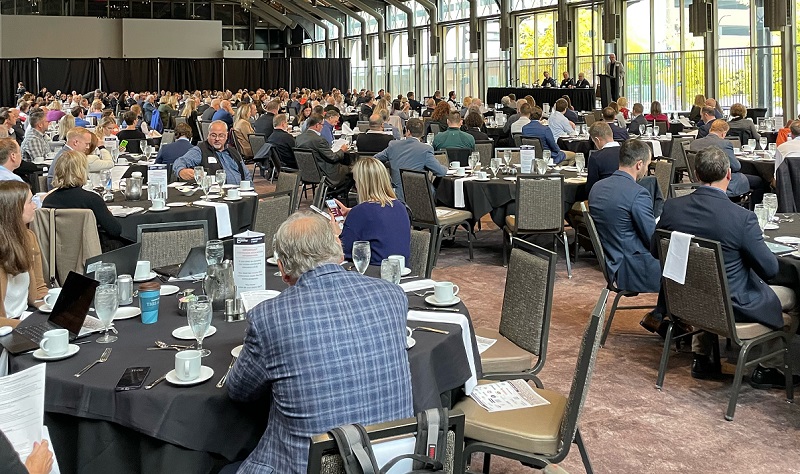
Does downtown Minneapolis face challenges? Sure. What major U.S. metropolis doesn’t? But there’s plenty of hope in downtown Minneapolis, too, with developers still targeting the urban core of the Twin Cities market. And the future for downtown Minneapolis? It looks brighter today.
That was the key takeaway during the 10th annual Minneapolis Downtown Summit held Oct. 26 by Minnesota Real Estate Journal at the Renaissance Minneapolis Hotel, The Depot.
A full house packed the venue to hear the area’s top commercial real estate professionals give their thoughts on the state of downtown and what they expect to see in terms of commercial sales, leasing activity and development in the future.
Mitchell Simonson, owner and appraiser with Loretto, Minnesota-based Simonson Appraisals, wrote the following summary of the Downtown Summit. It provides an informative look at what’s happening in downtown Minneapolis today and what experts expect to see next year.
Downtown Minneapolis CRE market update
By Mitchell Simonson, Simonson Appraisals
Downtown Minneapolis, despite current headlines in real estate and news articles, remains a major driver of our economy and state. We need a thriving downtown economic engine. It spills out into every aspect of the economy and beyond. With many great speakers, here are my top distinctions from the Downtown Minneapolis Summit hosted by Minnesota Real Estate Journal this Oct. 26.
Sports Impact to Downtown Commercial Real Estate
Major sports have a significant impact on downtown Minneapolis commercial real estate. Members of the Minnesota Twins, Timberwolves, Lynx and Vikings spoke about the exponential growth the sports industry has experienced over the last 30-40 years.
This has been driven in large part by the growth of media, television contracts and scarcity. When you think of the four major sports, there are only 120+/- sports franchises in the entire United States. We also now have Major League Soccer and the Minnesota Lynx. Scarcity increases demand.
Lester Bagley with the Minnesota Vikings spoke about the development occurring around U.S. Bank Stadium and the Eagan practice facility. The big trend is mixed-use real estate/entertainment development around stadiums. Seeing neighborhoods developed around stadiums continues.
Target Field, home of the Minnesota Twins, opened in 2010. The stadium was funded by Hennepin County and the Pohlad family. A lot of the ongoing capital expenditures up to this point have been paid for by the owners. Looking ahead, more public investment will be needed over the next 15 years to maintain a viable, cutting-edge stadium. Great facilities and teams lead to great partnerships.
The Minnesota Timberwolves and Lynx have entertainment/facility needs coming. A big driver is about enhancing the gameday experience and attracting the next generation of fans as committed, long-time season ticket holders’ age.
Transforming Downtown for Viability and Sustainability
The Transforming downtown Minneapolis for viability and sustainability panel was moderated by former mayor R.T. Ryback, President of the Minneapolis Foundation. There has been significant headline news about the doom and gloom of downtown Minneapolis. It’s important to realize and remember the Minneapolis CBD is comprised of many smaller neighborhoods or what Ryback referred to as villages.
The primary area facing the greatest challenges right now is the four- or five-block area at the core of the CBD comprised mostly of high-rise office buildings. This is where most of the pain is occurring in terms of lower property values, higher vacancies and properties going back to the lenders. Many of the downtown CBD buildings, even the “Class-A” properties are 30-40 years old.
Yet, many smaller nodes are performing well such as Downtown East, North Loop and the Warehouse district. There was a call to action for everyone in the room to do what they can with time, energy and financial investment to continue to find ways to innovate and repurpose properties and generate new ideas to accelerate the next phase of growth, to look for the opportunities and stop waiting for the major companies to come back and interest rates to come down.
Downtown Office Market
Russ Nelson moderated a large panel of office market experts. Bob Pfefferle, with Hines, noted small pockets and nodes are doing well. Restoring safety and security is key.
Jim Freytag, with CBRE, said that the perfect storm of events have impacted the office market. Starting with COVID, this accelerated the work-from-home trend. Employees who don’t want to commute to the office need a stronger, compelling reason to return. There are real or perceived safety concerns being considered by employees. The big unknown is how long it will take for the office market to fully recover.
Hempel Properties has been an active local investor making big bets downtown. Josh Krsnak shared more details about the recent purchase of LaSalle Plaza, a 650,000-square-foot, 30-story office building.
Krsnak said that Hempel bought the property for two key reasons. First, they acquired the property at a very low basis at $75 per square foot. Most of the other office buildings in the CBD have cost basis exceeding $200 per square foot. From a pure break-even occupancy and competitive standpoint, LaSalle Plaza is able to operate at a much different price point.
Second, the owner was able to acquire the adjacent 850-stall parking ramp. This is important because they’re offering something that’s never been done before in downtown Minneapolis. On any new leases, the landlord is offering tenants free parking. One of the motivations is to help attract younger workers downtown. Younger employees in their 20s have higher student-loan payments coming and have never paid for parking. Free parking is a way to entice younger people downtown. This is a new innovative strategy and will seemingly put pressure on other buildings to compete.
On the landlord side, landlords are working hard with tenants and employers to find ways to help bring employees back to the office. Piedmont Office Realty Trust has tripled its investment compared to pre-pandemic in this area to engage employees. Repurposing retail space and building amenity space are crucial.
On the leasing front, JLL and Newmark provided insight. Brent Robertson, JLL noted a common theme compared to pre-pandemic is to think of everything in terms of one-third. Overall activity is about 1/3. Tenant size is about 1/3. One-third of the buildings are crushing it. One-third of the buildings are holding their own. One-third of buildings are going to need to reposition or become obsolete.
Robertson also noted that recent new office buildings are doing well. RBC Gateway, with 550,000 square feet of Class-A office space, only has 6,000 square feet of vacancy. It has a good mixed-use configuration of office, restaurant, hotel and condominium space.
Another new building, North Loop Green, is under construction with a scheduled first quarter of 2024 completion. The building is 65% pre-leased. With the right location and amenities, it shows that demand exists for the new Class-A type office product that has not existed for many years downtown. Lastly, Robertson shared the following analogy: The light switch isn’t flipping right back on, but it is coming back.
Leasing trends shared by Callie Ronkowski with Newmark indicated tenants on average are shrinking by about 20% or 1/5 of their prior average space. Termination options are being utilized and considered important to tenants. Right now, tenants are exercising and want termination options. They’re being used more frequently as a trend or as a negotiation tool to downsize.
On the positive side, tenants are more committed again. Over the past few years, tenants have been non-committal with so much uncertainty. The trend now on leasing activity is tthat tenants are moving away from one- to two-year terms to five- to-10-year terms.
A question was raised on the typical occupancy break-even requirement on downtown office buildings. While difficult to pinpoint as it varies by building, Hempel Properties provided perspective on the LaSalle Plaza acquisition. The owner shared that its breakeven occupancy rate is 48% because of the low acquisition basis. The property was purchased at 68% occupancy and is now at 72%.
Session speakers concluded that demand for new office exists, but financing is not available. Another item to watch is the probable resetting of assessed office property values and the greater impact on city tax rolls.
Multifamily in Downtown
Multifamily vacancy downtown is 8-9% with one to two months free rent concessions being offered. Rents have been flat over the past year. Of note is the downtown population has about doubled from 30,000 to about 60,000 people since 2010. Rent concessions are reduced for rents in the $1,500 to $2,500 range and greater for rents exceeding $3,500. Penthouse units are most difficult to lease up. Josh Grunnet with DRG reported leasing brokers are getting more calls from landlords asking how they can retain tenants rights today.
According to Sherman Associates, the market challenges are property specific. While revenue has increased modestly in past years, rent growth is expected to increase further over the next year and keep in line with rising expenses. Across Sherman Associates’ portfolio, expenses have increased 10% over the past 2.5 years. Expense growth is anticipated to slow in the next year.
Does the math work to build new apartments right now? The short answer is “no.” Kraus-Anderson stated construction has slowed significantly. Interest rates have more than doubled over the past 18 months and LTVs are down.
The topic of office conversion to multifamily space was discussed. One developer estimated 10% to 15% of the existing office inventory could be redeveloped into multifamily. This would equate to about 1,500 to 2,000 units. Office buildings that work for conversion need the right footprint and operable windows. The age of the building is important, too, as that can help for historic tax credits. The new changes to the 4D tax classification rate help.
On the sales side, some of the recent cap rates on existing downtown multifamily sales have been lower than expected, but still trading well below replacement costs
Rent control is a constant topic with Minneapolis apartments. While strong opposition exists and evidence supports that rent control is not effective, it’s unlikely to go away. The key is to continue to find ways for public-private partnerships to work together instead of being in opposition and to help support office to multifamily conversions. With the slowdown in new construction, it will help stabilize property values and help bring up market occupancy because people continue moving downtown.
From a public safety standpoint, Minneapolis Police Chief Brian O’Hara reported the Minneapolis Police Departments lost one-third of its police officers during the past three years. It’s forcing the department to innovate on recruitment, and get people committed to joining the police force while changing the culture to attract the next generation. A big emphasis from the department is changing the police narrative for both the community and police officers.
Tenants Commitment to Downtown Impacting the Market
Major employers including Wells Fargo and Xcel Energy shared strategies on bringing employees back. Wells Fargo started about 18 months ago by gently asking employees to come to the office for different events. This year, the requirement was raised to three days a week.
Xcel Energy started with three days a week mandate in September 2023. It’s about establishing the culture and knowledge transfer of retiring employees to new hires. The focus has been on culture and innovation in raising the bar to get tenants and employees recommitted downtown.
Mitchell Simonson is owner and appraiser with Loretto, Minnesota-based Simonson Appraisals.