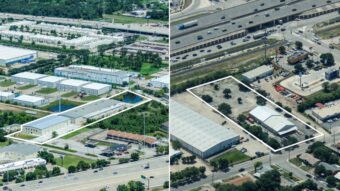
Texas’ industrial market is not slowing in any simple statewide way. It is sorting itself out.
In Dallas-Fort Worth, tenants are still moving, but product selection has become far more exacting. In Houston, demand is holding up even as a heavy wave of new deliveries keeps pressure on vacancy. In Austin, new space has arrived faster than the market can absorb it and landlords have not fully adjusted their expectations. So the state still has growth, relocations and a business climate that keeps occupiers interested. What it does not have is one unifying industrial story anymore.
“We’re seeing a pick up in leasing activity,” said Allen Gump, executive vice president at Colliers’ Dallas office. “In particular we’ve handled some businesses from outside DFW that are landing here. Also, landlords in many instances we’ve seen are ready to deal, both renewals and new deals. We’ve had a significant number of large deals happen and the inventory of million SF deals is very low. There are quite a few new ones that are going to be breaking ground soon.”
Across the market, newer institutional-owned warehouses in the 150,000-square-foot to 250,000-square-foot range have become more common, with roughly 140 options available across DFW based on a recent CoStar search. CBRE’s 2026 DFW outlook also notes that bulk demand remains strong while small-to-midsize demand has moderated, with manufacturing accounting for 35.3% of leases above 100,000 square feet in Q3 2025.
“We’re seeing a clear shift from smaller, infill properties to larger bulk spaces, particularly those of 500,000 square feet or more,” said Max Mueller, senior director of development for VanTrust Real Estate in Dallas. “Over the past few quarters, infill product surged amid limited supply, strong demand and significant rent growth. That dynamic has since reversed. Developers concentrated on smaller products, creating oversupply, while larger bulk space was underbuilt. Today, much of that inventory has been absorbed and is now undersupplied, driven by evolving tenant demand.”
That makes DFW feel less like a market in retreat than a market getting stricter. CBRE reported that demand for big-box facilities has cooled enough that only nine projects of 500,000 square feet or more were under construction in Q3 2025, down from 20 completions in 2024 and one completion in 2025, while preleasing for new construction rose to 40%. Owners are also beginning to use modest free rent and tenant improvement allowances to hold face rates. In other words, activity is still there, but the easy assumptions are gone.
“The disconnect mirrors that shift,” Mueller said. “Supply and demand for large bulk space versus smaller infill products have essentially flipped. Pricing followed suit. Rents for 500,000-plus-square-foot product have risen sharply, even over the past 60 days, while rents for smaller product have plateaued or, in some cases, declined.”
Houston is working through a different kind of pressure. Leasing activity remains active, but a large wave of recent deliveries is still moving through the market with new space competing for tenants across expanding logistics corridors.
“Seems that tenant leverage is showing back up, but only on commodity product,” said John Nicholson, vice chairman at CBRE’s Houston office. “Class A, well-located space with modern specs is still tight and landlords know it. The shift is that occupiers are finally slowing down — deals that used to close in 60 days are now taking 120-plus days. Companies that panicked into longer-term leases in 2021-2022 aren’t making that mistake again. That discipline is real, and it’s reshaping how we negotiate.”
Newer buildings continue to draw tenants looking for modern specifications, while older inventory faces longer marketing timelines. Large-format space is taking more time to stabilize, and leasing velocity has slowed as tenants weigh decisions more carefully.
“Tenants have options now and won’t pay the previous year’s pricing,” Nicholson said of 50,000-150,000 SF spaces in certain submarkets. “That gap is exactly where deals are dying. If you’re a tenant in that size range, this is your window to push hard.”
The risk in Houston is not just timing or product mix.
“The Southeast submarket and Ship Channel are still being underwritten on pre-tariff assumptions,” Nicholson said. “A significant chunk of that demand base — importers, 3PLs, freight-dependent users — is directly exposed to trade flow disruption. If import volumes pull back, that corridor feels it first. Most people aren’t recognizing this and they should be.”
Austin is the outlier because the issue is timing. Vacancy has climbed to nearly 20% citywide as new supply hits the market, even as tenant requirements continue to grow in size and infrastructure needs. That shift is being driven largely by advanced manufacturing and defense users, alongside a steady pipeline of new projects across Central Texas, including major expansions and new industrial parks in Georgetown, San Marcos and Northeast Austin.
“While search activity appears robust with substantial multi-market interest, this surface-level demand may not accurately reflect genuine absorption potential in Austin,” said Zane Cole, senior managing director at JLL Austin. “Nevertheless, this perceived demand has encouraged landlords to maintain aggressive pricing expectations, creating the market’s most significant disconnect today.”
Available space has increased, but pricing has not moved in parallel. Asking rents and concessions have remained relatively stable, creating a gap between what landlords expect and what tenants are able to underwrite.
“Beyond the absorption concerns mentioned above, affordability poses a significant risk—particularly for local and regional companies whose leases are expiring after 5-7 years into a substantially different pricing environment,” Cole said.
Mueller put a name to what links these markets.
“The risk is the industry’s tendency toward herd mentality, which drives cyclical over- and undersupply across product types,” Mueller said. “Additionally, the operating environment is evolving quickly. Tenant mix and industry demand are shifting—while 3PLs drove much of the leasing activity last year, that may no longer hold by the end of 2026. Developers will need to stay flexible and adapt to these changing dynamics.”
That feels like the real statewide takeaway. Texas still has the same advantages everyone cites: in-migration, infrastructure, relocations and a business climate that continues to attract occupiers. Gump even argued that, so long as the national economy holds up, Texas should keep benefiting from businesses leaving states that have become harder to operate in. But those advantages are no longer smoothing over bad assumptions. Markets are getting more precise. Space has to match the user, timing has to match the demand cycle and pricing has to reflect what tenants will actually absorb. The state is still building. It is just no longer forgiving.