Michigan City is no longer a quiet outpost on the southern shore of Lake Michigan. It is quickly becoming one of the most closely watched commercial real estate markets in Northwest Indiana, fueled by transit investment, residential growth and a steady pipeline of industrial development.
“The market is robust,” said Clarence L. Hulse, Executive Director of the Economic Development Corporation Michigan City. “We’re getting a lot of interest in the marketplace due to increased residential activity, technology projects like data centers and strong activity in office and retail. I believe we’ll continue to see growth over the next three to five years.”
Michigan City’s surge reflects a broader shift across Northwest Indiana, where industrial demand, logistics activity and advanced manufacturing investment continue to reshape the commercial landscape. What sets Michigan City apart is the convergence of infrastructure, housing and economic development happening at the same time.
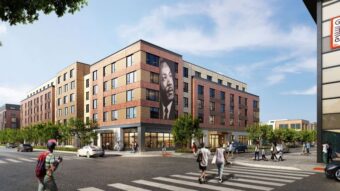
One of the clearest signals of Michigan City’s trajectory is the scale of residential development now underway. Hulse said the city is experiencing a wave of new units that will support future retail, office and service demand.
“In Michigan City alone, we have about 1,000 units under construction and another 1,000 in the pipeline over the next five years,” Hulse said. “Downtown, we have roughly 500 units being built right now with a goal of 1,000 units within three years.”
Additional housing momentum is already taking shape. The Moore townhome community is expected to welcome its first residents in May 2026, adding another layer to the city’s expanding residential base.
If residential growth is providing fuel, transportation infrastructure is providing the spark. Michigan City is home to Indiana’s first and only transit-oriented development rail station and the $1.6 billion Double Track project has materially changed commuting patterns.
“Reducing the commute to downtown Chicago from nearly 90 minutes to about an hour has transformed us into a true commuter community,” Hulse said. “You can live here and work in downtown Chicago.”
That improved connectivity is drawing both residents and employers to the area, reinforcing Northwest Indiana’s position within the broader Chicago metropolitan ecosystem. Regional leaders say Northwest Indiana’s position within the Chicago MSA continues to draw new investor attention.
“We love our proximity to the city of Chicago and believe that together we can continue to be a powerhouse of the Midwest,” said Heather Ennis, president and CEO of the Northwest Indiana Forum.
While residential headlines have captured attention, industrial continues to anchor the Northwest Indiana market. New speculative development is largely concentrated in logistics, advanced manufacturing and distribution facilities.
“For the spec buildings, it’s a lot of industrial: advanced manufacturing, distribution and logistics,” Ennis said. “We’re also seeing significant data center investment happening in Northwest Indiana.”
That pipeline is already taking physical shape in Michigan City. The planned Tailwind Business Park, a roughly $31.5 million development off Cleveland Avenue, is expected to deliver 11 flex and industrial buildings totaling about 132,000 square feet while supporting more than 200 permanent jobs at full buildout.
“The challenge isn’t lack of demand, it’s lack of inventory,” said Lori Tubbs, president and CEO of Lori Tubbs Real Estate & Development Consulting, noting that vacancy across the region’s industrial sector remains under 5 percent.
Tubbs said the shift is most visible in current transaction activity.
“We are actually seeing more owner-users than investors competing for buildings right now because businesses are choosing to buy rather than lease when they can,” Tubbs said.
She noted that the most acute shortage exists in the 10,000- to 50,000-square-foot range, where many local manufacturers and service companies operate.
Two properties currently being marketed by Tubbs illustrate the type of product gaining traction in the region. At 301 Enterprise Drive in La Porte, a newly constructed industrial facility offers between 75,000 and 150,000 square feet on a 23-acre site within a new industrial park. The building features 30-foot clear heights, multiple dock doors and rail accessibility, positioning it for modern logistics users. The property’s proximity to I-94, I-80/90 and IN-20 underscores the transportation advantages that continue to attract tenants to Northwest Indiana. Meanwhile, a 12.5-acre industrial parcel at 551 E. Boyd Blvd. in La Porte is being marketed as a prime development opportunity. Zoned Manufacturing 2, the site can accommodate up to 200,000 square feet of industrial space and sits just 7 miles from the Indiana Toll Road. Together, the two listings highlight the region’s focus on scalable industrial product and shovel-ready sites that can meet user demand quickly.
Despite the strong fundamentals, market professionals such as Belinda Schuster, Owner and Managing Broker of NWI Commercial Real Estate, acknowledge that Northwest Indiana is entering a more complex phase of growth. Industrial growth, housing economics and commercial redevelopment are no longer moving in parallel, creating both opportunity and friction across the marketplace, she said.
“The market is becoming increasingly bifurcated,” Schuster said. “Institutional-grade industrial assets continue to perform well while many legacy retail, small industrial and mixed-use properties face rising renovation costs, changing tenant demands and uncertainty around adaptive reuse.”
Higher interest rates have also reset buyer expectations, expanding cap rates across asset classes and pushing investors to prioritize conservative underwriting and realistic yields.
In Michigan City, officials are responding by focusing on process improvements designed to shorten development timelines.
“Developers are very gung ho,” Hulse said. “We’ve had three developers tell us they don’t want incentives — just get them to market within six months. That’s what they’re looking for.”
The results are already showing up in investment totals.
“Last year, we secured $1.3 billion in capital investment for a city of 30,000 people,” Hulse said. “That’s punching above our weight class.”
Across Northwest Indiana, stakeholders say the narrative around the region is evolving. What was once viewed primarily as an industrial extension of Chicago is increasingly being framed as a diversified, strategically positioned growth market.
“We’ve seen people be pretty bullish about Northwest Indiana,” Ennis said. “More folks are starting to understand that we’re part of the Chicago MSA and that our tax structure and infrastructure assets continue to drive investment to our region.”
For Michigan City in particular, the combination of lakefront lifestyle, commuter access and accelerating development activity is creating a powerful value proposition.
“We’re not just open for business — we’re doing business,” Hulse said. “We’re trying to attract different product types, different restaurants, different entertainment. Anyone looking to expand in the Midwest should call us.”
If current trends hold, Michigan City’s momentum may signal more than growth for a single community. For Chicago-area investors and occupiers increasingly priced out of core markets, Northwest Indiana is beginning to look less like an alternative and more like the next logical move.