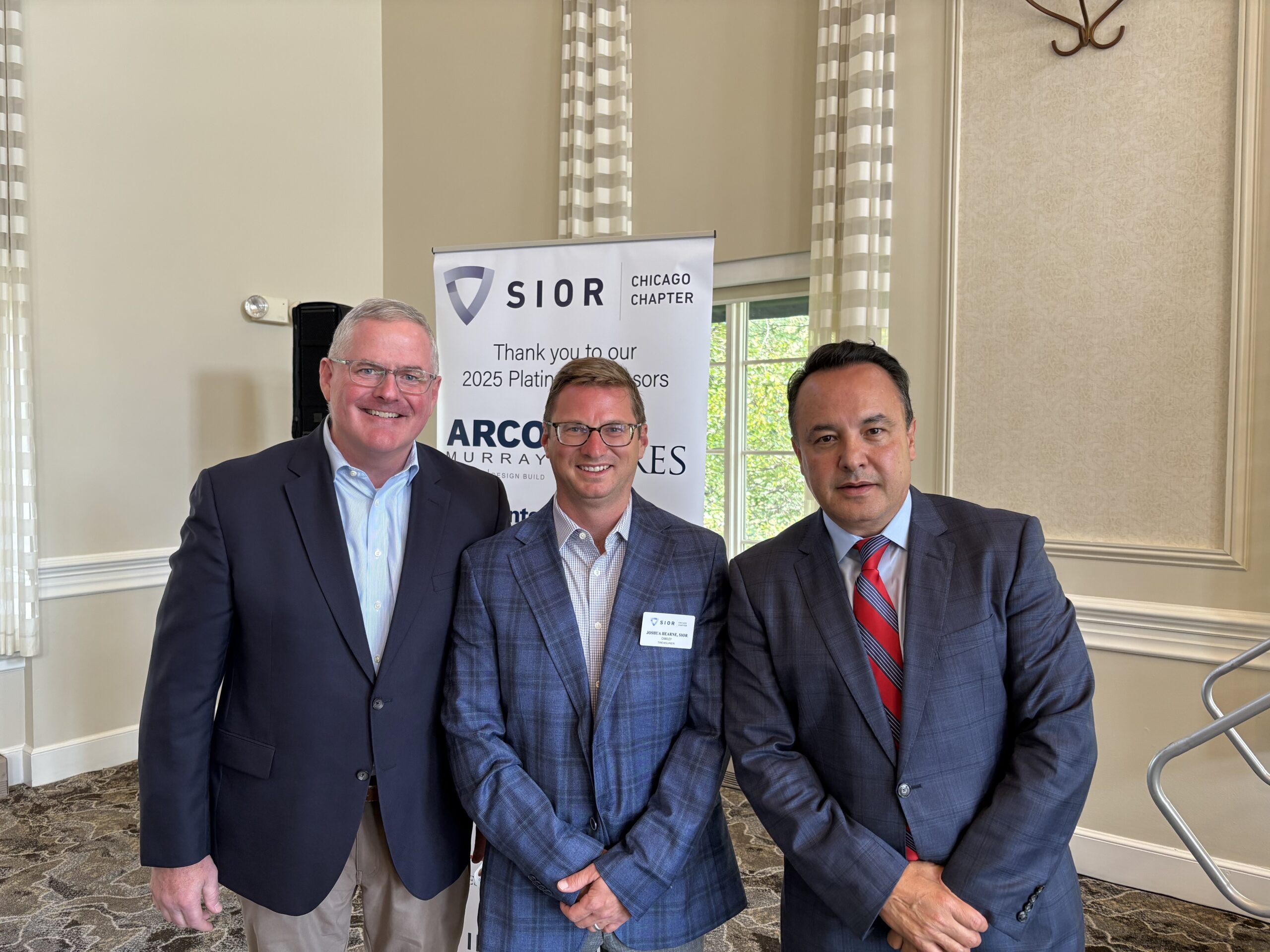
If you have ever tried to underwrite a deal or value an investment property in Cook County, you know that property taxes can be one of the most unpredictable and one of the most influential variables in the region’s commercial real estate. That uncertainty was the focus of a recent SIOR Chicago Chapter luncheon in Glenview that I moderated with George Cardenas of the Cook County Board of Review and Jay Rock of Rock Fusco & Connelly, LLC.
The discussion covered the complexities of real estate tax assessments and the appeal process, emphasizing the roles of assessors, boards of review, and the importance of providing evidence when contesting property valuations. The panel also explored tax incentives such as the 6b program, including eligibility, renewal, and the political considerations involved in securing and maintaining these incentives. The conversation also compared tax trends and infrastructure challenges across Cook County and neighboring counties, highlighting how new developments and population shifts impact tax rates.

Joshua Herne is principal of Cawley Commercial Real Estate Services.
How Assessments Work and Why Appeals Are Important
I opened the discussion with a question that nearly every investor and broker has asked at some point. How can one property can be taxed at $1.50 per square foot, while the property next door is taxed at $4.00 per square foot?
Rock explained that while assessors can’t legally chase sales or automatically increase valuations based on sales price, they do use sales data to guide their models. That, he said, can lead to outliers, especially when new construction or high-priced transactions can distort the data.
“That is why there is an appeal process,” he said. “Just because the assessor says something, that doesn’t mean that it’s the final word.”
Rock went on to explain that every county in Illinois has a Board of Review, where property owners are able to challenge assessments, provide comparable property data and make the argument on the basis of uniformity, which is guaranteed under section nine of the owner constitution.
Cardenas described the Board of Review simply as “the people’s agency,” noting that that is where due process comes in, is upheld, and where property owners can engage directly with analysts as well as commissioners to make their case.
Unlike the assessor’s office, which typically sets values based on a limited amount of data or formulas, it allows everyone to be treated fairly and have evidence in hand, he continued.
Importance of Evidence and Transparency
Throughout the discussion, the panelists noted that the key to a successful appeal lies in preparation and evidence, and that owners appealing on an income basis should be ready to submit detailed income and expense statements, rental data, and vacancy information.
“If you’re going to claim your property is over-assessed, you have to back it up with data,” Rock said.
Cardenas agreed, noting that while some owners might be tempted to “play cute” with their numbers, the Board can easily spot inconsistencies. He also encouraged property owners to stay engaged throughout the process and to communicate with your municipal leaders or government contacts if you run into issues. Transparency goes a long way, he added.
The Advantage of Incentive Programs
Much of the conversation focused on Cook County’s Class 6b incentive, an important tool used to attract and retain industrial investment. The 6b provides a 12-year reduced assessment rate of 10% for the first 10 years and a gradual increase in years 11 and 12 for qualifying properties that undergo new construction, substantial rehabilitation, or reactivation of abandoned building after at least 12 months of vacancy.
But municipal support is the real key to success, panelists explained. “If the municipality is in favor of it, the county is usually a rubber stamp,” Rock said. He encouraged investors and owners to begin renewal discussions about 18 to 24 months before expiration as well as to document how the tax savings were used, whether that was through job creation, facility upgrades, or community reinvestment.
Cardenas added that transparency and visibility are powerful allies. If a property owner has created new jobs, improved the property, or invested in the community, they should show it off. “Invite local officials to ribbon cuttings. Share your success stories. It’s good politics and good business.”
Renewals of the 6b classification, however, should never be thought of as automatic. Panelists noted that municipalities are sometimes counting down the days until that 6b expires to see that full tax revenue. The best way to improve your odds for renewal, Rock added, is to show tangible and ongoing benefits to the community.
Regional Trends and Rising Rates
Surrounding counties like Will, DuPage, and Lake are also facing their own set of tax challenges. As Rock explained, the rapid pace of industrial and residential development in these areas has created other infrastructure needs such as roads, schools, utilities, and emergency services, which inevitably can drive the need for higher tax rates.
While panelists said their tax rates aren’t catching up to Cook County as of yet, there has been an increase. Cardenas was quick to point out that relocating purely to avoid high taxes, though, may not be the solution. “There’s no free lunch. If demand rises and values go up, taxes follow. It’s market economics,” he explained.
He also notes that Cook County has many advantages such as connectivity, access, and infrastructure. “I can get anywhere in 30 or 40 minutes,” he explained.
Practical Takeaways
As the panel moved into audience Q&A, the conversation turned more into the practical strategies for owners and investors in managing taxes and avoiding missteps. The top pieces of advice offered early included:
- Engage early and don’t wait until after a sale to explore appeals or incentives. For 6b applications, initiate conversations well before closing.
- Being accurate and honest.Overstating jobs or investment commitments can backfire, as municipalities often verify compliance and can revoke incentives or impose penalties.
- Keep detailed records like marketing materials, vacancy affidavits, and financial statements. Records can strengthen a case during appeals or renewal applications.
Most counties require appeals to be filed within 30 days of receiving an assessment, so understanding the timeline is key. Board of Review decisions typically follow within 60 days, though appeals to the Property Tax Appeal Board can take up to two years.
And lastly, staying connected and maintaining relationships with municipal and county officials is critical. As Cardenas said, “Good communication and good citizenship are just as valuable as good data.”
Joshua Herne is principal of Cawley Commercial Real Estate Services in Oakbrook Terrace, Illinois, and treasurer of SIOR Chicago Chapter.