In Chicago’s neighborhoods, residents and retailers are interdependent. Without local residents, retailers, restaurants and entertainment venues likely wouldn’t generate the traffic necessary to be successful. And without local retail, residents may be forced to look elsewhere for conveniences.
Nearly five years after the start of the Covid pandemic that decimated retail, neighborhood retail is playing out better than expected, said Joe Schwieterman, Director, Chaddick Institute, DePaul University.
“There are hot and cold pockets, however,” he cautioned. “In some neighborhoods they are gobbling up the space while others haven’t seen the magic.”
Chris Brewer, VP AECOM agreed, stating in his keynote address, “The retail apocalypse is almost over.”
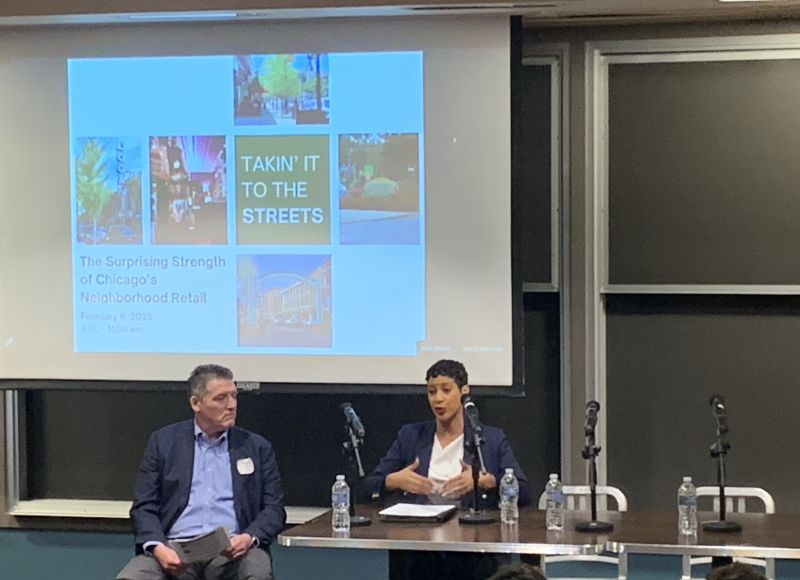
During the first quarter of 2025, DePaul University’s Real Estate Center and Chaddick Institute hosted “Takin’ It to the Streets: The Surprising Strength of Chicago’s Neighborhood Retail,” a conference that brought together professionals whose careers are closely linked to neighborhood retail.
Emi Adachi, Co-Head Global Investment Research, Heitman said according to CoStar statistics, Chicago’s downtown vacancy rate is 5.5%; in the neighborhoods it is as low as 3%. “Retail has emerged stronger than it’s been in years,” she said. “The market is very healthy in many submarkets, but challenges remain in others.”
Opportunities vary by street and neighborhood. Brewer named two areas that differ substantially. Andersonville is a strong submarket where there may be fully occupied storefronts along entire blocks. By contrast, in Edgewater significant gaps persist even on major blocks. In some cases, the vacancies may be due to the quality of the space. This is often exacerbated by the economic choices of landlords unwilling to deploy capital into low-cost basis assets. “There may be fewer marketable spaces than you’d think,” Brewer said.
Ciere Boatright, Commissioner of Planning & Development for Chicago said there is a need to focus on the repopulation of the city “in a strategic, responsible and holistic way.”
Boatright took part in a fireside chat with Reagan Pratt, Douglas and Cynthia Endowed Director, the Real Estate Center, DePaul University.
“We need to ensure that the rising tide lifts all boats,” she said. “We want to attract the national retailers and keep the ‘mom and pop’ operations.”
Pratt noted this is crucial because the “mom and pops” are most often the urban pioneers, pushing locational and neighborhood boundaries.
Boatright’s time in the private sector shaped her views and outlook for the City. “I understand the Chicago challenges and opportunities. I’m here to cut the tape and move the needle. We all know time kills deals.”
Boatright said because of the work she and the department have done, a zoning process that used to average 131 days now averages only 79.
The department is also working on more proactive zoning regulations to streamline the process. One example is the proposed elimination of parking minimum requirements in certain places. This allows private developers to provide parking based on market dynamics, without being bound to outdated rules and regulations.
Boatright did not discount any of the challenges that Chicago is facing, but noted that they are challenges being faced by cities across the U.S.
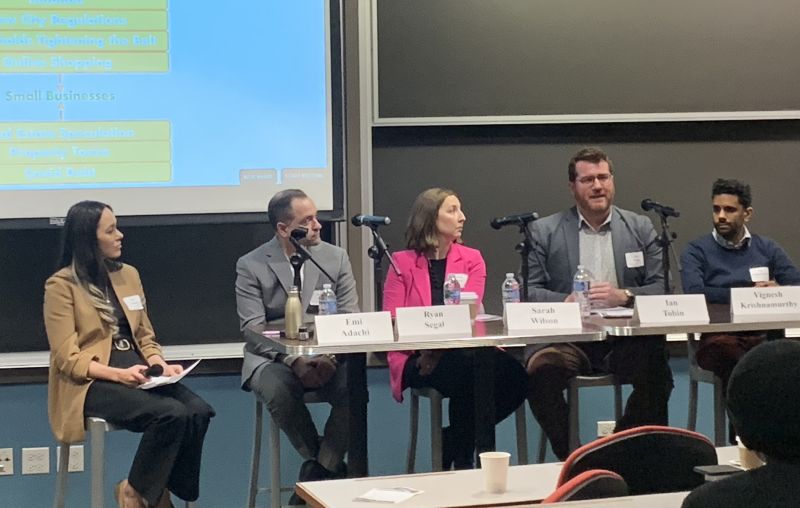
Adachi led a panel discussion generating perspectives from a retail property owner, two neighborhood Chamber of Commerce leaders, and a representative from the Chicago Department of Transportation.
Ryan Segal’s firm, Acadia Realty Trust, is a publicly traded REIT (AKR) that operates nationally with a market cap of $2.77 billion dollars. The firm has considerable holdings in Chicago’s Gold Coast market, the Halsted/Armitage area, and near Clark & Diversey.
Segal characterized the Halsted/Armitage area as having a lot of clicks to bricks in the area—retailers that started online but later added stores. Because of the demographics of the area, Segal said there is a waiting list for space. Those supply and demand forces have translated to 20% rent growth in a one-year time period and 50% growth over five years.
He noted similar popularity in the Clark and Diversey market area because “people like to stay close to home.”
“The retail properties in these neighborhoods and corridors are attracting institutional investors. It’s not just happening in highly recognized corridors like Michigan Avenue.”
Some retail areas, such as Uptown, Ravenswood and Lincoln Square are driven by a mixture of unique retail experiences and iconic entertainment venues.
Uptown is an established, immigrant-based community where many businesses, including restaurants, coffee shops and retailers, are closely linked to the neighborhood’s proximity to entertainment venues. Sarah Wilson, Executive Director of Uptown United and the Uptown Chamber of Commerce said there is a significant correlation between show nights at places like Aragon Ballroom, Metro and Double Door, and higher sales volumes.
Some of the challenges faced by the neighborhood she noted include storefront vacancies that are the result of red line construction projects. Now, with construction nearly done, other challenges include older vacant properties that need capital to compete. Often long-time owners with a low-cost basis eschew capital investment in the retail space when the residential component of the asset provides adequate cash flow.
Operationally, “Many businesses, especially restaurants, experience a real squeeze between attracting customers and paying employees,” Wilson said. “Because of lingering Covid issues and material cost increases, restaurants report that the price per check remains about the same, but patrons are coming less often.”
Vig Krishnamurthy, managing deputy commissioner, Planning and Design, CDOT relayed that Chicago has 4,000 miles of streets and 7,000 miles of alleys that CDOT makes sure work.
He said the department oversees a Streetscape Program that is tasked with “determining what goes where and why. Under its jurisdiction, CDOT decides the location of speed bumps, bike lanes, stop lights and sidewalk benches,” among other things.
The quality of the environment is very important to the $500 million Streetscape program he said. With so much history and culture woven into the fabric of Chicago’s neighborhoods, the department strives to sustain, enhance and cultivate a sense of place.
“We build on what is there, so it doesn’t come across as contrived,” he said. “We strive to create a place to be, not just a place to go through.”
Ian Tobin, VP and Director of Community Development Lincoln Square/Ravenswood Chamber of Commerce, described his neighborhood community as “fiercely local—the port of entry for Europeans.”
Given some of the demographic similarities to Ravenswood and other established Chicago neighborhoods like Southport, the area has similar challenges, including low vacancy resulting from strong rent increases which is leading some long-time tenants to vacate.
Tobin said that given overall economic conditions (and uncertainty) one of the greatest conflicts is the length of leases. Landlords want longer term leases, but some businesses are hesitant to make that commitment. Further, because of some landlord’s reluctance to focus on deferred maintenance, some spaces need significant upgrades to meet the needs of restaurants and other users.
Tobin is optimistic about the potential impact of upcoming transit-oriented redevelopment projects. “With a focus on neighborhood planning, saying yes to the plan has made it possible to drive development.”
And, of course, much of the retail and entertainment sectors rely on transportation and related infrastructures that provide greater access for customers, business owners and employees.
According to Helen Bailey, one of the owners of Pioneer Realty Group, a residential realtor that focuses on for sale and rental properties in Chicago’s neighborhoods, retail is vital to Chicago’s neighborhoods
A vibrant neighborhood impacts the value of real estate. The retail and entertainment fabric of the neighborhood are what draw people to want to live and work here. It’s what drives business.
“The price of apartments and homes are worth what a tenant or buyer is willing to pay,” she said. The neighborhood impacts pricing more than anything else. When you think about what makes a location desirable, much of that is the feeling and the vibrancy it evokes.”
Michael Millar is a principal of Open Slate Communications and a member of the Executive Advisory Board of The Real Estate Center at DePaul University.