Office buildings that offer amenities such as on-site restaurants, fitness centers, high-tech conference rooms and collaboration spaces are attracting more tenants as the flight-quality in this sector remains a reality.
But what about outdoor space? Do walking trails, green lawns and park spaces help attract tenants to office parks? Yes, and the success enjoyed by a Class-A office park at the northern boundary of Indianapolis is evidence of that.
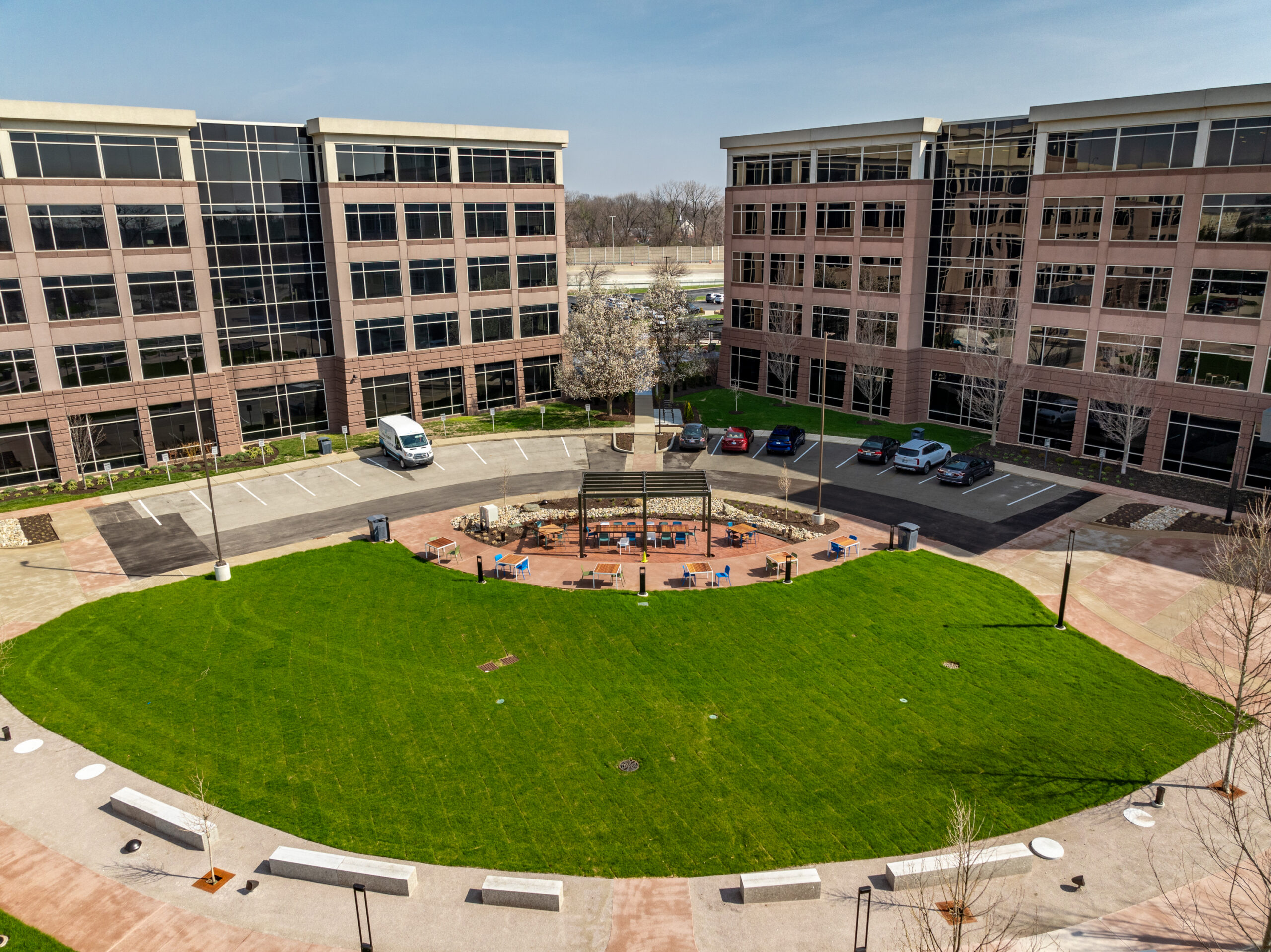
Carmel Gateway, a Class-A office park adjacent to the Indianapolis suburbs of Carmel, Zionsville and Fishers recently reclaimed more than 2 acres of parking lot to create its newly opened East and West Lawns, unique green amenity spaces for tenants to enjoy, gather and work outdoors.
We spoke with Patrick Moyers, senior property manager with Carmel Gateway, and Jason Fiddler, account manager with Komplete Landscape Contractors, about the effort to bring more green space to this Central Indiana office park and the positive impact this move has brought.
We’ve written quite a bit about how important outdoor spaces are for improving the health of office employees. How will the new green space at Carmel Gateway help boost both employee health and productivity?
Patrick Moyers: Through our extensive market research as employers are coming out of the Covid-19 pandemic and reimagining the workspace and how it supports their team, Carmel Gateway realized very quickly that the nature of work is changing. Our tenants began asking for more from their workplace community to boost productivity for their teams, promote a healthy work-life balance for their employees and increase employee retention rates and the office itself played a big role in those areas.
Our tenants at Carmel Gateway appreciate our intentionality of bringing the outdoors into their work environments. We incorporate creative uses of natural light while indoors, decompression and break areas throughout campus, designer lobbies, walking paths and extensive landscape features including our newly opened East and West Lawns. We see these spaces as an opportunity to build community and camaraderie on our connected campus.
For Carmel Gateway, our green spaces are about providing our tenants and their employees with more choice in how and where they work, take breaks and interact with one another. When employees have an environment that supports those needs, we believe it can contribute to a more positive, energized and productive workday.
How does offering a green space like the East and West lawns help tenants at Carmel Gateway attract and retain workers? And does it make the office building more attractive to tenants?
Moyers: When we faced the Covid-19 pandemic, businesses needed space and fresh air to even operate during some period of time, when indoor spaces were considered unsafe. Office environments over the years have become more flexible to accommodate different types of work, whether it is collaborative spaces for team projects or personal workspaces. At Carmel Gateway, we provide more than just flex workspaces or an outdoor patio for our tenants and their employees, which makes the prospect of coming into the office more attractive.
When Carmel Gateway and our ownership looked at flexible outdoor working spaces, we wanted to take this concept to the next level, where nothing else in central Indiana could rival what we are doing here. Our East and West Lawns allow our campus to put on full-scale professional presentations at our waterside amphitheater with full AV capabilities. We can host social events and gatherings right outside the office, but thanks to extensive landscape work and unique features at both lawns, they feel like they are in more of a resort-style space rather than an office park.
Our leasing partner JLL now has this in its back pocket as their representatives work to attract new tenants to our office space. We have had tenants relocate to our property recently because of the investments in our outdoor amenities and green spaces. We include the PARC amenities building that includes our on-site cafe and caterer, conference rooms and fitness center as the start of our tour for prospective tenants, followed by a walk outside on the West Lawn, which is a landscaped greenspace and amphitheater with terraced limestone block seating with a waterside backdrop, and then we tour their potential office space.
Can you talk about the factors that went into choosing the correct mix of trees, shrubs and other foliage for the site?
Jason Fiddler: Before the renovation, much of the area that is now the West Lawn was an unused parking lot. Reconfiguring vehicle access allowed different areas of campus to become a connected green space while helping address traffic circulation during peak periods. A total of 68,537 square feet of hard surface was removed and returned to turf, with upgraded landscaping throughout East and West lawns.
From the landscape side, this continued our broader work across Carmel Gateway of revitalizing planting areas with a proven plant palette, stone accents and seasonal color while creating more space for people to enjoy getting outdoors during their workday.
Thousands of select plants are organized into repeatable patterns to create color, texture, durability and a strong sense of place as people move about their workspace. For a high-traffic commercial property like Carmel Gateway, intentional plant choices look purposeful and make an impact in all four seasons we experience here in the Hoosier state.
As the gateway to the city of Carmel, our signage flanked by impeccable landscape design welcomes tenants and travelers alike to the best city to work, live and play. Our West Lawn project and 96th roundabout landscaping included more than 3,000 plant installations to beautify our newest amenity-rich outdoor space of both the East and West lawns.
What impact has Carmel Gateway seen after the opening the new green spaces?
Moyers: Since opening the East and West lawns, one of the biggest impacts we’ve seen is our ability to take tenant programming and events to an entirely new level. We’ve already hosted a full monthly speaker series with professional development opportunities for tenants and their employees over the lunch hour, summer socials with local vendors and live music, performances by the Carmel Symphony Orchestra and more.
We also dedicated a portion of the West Lawn to a memorial for a longtime employee of one of our largest tenants who passed away from cancer, with input from his family on tree, shrub and flower selections, which is a unique part of the project I take great pride in. Before the West Lawn, we had to work within the constraints of smaller patio areas or indoor spaces to host these types of professional development or networking-style events. Now, with nearly 2.5 acres of flexible green space, an amphitheater with full AV capabilities and a scenic setting, the possibilities are seemingly endless. We’re incredibly proud of how the space has been embraced so far by our campus community, but what’s most exciting is where we can take it next.
Why was the decision made to add an amphitheater instead of just greenery and walking paths?
Moyers: We already enjoyed our large pond and fountains as a natural focal point. Rather than creating a flat green space adjacent to the pond with walking paths and picnic tables, we decided to elevate that area, make it more distinctive and transform it into an oasis that blocks the hustle and bustle of the world around campus. By cutting the amphitheater into the natural slope of the pond, we were able to create a lakeside setting that feels surprisingly removed from the traffic and activity along College Avenue and 96th Street. The limestone seating helps nestle the amphitheater into the landscape and gives it a more permanent, natural feel than simply placing tables and chairs throughout a flat lawn.
Just as importantly, the amphitheater makes the West Lawn functional for our campus to host large-scale events. With built-in audiovisual capabilities including outdoor sound system and television screens, we can accommodate everything from outdoor meetings and corporate presentations to a speaker series, concerts, tenant socials and larger community events. We’ve already begun exploring that potential through our programming, including bringing the Carmel Symphony Orchestra to the campus.
Making the investment in the amphitheater space allowed Carmel Gateway to turn what could have simply been landscaped green space into an amenity-rich environment that can evolve with our tenants. It can be a quiet place to have lunch or meet with colleagues one day and become a venue for hundreds of people the next.
How important was it to create a green space that doesn’t require extensive maintenance?
Moyers: Carmel Gateway and our landscape contractor Komplete Landscape invested in durable materials and infrastructure so the space will remain attractive, functional and sustainable over time. We want these green spaces to look and feel intentional every day, no matter the season.
That proactive thinking influenced everything from landscaping and irrigation to drainage and technology. The lawns are fully irrigated to help maintain healthy green space throughout the season, and we installed larger, more established trees from the beginning, so the East and West lawns immediately had height, structure and shade. Evergreens also serve a practical purpose throughout the landscape, including screening electrical and technology infrastructure so those necessary elements blend naturally into the environment.
The music and audiovisual systems, including the outdoor televisions, were specifically selected and rated for outdoor use. It was a greater investment upfront, but a lasting selection for the use of our lawns.
On the East Lawn, we also incorporated a compact, walkable surface around high-traffic areas such as the swings. It provides the character of a more natural surface while remaining stable underfoot and helping prevent the wear and tear that would occur with grass in those areas.
Even the drainage was carefully considered, with systems designed to manage water across the lawns and help prevent debris from entering the watershed. Those details may not be the first things tenants notice, but collectively they help ensure these spaces continue to look good and function well as they receive more use over time. We considered the lifecycle of this major investment, not just how impressive it would look on opening day. We want it to be sustainable.
Fiddler: We have crews working throughout Carmel Gateway every day of the week. The West Lawn typically receives attention from three to four service crews each week, with two to four people per crew depending on the task. Routine care includes weekly mowing and litter removal, plus bed weeding once or twice weekly as needed. Seasonal services include fertilization, selective herbicide treatments where needed, aeration and overseeding, two applications of bed pre-emergent, and three dedicated perennial-care visits to remove spent blooms and encourage repeat flowering where appropriate.
Insect control helps reduce nuisance insects so people can comfortably enjoy the space and we’re also refining turf aftercare and using the smart irrigation controller to adjust watering as the landscape establishes.
We also utilize technology and AI to create a full 3D model of the entire landscape design on campus visualizing each plant, bush and tree mapped out. We have programmed agents to keep track of watering and care that way if anything needs immediate attention we can quickly address it.
Do you expect more office properties to invest in green space to bring in more tenants?
Moyers: A transformation like Carmel Gateway’s doesn’t happen simply by deciding to tear out a parking lot. There are a lot of pieces that must come together to make a project of this scale successful.
One of the things that made this project possible was our strong partnership with the City of Carmel, which has built a national reputation for being intentional about how people experience the environment from its extensive trail network and signature roundabouts to its parks, public spaces, landscaping and continued investment in quality-of-life amenities.
There is an attention to detail here and an emphasis on creating places where people can live, work and enjoy their surroundings. We wanted Carmel Gateway to reflect that same philosophy within our connected office park and campus. Because of that alignment on vision, our partnership with Carmel made this project possible as we had to request variances and permits to remove parking spaces to make room for usable green space. We recognize that not all municipalities would be on board with a project of this magnitude, but the city has been a vital partner in our reclamation effort, and we worked together to connect existing city infrastructure with paths, trails and roadways through campus.
It also required a significant financial commitment from Rubenstein Partners and its affiliates. This was a multimillion-dollar investment made during a challenging period for the office market. Ownership had to believe in the long-term value of the project, lenders had to understand that vision, and tenants had to be comfortable with rethinking portions of the campus that had traditionally been dedicated to parking.
From my experience as a property manager, I recognize every property is different and not only do you need the right physical environment to pull something like this off but you also need strong partnerships among ownership, municipalities, lenders and tenants. At Carmel Gateway, those pieces came together around a shared belief that some of our existing concrete could provide greater value to tenants as a place for people to work, gather and connect during the workday.
Carmel Gateway is strategically positioned at the gateway of Carmel and the north side of Indianapolis. The more than 1-million-square-foot campus offers on-site amenities for tenants including a stand-alone amenity center with executive fitness club and exclusive tenant cafe, abundant green space and recently renovated lobbies and restrooms. With more than $52 million worth of capital investments in recent years by affiliates of Rubenstein Partners, L.P., the park is the foremost area leader in central Indiana office space. Carmel Gateway is leased by JLL.