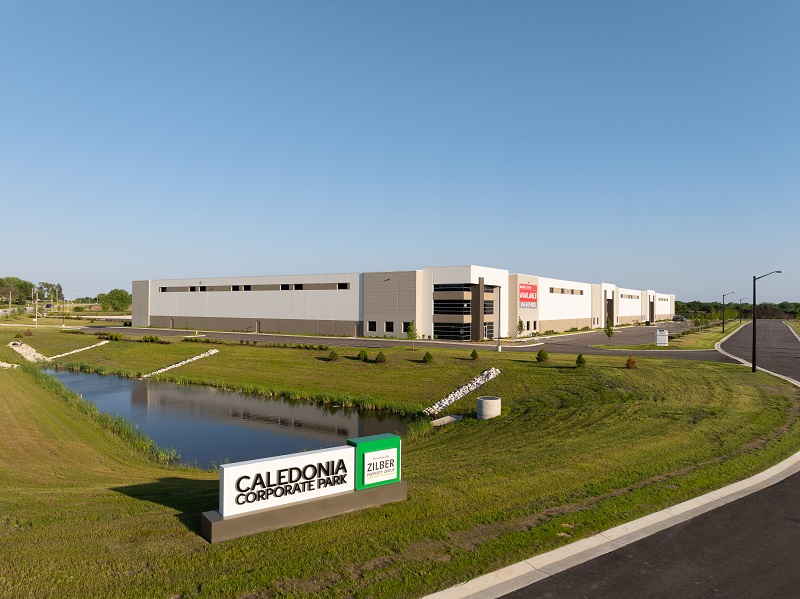
The industrial market faces challenging times today. Demand for new warehouse and distribution space is finally cooling off. And the pipeline of new industrial construction is is not nearly as full as it was just two years ago.
But does that mean that the industrial market is heading for a long-term slump? At least one CRE professional working this asset class says “no.”
Todd Battle, director of industrial investments with Milwaukee-based Zilber Property Group, said that while it’s true that there has been some softening in the industrial market thanks to higher interest rates and construction costs, this sector remains healthy and robust.
And that’s especially true in the markets in which Zilber works, Southeast Wisconsin and in Cook County and Will County, Illinois.
“During COVID, we saw record year after record year,” Battle said. “We saw records in industrial sales, leasing and development. We are now a little bit off from those years. But those were record-setting years. Our industrial market is still a healthy and dynamic one today. It just feels a little different from those record-setting years.”
The markets in which Zilber works had seen a surge of new industrial space during the pandemic years. New construction has slowed throughout late 2023, though. Developers aren’t adding spec industrial space to the market today. This makes it a bit more challenging for end users to find industrial space in the Milwaukee and Chicago regions today, Battle said.
Supply is most constrained in the 200,000-square-foot to 250,000-square-foot end of the market, Battle said. Vacancy rates in these smaller facilities are in the low single digits, Battle said, because there simply isn’t enough space to meet demand.
“You can find those spaces,” Battle said. “We do build spec industrial. As they say, ‘Build it and they will come.’ We also do a fair amount of build-to-suit work where we have a tenant in hand and are building a specific industrial property to suit that tenant’s needs. You can do build-to-suits all day long in this market. There is a balance that needs to be struck. There has to be enough product in the market to meet tenant demand. When the amount of product starts getting constrained, the industrial development industry will respond. They will start to build more.”
Battle said that he expects this to happen shortly. End users seeking small to mid-size industrial properties are struggling to find existing spaces to fit their needs. There just isn’t as much new supply of these smaller facilities coming online.
Battle said that during the next one to two years, developers will respond to this by building again.
“This always goes in cycles,” Battle said. “We were coming off a series of record years. It reached the point at which development and new construction got a little bit ahead of user demand. When that happens, construction slows, demand catches up with supply and then the market switches to one in which developers are encouraged to add more supply.”
Investment sales have slowed in the Milwaukee industrial market, too, thanks to higher interest rates. Battle, though, says that he expects sales activity in this sector to rise now that there is more certainty with rates.
Battle said that while falling interest rates would help unclog investment sales activity, certainty about how high rates can go is just as important.
“I think people feel that we have probably hit the ceiling on rates,” Battle said. “Once people get even more certainty with that feeling, you will start to see more transactions. Once people know that this is as high as rates are going to be, you’ll see more trades, more activity, more investment sales. If rates go down? That will only help because that will enhance investors’ ability to make deals.”
What about amenities? What features are tenants looking for when searching for modern industrial space today?
Battle said that tenants still want industrial buildings that boast easy access to highways and roadway infrastructure. Tenants are also increasingly looking for buildings that are energy-efficient, well-maintained and modern. High clear heights are critical. Industrial spaces that also offer quality office areas are in demand, too.
There is more of a focus today on providing amenities that enhance the quality of life of employees, Battle said. For industrial, that could mean buildings that are located close to health clubs, daycare centers, restaurants, grocery stores and quality housing. It might mean outdoor areas and walking trails. Some industrial facilities offer higher-quality cafeteria areas or indoor gathering spaces for employees who are on breaks.
“Because there is such a tight labor force, companies want to be able to offer employees a nice place to work. It makes it easier to attract talent,” Battle said. “Is it easy to get to the facility? Are there amenities in and around the business park? Is there a healthcare center nearby or daycare? A lot of these factors influence tenants’ decisions on the industrial space they will lease out.”