The leaders at Saber Hall Investment Management? They believe in the strength of the Twin Cities-area industrial sector. They’re especially bullish on the community of Eagan, Minnesota.
And to prove it? They’re investing heavily in it, making new industrial acquisitions in the region.
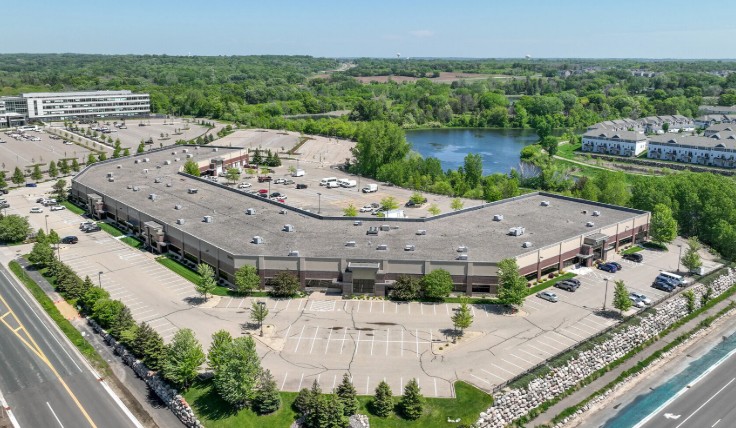
That includes Saber Hall’s newest acquisition, Boulder Lakes III, a 116,549-square-foot, Class-A light-industrial/tech building at 3000 Ames Crossing Road in Eagan, Minnesota.
The $15.4 million acquisition marks the fourth Eagan industrial property that Saber Hall has added to its commercial portfolio.
Ryan Bohrer, managing partner with Saber Hall, said that the Boulder Lakes acquisition came with several positives that made it a good fit for the company’s portfolio.
Chief among these is its location near the Viking Lakes mixed-use development in Eagan Thomason Reuters’ sprawling campus in the same community.
“It’s a newish building in such a strong location,” Bohrer said. “It comes with a lot of positive talking points. We feel that it’s a good add for our portfolio.”
Boulder Lakes III still counts as a newer industrial property, having been built in 2008. The property is also in demand, currently 82% leased to five tenants: Krech Exteriors, Lynx Innovation, The Open Door Pantry, People, Inc. and Service Express.
The building has a clear height of 19 feet along with three loading docks and five drive-in doors. It sits in the corporate hub of Eagan with easy access to Interstates 35E and 494, and is just minutes from the Minneapolis/St. Paul International Airport.
Cushman & Wakefield’s Avery Ticer and Adam Hoffman helped secure the deal.
Saber Hall also owns and operates Eagan Business Commons I & II (2915 & 2980 Commers Dr) and 2956 Center Court in Eagan. The firm’s portfolio spans 39 properties, totaling over 1.7 million square feet across Minnesota, South Dakota and Florida, with assets valued at more than $175 million.
Bohrer said that he expects Saber Hall to continue to invest in the Twin Cities area. He also expects to see the area’s industrial easing activity rise in 2026 and beyond.
“We generally are not builders, but we know that the construction pipeline is not as strong as it has been,” Bohrer said. “About two-thirds of what is being built is build-to-suit versus developers building spec. The developers across the country don’t feel great about building spec right now. But that has resulted in less supply, which has kept vacancy rates low and leasing activity strong.”
Evidence of this? Rohrer points to the industrial absorption numbers in the Twin Cities region: Users have generated more than 3 million square feet of positive absorption this year.
At the same time, the industrial vacancy rate is lower than 4% in the Twin Cities region. Those are both strong numbers and indicative of a healthy industrial sector.
Bohrer says that the more affordable prices for industrial real estate are helping to keep vacancy rates low in this market.
“We are not a gateway city. We are not Los Angeles or Chicago, a mega city,” Bohrer said. “The price point at which you can buy industrial real estate is lower here. There is less risk when investing here. People can make cautious buys here, conservative buys. Based on where rents are going, where cap rates are headed in other major markets, the Twin Cities remain more of a pocket in which local investors can still buy product comfortably.”
Bohrer said that the Twin Cities area is attractive for companies seeking industrial space, too. The area is an affordable place for employees to live. It’s also the logistics crossroads between I-35 and I-94. Companies also benefit from Minneapolis-St. Paul International Airport.
What will construction activity in the industrial sector look like next year? Bohrer predicts that most building activity in this sector will be of the build-to-suit variety again.
“New construction activity will be targeted more toward large users of space,” Bohrer said. “Our region is so built out in the core, more building will need to take place a little further out. Building costs are so high. It makes more sense for a company like us to find an existing space for our clients than it would to build something new.”