The Southeast Wisconsin industrial sector has faced challenges, many of them stemming from higher interest rates. But the market has also been resilient. And at least one top CRE professional working this market told Midwest Real Estate News that even better days are ahead for this region’s industrial sector.
Todd Battle, director of industrial investments with Milwaukee’s Zilber, said that the Fed’s rate cut will provide a boost to the industrial sector in the Milwaukee market. But that boost won’t happen immediately, he said.
“The change in rates will take a little time to cycle through,” Battle said. “In terms of the cost of capital coming down, it definitely will provide some relief and help in terms of demand, transactions and activity level.”

Todd Battle, director of industrial investments, Zilber
Even with the higher interest rates of the last two-plus years, the Milwaukee-area industrial market has proven resilient, Battle said. That’s because while interest rates are one factor that influences industrial development and sales, the Milwaukee area boasts other positives that have helped this sector remain stable even during economically challenging times.
Battle points to the strong industrial base throughout the Midwest, Milwaukee’s location in the center of the country, its strong labor base and its proximity to Chicago as factors that have helped this market weather higher interest rates.
“This is a dynamic industrial market,” Battle said. “There have been factors that have been positive for domestic manufacturing and industry. Because of this, this sector has held up well when compared to other product types.”
This isn’t to say that activity isn’t down somewhat in the Milwaukee industrial sector. Battle said that leasing activity is below the peak levels that this sector saw in 2020, 2021 and much of 2022. New construction starts are also down.
But Battle says that there is still a reasonable amount of leasing activity throughout the market when you compare 2024 to pre-pandemic years.
Like other parts of the country, the Milwaukee area and Southeast Wisconsin saw a significant amount of new industrial construction in 2020, 2021 and 2022. Much of this new product rose along the Interstate-94 corridor in the Kenosha County area.
In good news, tenants filled most of this new product, Battle said. That high demand led to even more product. The more recent industrial deliveries in the market are still attracting leasing activity. But vacancy rates in these newest properties are slightly higher.
“That is why we are seeing a little bit of a slowdown in new construction,” Battle said.
Industrial vacancy rates throughout the Southeast Wisconsin market remain low, though. Battle says that vacancy rates throughout the market fell to 4% to 6%. More recently, industrial vacancy rates have ticked up to 10% to 12% in the Kenosha County submarket, Battle said, with most of these higher rates tied to newer and larger industrial product delivered on a spec basis. Those spaces have yet to be absorbed, which is impacting the area’s vacancy rates.
Will that space get filled? Battle says it will.
“That space will definitely get filled,” Battle said. “There is probably more demand today by users seeking a smaller footprint. Some of these big buildings of half-a-million square feet are seeing a slowdown. But there is a lot of leasing activity among tenants looking for 50,000 to 100,000 square feet.”
Developers and owners might have to divide their larger buildings and go the multi-tenant route, Battle said. But those larger spaces, too, will fill up, he said.
“It will be interesting to see in the next couple of years how this gets worked out,” Battle said.
Battle said that the actions of one big industrial player have also made an impact on the industrial market in Southeast Wisconsin. Uline, a distributor of shipping and packaging materials that is headquartered in Pleasant Prairie, Wisconsin, has long been one of the dominant leasers of space in the market. Recently, though, Uline has invested in acquiring land and building industrial properties that are Uline-owned and -operated.
Uline, then, is vacating a sizable portion of industrial space that it previously leased, Battle said, returning that product to the market and impacting current vacancy rates.
Overall, though, Battle said that several submarkets in the Milwaukee area remain strong when it comes to industrial leasing activity. The greater Milwaukee market has held up well, he said. The Airport South submarket has also performed well, a submarket that includes suburbs such as Oak Creek, Franklin and Caledonia.
Battle said that he expects even better times for the industrial market in the future. That’s largely because the Southeast Wisconsin industrial market has long been a strong one. Part of this is because of the state of Wisconsin’s favorable business climate. Business owners recognize Wisconsin as a good place to operate. They also know that they can select workers from a strong labor pool.
Then there are taxes. They are lower here than they are across the border in Illinois. Businesses can locate in Southeast Wisconsin to gain quick access to the Chicago area, without paying the taxes and higher operating costs that go with locating in Illinois.
The Southeast Wisconsin area is also benefitting from a large investment by Microsoft, which plans to build a massive data center in Mount Pleasant, Wisconsin. These investments include $3.3 billion in cloud computing and AI infrastructure and the creation of the country’s first manufacturing-focused AI co-innovation lab.
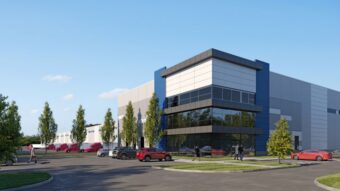
And while spec development remains a rarity today, Battle said that build-to-suit projects continue to happen. Zilber, for instance, is constructing a build-to-suit 311,000-square-foot industrial facility in the Caledonia Business Park in northern Racine County.