The project team on a new food production facility rising in Huntley, Illinois, is helping the client successfully navigate the pressures shaping today’s construction environment: rising costs, labor shortages and tighter project timelines.
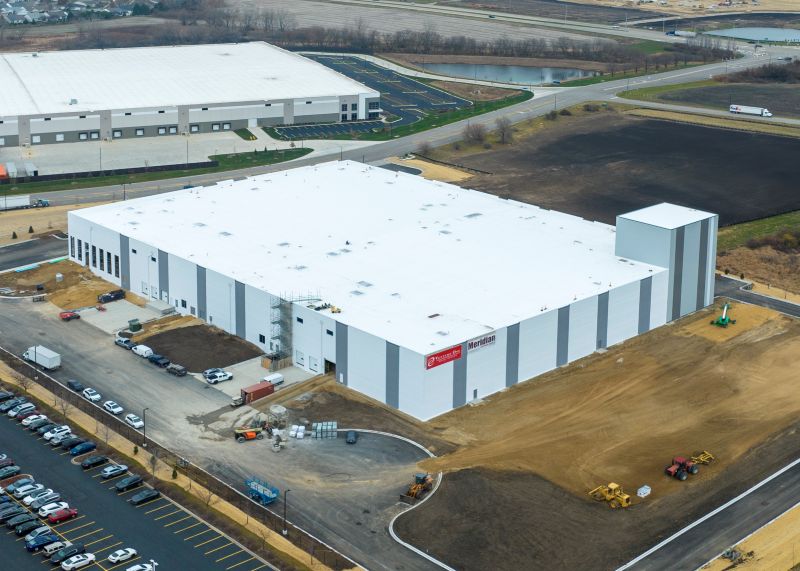
Meridian Design Build recently broke ground on a 130,000-square-foot production facility for Silesia Group at Huntley Industrial Park near the Interstate-90 interchange. The project will more than triple the global flavor manufacturer’s U.S. footprint while integrating research, manufacturing and warehousing operations in a single facility designed to serve customers across the Americas.
The Silesia Huntley project is being delivered through a phased design-build approach. Meridian is working collaboratively with Ware Malcomb to design and permit the various portions of the building in stages, allowing construction to begin while the requirements within specialized spaces such as laboratories, offices and food production areas were still being finalized. Brian Kling of Colliers International and Venture One Real Estate played a key role in helping Silesia make the determination that this approach best suited the needs of their project.
“The phase design/build approach allowed us to get the building up and enclosed while we worked with the client on the design and detailing of the office, laboratory and food production areas,” said Howard Green, executive vice president at Meridian Design Build.
For Meridian, the project reflects a broader shift in how construction teams are approaching complex projects as developers and corporate clients seek greater cost certainty and schedule control.
“We see an increasing number of developers and end users leaning into the design/build delivery method,” Green said. “The appeal of the design/build process is that it allows clients to compress project timelines and lock in guaranteed pricing early on in the process.”
The Huntley project reflects broader adjustments across the construction industry as developers and contractors work to manage cost pressures, labor shortages and shifting project timelines.
Across the Chicago region, construction firms such as PREMIER Design + Build Group say those challenges continue to shape how projects are planned and delivered.
“Developers are building larger contingencies into budgets to account for ongoing material price volatility, labor cost increases and unforeseen delays,” said James Smiley, senior vice president at PREMIER Design + Build Group. “The ‘just-in-time’ lean budgeting mindset has shifted toward more buffers to avoid cost overruns.”
Contractors across the Chicago market are also being brought into projects earlier in the planning process, Smiley said. Early collaboration between developers, designers and builders helps identify potential cost risks and explore value engineering options before construction begins.
“Contractors invest time upfront to develop detailed, line-item cost estimates based on current market data and local vendor pricing,” Smiley said. “Sharing cost breakdowns openly with clients builds trust and allows for collaborative decision making.”
In addition to cost management, labor availability remains a significant challenge across the construction sector. Smiley said the Chicago market continues to face shortages of skilled tradespeople in areas such as electrical work, HVAC installation and finish carpentry. Competition for experienced workers has pushed wages higher and can extend project timelines when crews are difficult to secure.
Permitting and regulatory requirements also contribute to longer schedules. According to Smiley, project timelines in some sectors have increased by as much as 10 to 20 percent compared with pre-pandemic norms due to labor constraints and material lead times.
In response, contractors are adopting strategies that prioritize efficiency and coordination. A growing number of developers are turning to design-build delivery. Under this model, a single team manages both design and construction, allowing project phases to overlap and reducing the risk of miscommunication between separate architects and contractors.
“Design-build allows for overlapping design and construction phases, which can significantly shorten overall project timelines,” Smiley said. “Owners seeking quicker occupancy or faster return on investment find this model attractive.”
Technology and prefabrication are playing a larger role in improving job-site efficiency, according to Smiley. Building Information Modeling, advanced project management software and mobile field technology help teams coordinate schedules, track costs and identify potential issues before they disrupt construction. Prefabrication of certain building components off-site has also become more common, reducing on-site labor requirements and helping projects move forward even when skilled workers are in short supply.
Strong demand in the industrial sector continues to support construction activity across the Chicago region.
“We’ve continued to see increased activity in both build to suit and speculative industrial construction over the last six to eight months,” Green said.
Contractors say collaboration and early planning will remain critical as market conditions continue to shift. As developers seek greater certainty around budgets and timelines, construction teams that provide integrated planning, transparent cost management and efficient delivery will play an increasingly important role in moving projects from concept to completion.