A rebound in large industrial occupancies helped push the U.S. industrial sector closer to recovery in 2025, a sign that demand for big-box logistics and manufacturing space is strengthening after several years of slower activity.
That’s one of the key takeaways from the March 10 Industrial Tenant Tracker report released by Colliers. The report shows that new leasing, build-to-suit completions and user purchases all contributed to a surge in bulk industrial occupancies — defined as spaces of 100,000 square feet or larger — during 2025.
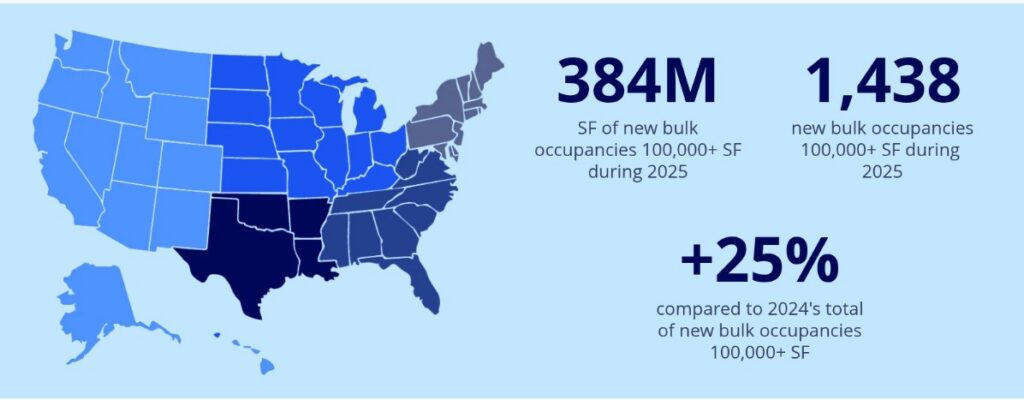
According to Colliers, industrial users moved into 384 million square feet of bulk space across the United States in 2025. That represents a 25 percent increase from the 307 million square feet recorded in 2024.
The rise in move-ins also helped lift demand, particularly in the second half of the year. Net absorption during the final six months of 2025 jumped to 118 million square feet, more than double the 57 million square feet recorded during the first half of the year. Even so, elevated move-outs limited how much those gains could boost overall market performance.\
Large facilities continued to play a key role in the market’s activity. Industrial users moved into 36 buildings of 1 million square feet or larger during 2025. More than one-third of those properties were build-to-suit facilities or buildings purchased directly by their occupants.
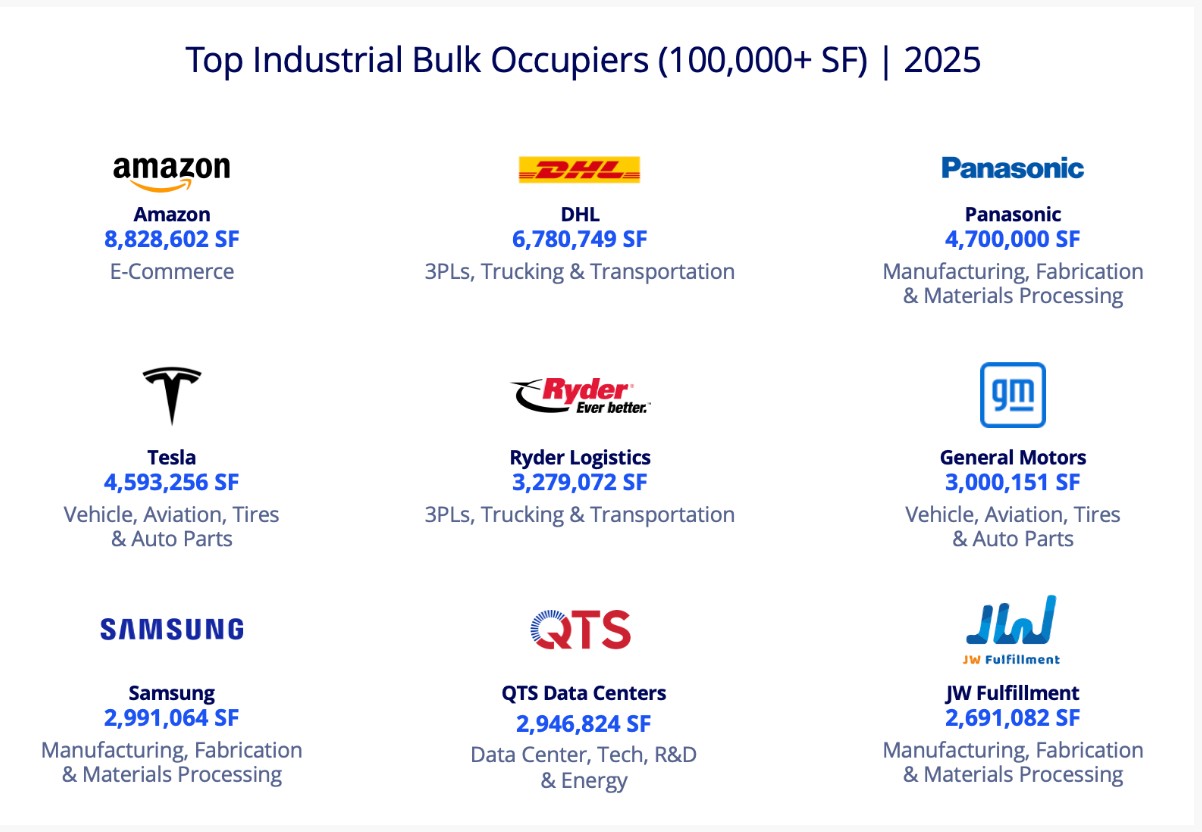
Several major advanced-manufacturing projects represented the largest occupancies of the year. These included a 4.7 million-square-foot electric-vehicle battery manufacturing plant developed by Panasonic in Kansas, a 2.8 million-square-foot battery facility developed by General Motors and LG Energy Solution in Michigan, and a 2.8 million-square-foot semiconductor manufacturing facility operated by Samsung Electronics in Texas.
While average deal sizes grew slightly, they remain below the levels seen earlier in the decade. The typical bulk industrial transaction measured about 267,000 square feet in 2025. That is up slightly from 2024 but below the 289,000-square-foot average recorded in 2023 and the 309,000-square-foot average seen in 2022.
Still, the number of individual bulk occupancies continued to climb. Industrial tenants moved into 1,438 large spaces in 2025, up from 1,160 in 2024 and 1,041 in 2023.
Regionally, activity varied across the country. The West recorded the greatest number of move-ins with 404 new occupancies totaling about 100 million square feet, a five percent increase from the previous year.
The Midwest, however, recorded the largest total volume of space absorbed. Industrial users occupied 105 million square feet across 363 move-ins in the region during 2025, a 53 percent increase from 2024 and the highest total of any region in the country.
The Northeast was the only region to record a decline in bulk occupancies, falling 22 percent year over year to 26 million square feet across 87 move-ins.
Activity increased across all building sizes during the year, but the strongest growth occurred in properties ranging from 500,000 to 749,999 square feet, where move-ins climbed 47 percent compared to 2024.
The greatest concentration of deals, though, remained in buildings between 100,000 and 199,999 square feet. Industrial users moved into 792 buildings in that size range during 2025, accounting for 108 million square feet of occupancy and a 23 percent increase from the previous year.
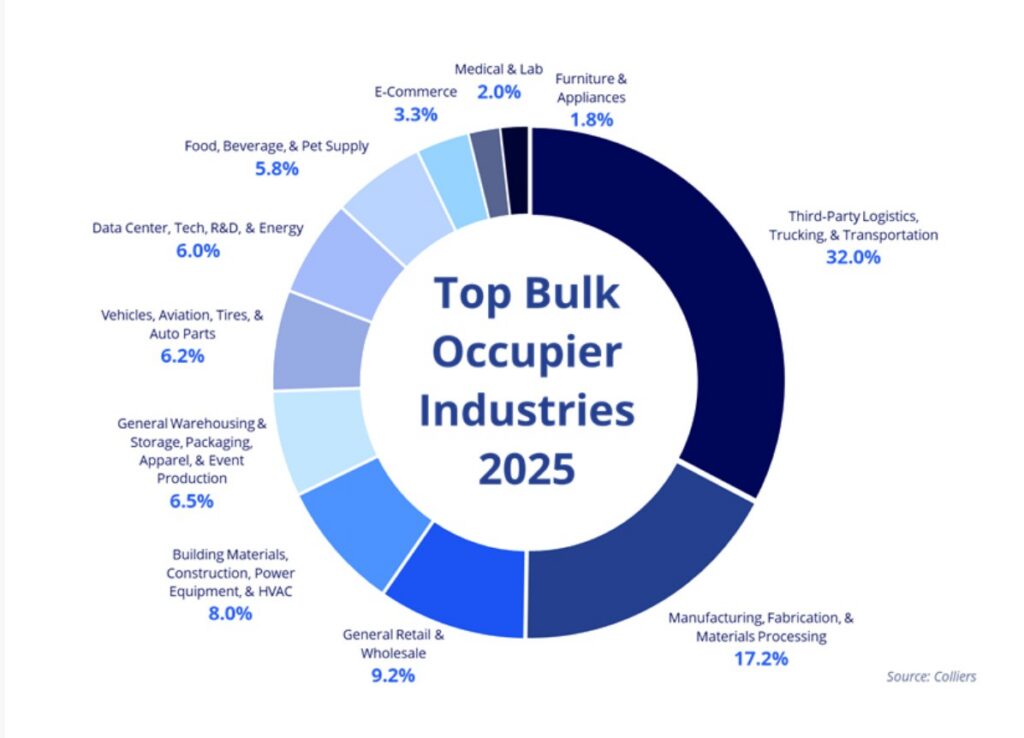
Third-party logistics firms and transportation companies continued to dominate large industrial transactions. These users accounted for roughly one-third of all bulk occupancies in 2025, occupying about 123 million square feet across 430 buildings. That total is up from 100.5 million square feet across 353 occupancies in 2024.
The category was especially prominent in the Northeast, where logistics and transportation firms represented 41 percent of all large industrial occupancies.
International logistics firms also continued expanding their U.S. presence. Asian-based third-party logistics providers accounted for 21 percent of occupancies within the logistics category since 2024, expanding their footprints to move closer to American consumers, reduce tariff and trade risks and strengthen supply chains near seaports and inland ports.
Manufacturing companies also boosted demand. Firms involved in manufacturing, fabrication and materials processing occupied 66 million square feet of bulk space in 2025, a 49 percent jump from the 44 million square feet recorded in 2024. More than 40 percent of that activity occurred in the Midwest, where manufacturers moved into 27 million square feet during the year.
Among individual companies, Amazon remained the largest new industrial occupier. The e-commerce giant moved into at least 20 large facilities totaling about 9 million square feet in 2025. However, its annual space occupancy has declined each year since 2022.
Global shipping and logistics firm DHL ranked second, occupying 11 facilities totaling about 6.8 million square feet.
Looking ahead, Colliers expects the recovery to continue. Increased leasing activity over the past several quarters should translate into more move-ins during 2026 as tenants take occupancy of recently leased buildings and newly delivered build-to-suit projects.
As the construction pipeline slows and the market stabilizes, new supply and tenant demand are expected to move closer to balance. That could also slow the pace of tenant move-outs and eventually push the national industrial vacancy rate downward after more than three years of increases.
While the pace of recovery will likely vary by market and region, the diverse mix of industrial users driving occupancy gains in 2025 could help sustain the sector’s momentum through 2026 and beyond.