When property owners or build-to-suit clients want to construct a building in Omaha or elsewhere in Nebraska, they typically follow the traditional three-step design-bid-build process. This process often results in competitive bidding and definitive separation between design and construction costs, but because it is so siloed, it also often results in a longer project timeline, a lack of collaboration and frequent change orders.
Design-build is an alternative construction approach in which the design and build phases are pursued simultaneously and managed by one partner. By streamlining these project phases, this approach maximizes efficiencies and minimizes costs without sacrificing structural performance and quality. The approach is lauded for delivering significant time and cost savings.
Omaha-based GreenSlate Development experienced the benefits of design-build for the first time after it prepared preliminary drawings for an industrial build-to-suit client who later changed plans and no longer needed the space.
Wanting to get a new speculative industrial/flex facility built on the site and filled as quickly as possible, GreenSlate put its drawings out for bid. But rather than hiring a general contractor as the company had always done, on the recommendation of a valued brokerage partner, GreenSlate hired development, design and construction leader Opus.

Mike Anthony, Director of Project Management, Opus
Trusting the unknown
“The idea of not just hiring a contractor to build our existing design was completely foreign to us, and, honestly, it took a significant leap of faith,” said Matt Dwyer, GreenSlate Development’s principal and founder.
But Opus did what general contractors can’t do. Prior to having a completed design, Opus provided GreenSlate with a guaranteed maximum price (GMP), and it was at a lower cost-per-square-foot than GreenSlate’s own construction estimate.
“That GMP really put our minds at ease and demonstrated Opus’ experience and expertise,” Dwyer said. “With a GMP, we knew we could secure the financing we needed and reduce our financial risk.”
Opus’ GMP included the architectural and structural engineering design for the facility. This gave Opus the opportunity to maximize efficiencies and significantly reduce costs through is integrated design-build delivery model. And as an added bonus to GreenSlate, this model eliminated the risk of change orders that can often arise as a result of conflicts between the design and construction phases of a project.
“Opus’ approach was compelling, but we didn’t want to walk away from our existing architect or the plans and drawings we’d already secured,” Dwyer said. “Ultimately, though, we recognized the value of giving Opus an opportunity to recommend changes that could deliver a significant return-on-investment.”
To that end, Opus and GreenSlate’s Omaha-based architect partnered on the project, which enabled Opus to operate as a design-builder, providing certainty of outcome to the development team.
Maximizing value
After studying the site plans and design drawings, Opus’ first course of action was to identify and propose an alternative soil mitigation solution.
GreenSlate completed the geotechnical investigation of the site prior to Opus joining the team. The preliminary report recommended 10 feet of surcharge soil above the finished floor elevation for a duration of six months. That recommendation, which in a typical design-bid-build scenario would have been followed without question, necessitated an additional four-plus months of settlement time. It also came with price tag of more than $4 million. Opus worked directly with the geotechnical engineer to evaluate different strategies, their costs and the impact to the overall settlement time.
Opus recognized that a faster and less expensive option existed, so it recommended, and GreenSlate approved, a soil mitigation alternative that leveraged wick drains, also known as prefabricated vertical drains. Opus had used wick drains on a prior project in the Omaha market with great success and knew they would perform well. The use of wick drains also requires less surcharge fill and shortens the required settlement time.
This alternative to the original geotechnical recommendation shaved four months off the project and, in part due to Opus purchasing the fill at a reduced cost from a nearby highway construction project, provided more than $2 million in cost savings to GreenSlate.
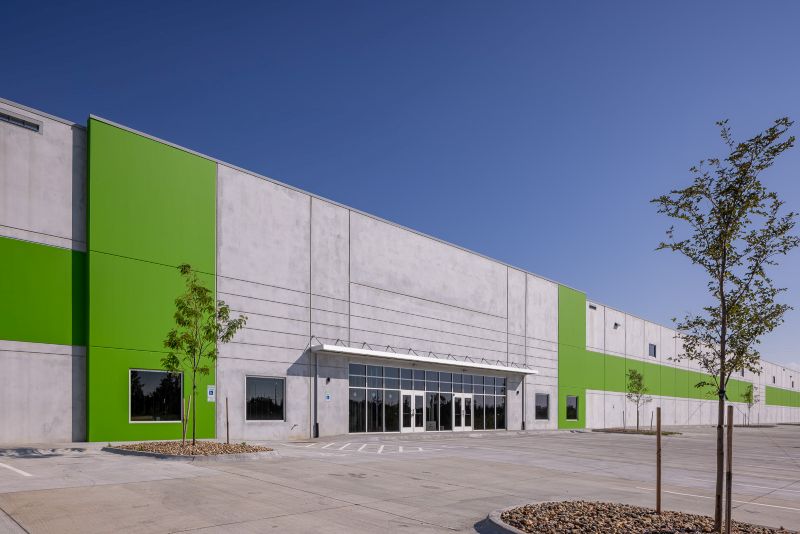
Once the soil issues on the site were mitigated, Opus’ next focus was on the site design. By splitting the storm water basins, Opus was able to make some modifications to the original building design. First, Opus flipped the building, moving the truck court to the rear, facing an adjacent facility’s trailer storage, and the offices to the front, with a view of the green space. This eliminated paving inefficiencies within the original plans and resulted in a 50,000-square-foot addition of leasable space to what was originally a 150,000-square-foot building. This added square footage significantly increased the value of the overall development.
Additionally, Opus incorporated clerestory glass on the now front (south facing) elevation to provide natural light, more welcoming entrances and improved exterior aesthetics. It also coordinated bay widths and building heights to optimize the steel framing while still providing two drive-in doors with the potential for two more and accommodating 13 dock doors with the ability to add up to 54.
An ongoing partnership
“I never could have imagined there was a way to expedite our timeline, add 30% more leasable space and secure a seven-figure cost reduction on this project,” said Dwyer. “Opus’ design-build framework delivered for us at every turn.”
In fact, GreenSlate was so pleased with Opus and its design-build approach that it hired Opus as the design-builder architect, and structural engineer of record on a parking garage GreenSlate was developing for the City of Omaha near the University of Nebraska Medical Center.
Said Dwyer, “Not only did we find the benefits of design-build to be incredibly advantageous, but we also found Opus to be a great partner. Their expertise, collaboration, communication, and professionalism are second to none. I anticipate we’ll be seeing more of them on future pursuits.”
Mike Anthony is director of project management with Opus and was responsible for securing and managing the Storz Warehouse project. He holds a Bachelor of Science in Civil Engineering from Iowa State University, a degree that gives him unique expertise in the design and construction of the built environment. He is a member of the Iowa Commercial Real Estate Association, the Design Build Institute of America Mid-American Region, and Master Builders of Iowa. Mike can be reached at [email protected].