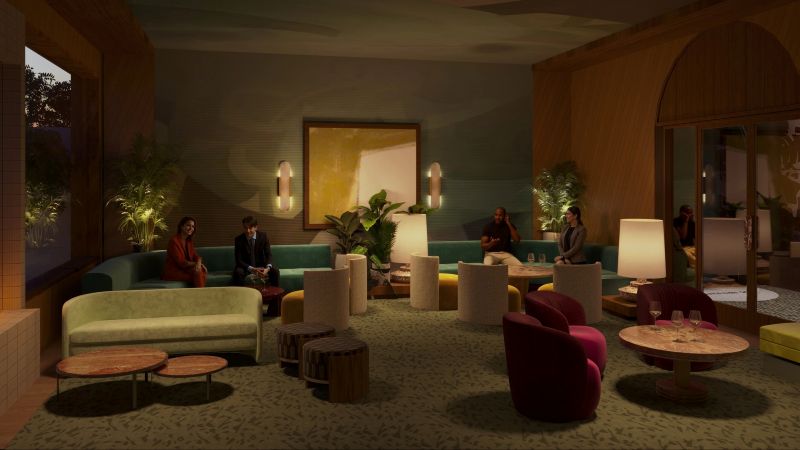
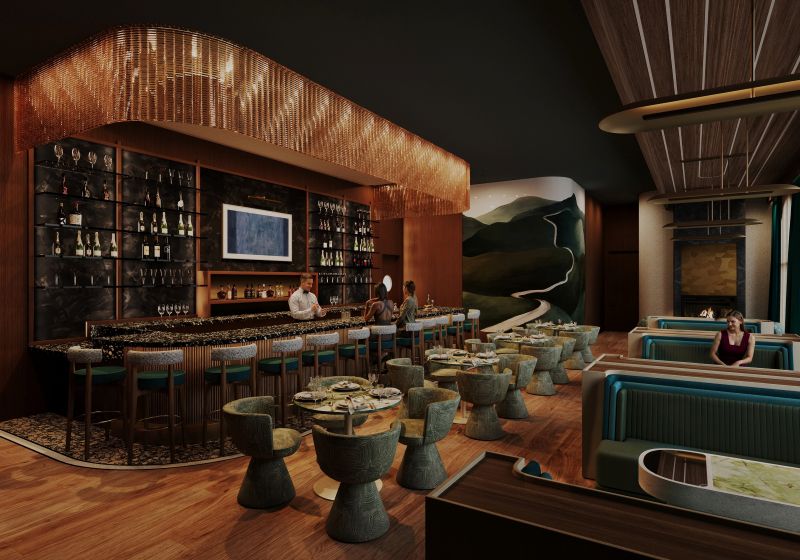
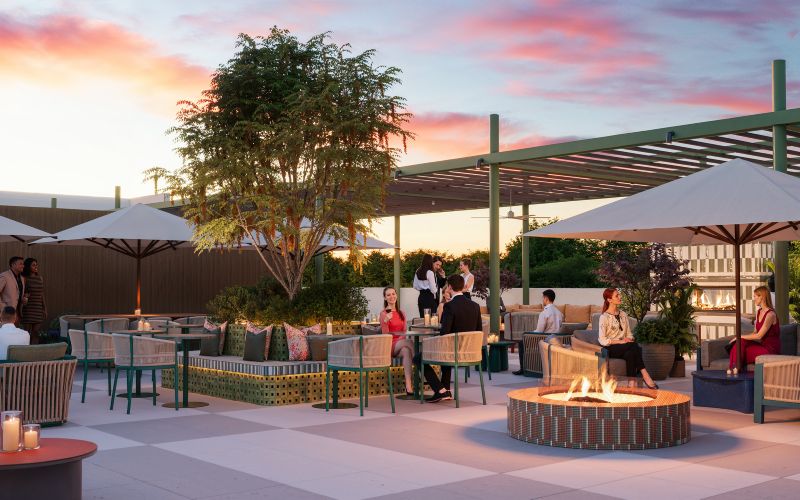
The announcement that 55 Seventy will build a 30,000-square-foot private wine club in Houston’s River Oaks-adjacent Upper Kirby district landed like a quiet declaration: luxury retail in Texas is evolving beyond handbags and flagship windows. 55 Seventy is selling exclusivity not just in brands but in atmosphere with 800-plus climate-controlled wine lockers, chef-driven fine dining, a sommelier-staffed wine-brokerage service and programming designed to make the space feel more like a social institution than a club.
“It really came down to the location and the chance to build something exactly the way we envisioned it,” founder Tommy Shuey said. “From the moment someone pulls into the parking lot, we wanted every detail to signal an elevated experience.”
More than just bottles lined up in perfect humidity, 55 Seventy aims to deliver ritual and refinement: chef-led dinners, wine broker-access to rare and allocated bottles, no corkage-fee cellars and an atmosphere calibrated for privacy, connection and indulgence.
“This area is right on the edge of so much exciting development,” said sommelier Jeff Gregory. “And for us, the point is to make wine feel approachable and fun, whether someone has a 20,000-bottle cellar or is just starting to get curious.”
That blend of exclusivity and approachability where serious wine meets social ease reflects a broader shift in Houston’s luxury retail posture. National brands from Hermès to Saint Laurent are expanding store footprints or fully remodeling because Houston now belongs among their top-performing US markets.
55 Seventy doesn’t just add one more “luxury” pin to the map. It says something about consumption in 2025: that luxury isn’t just about what you buy. It’s about how you experience, store, serve and socialize around what you value. Houston and other Texas metros are increasingly defined by experience-first retail that emphasizes belonging as much as branding.
Behind that shift is a Houston retail market with fundamentals that continue to support high-end growth.
“Houston’s retail sector in 2025 is tight, steady, and remarkably resilient,” said Sydney Dixon, First Vice President with CBRE. “Vacancy has been hovering in the mid-5 percent range across all asset classes and around 2 percent for Class A retail. This is historically low for a market this large, with positive net absorption and modest rent growth.”
Even as sales growth begins to normalize, luxury performance remains strong.
“Although we are generally starting to see a flattening trend in sales (which have been surging for the past four to five years), Houston sales for most luxury retailers tend to fall in the top 5 percent of all of their US locations,” said Crystal Allen, managing director of retail for Transwestern. “Houston remains a top tier destination for both luxury and aspirational brands to expand. These brands are highly sought after so they compare available location opportunities across all of their top tier target markets and from there they start filling in the pipeline.”
That demand is not just steady; it is reshaping the city’s luxury landscape.
“At River Oaks District, new entrants like Stefano Ricci and L’Agence have pushed occupancy to around 90 percent, and we’re seeing brands like Loro Piana relocate there from the Galleria to lean into the quiet luxury trend and a more boutique environment,” she said. “At the same time, the Galleria remains the powerhouse regional draw, with Gucci opening an expanded flagship and Balmain relocating its Houston flagship there.”
Allen said one advantage Houston holds over competing metros is its range of viable locations. As new opportunities open at established projects, brands can enter the market without waiting for ground-up construction. That flexibility, she said, is often the difference between securing or losing a luxury tenant.
Allen also ties Houston’s long-term resilience to the fundamentals behind it: a diverse economy, an international customer base and consistent population growth tied to the region’s major employment centers.
“Our major industries including energy, petrochemical and The Texas Medical Center among others all create a diverse population that is well educated, making fair wages across all income levels and supported by a comparatively lower cost of living,” Allen said.
It’s a combination that fuels steady demand for luxury goods, reinforces reinvestment from global brands and creates the environment for experiential concepts like 55 Seventy to thrive. That same logic is now shaping how Houston’s most successful retail districts are designed and operated.
“The most successful owners have leaned aggressively into placemaking and programming rather than just building more shops,” Dixon said. “The goal is to give consumers multiple reasons to visit beyond a single purchase, whether that’s dining, events, wellness or green space, and to make these districts feel like the living room of their submarket.”
Houston’s luxury strength isn’t isolated. Dallas continues to anchor the state’s highest concentration of high-end brands, strengthened by steady household income growth and a retail availability rate below 5 percent. The most recent Dallas retail report shows positive absorption, strong leasing in neighborhood and community centers and sustained demand for premium space in submarkets like West Plano, Central Dallas and North Dallas.
The result is a market that blends legacy luxury icons at NorthPark and Highland Park Village with rapid expansion into suburbs like Frisco, Allen and Plano, where household incomes and planned communities support aspirational tenants. Dallas may not be adding significant new retail square footage, but it doesn’t need to. Its strength comes from density, spending power and stability.
Where Houston and Dallas succeed by scale and spending power, Austin succeeds by vibe and national brands have taken notice. Availability sits at 3.7 percent, one of the lowest in the state, yet the market recently posted negative absorption for the first time since 2020. Even with that cooling, retail rents remain high and lifestyle centers like Domain NORTHSIDE, South Congress and downtown’s 2nd Street District continue attracting brands that blend design, dining and culture. Austin consumers expect experience as part of the purchase and developers respond with outdoor space, hospitality features and event programming that give retailers more than a storefront.
San Antonio doesn’t have the luxury concentration of Houston or Dallas, but its fundamentals remain strong. The latest report shows a 4.3 percent vacancy rate, steady net absorption and more than 1.4 million square feet under construction. The city’s retail health is rooted in stability. Big-box refreshes, fitness concepts and neighborhood service retail drive activity, but mixed-use projects near the Pearl and Broadway corridor are laying groundwork for more premium tenants.
In the Rio Grande Valley, the retail landscape is shifting in ways that mirror larger statewide trends while also standing apart. McAllen, long known for cross-border shoppers with high discretionary income, is now seeing that spending power translate into interest from more premium and aspirational brands.
“Retail in the Rio Grande Valley is incredibly vibrant right now,” said Rebecca Olaguibel, the city’s director of retail and business development. “We’re seeing a strong blend of local entrepreneurship, national brands expanding their footprint and international shoppers who continue to view McAllen and the region as their preferred retail destination.”
That consistent demand is backed by rising household incomes, population growth on both sides of the border and record-breaking sales tax allocations. Olaguibel said the retail sector is benefiting from industrial expansion as well, with logistics, warehousing and port activity bringing new workforce, suppliers and corporate travel that spill over into hospitality and retail.
The region is also entering a new retail chapter driven by consumer sophistication. Olaguibel said developers are responding with intentional design choices that prioritize walkability, shade, elevated architecture and public spaces tailored to both local shoppers and international visitors.
“The data tells the story: spending patterns in McAllen and across the Valley already reflect a strong appetite for premium and aspirational brands,” Olaguibel said.
Those spending patterns, paired with a supportive local business climate, have made the Valley a more compelling long-term bet for retailers and investors who may have previously overlooked the market. One of the clearest examples of that shift is the Boeye Reservoir Redevelopment, a 30-acre urban infill project that McAllen is positioning as a master-planned district blending housing, retail, hospitality, recreation and public space. The city has opened the RFP and is seeking a development partner who can elevate the site into a destination for residents, visitors and cross-border shoppers. Boeye sits in a prime central location with strong demographics and flexible development potential, supported by city-backed infrastructure planning and a unified long-term vision. For developers looking for scale, visibility and return on investment in the Valley, it represents one of the region’s most significant opportunities.
“The RGV is no longer a ‘border market’ — we’re a binational economic region with momentum, sophistication and a strong identity,” Olaguibel said. “Retailers who invest here quickly realize the loyalty of our consumers and the strength of cross-border purchasing power.”
Across Texas, luxury retail is expanding, but not uniformly. Houston leads with experiential concepts like 55 Seventy that layer hospitality onto high-end spending. Dallas leans on scale and steady affluence. Austin attracts curated, design-forward brands. San Antonio builds on stability and long-term growth. McAllen stands out as an emerging market where cross-border spending and rising incomes open the door to new possibilities. It adds up to a statewide retail market where luxury is evolving, adapting and finding its place in every corner of Texas.