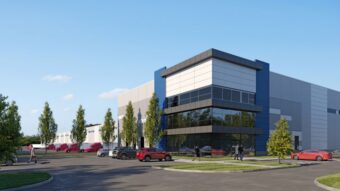
The former Caterpillar heavy equipment site in Will County will soon hum with a different kind of production. Hyundai Translead, the North American trailer manufacturing arm of the South Korean automotive giant, committed earlier this year to a $450 million investment that will spread across two Will County facilities including the previous Lion Electric operation site and create nearly 2,500 full-time jobs.
The deal closed in March and stands as one of the most consequential manufacturing announcements in the region in years. It is also the latest data point in a larger story: reshoring is not a series of headline-grabbing one-offs in Chicagoland. It is a structural shift and the activity on the ground is broad-based, sustained, and increasingly shaping how developers, brokers and policymakers think about the region’s industrial future.
“A regional production and distribution hub …”
Jeff Lanaghan, Senior Vice President of Development and Investments at Becknell Industrial, has been developing in Chicago for three decades. From his vantage point, reshoring has not redirected demand toward emerging markets so much as reinforced what Chicago has always done well.
“Reshoring has reinforced Chicago’s role as a regional production and distribution hub, rather than shifting demand elsewhere,” Lanaghan said. “We’ve seen manufacturers favor strategic infill and near-infill locations that enable just-in-time delivery, supply-chain redundancy and labor access close to existing operations.”
The data backs the observation. Chicago posted nearly 10 million square feet of new industrial leasing in the first quarter of 2026 alone, according to Lanaghan, keeping the region among the top U.S. markets for absorption. The momentum has policy roots as well as economic ones. Mark Denzler, President and CEO of the Illinois Manufacturers’ Association, pointed to a combination of federal and state forces driving the shift.
“Tariffs are also playing a role as well as other policies from the last two federal Administrations focused on increasing domestic content in manufactured products,” Denzler said. “Additionally, Illinois has revamped its economic toolbox annually for the last seven years to make it more competitive with other states.”
“From ‘considerations’ to gatekeepers …”
The operational requirements that come with reshoring tenants are reshaping how buildings get designed and how site selection conversations unfold. Power has emerged as the single biggest filter.
“Power and water availability have moved from ‘considerations’ to gatekeepers for many manufacturing users,” Lanaghan said. “This mirrors national reshoring trends, where advanced manufacturing, especially electronics, batteries and food production, requires dramatically higher power loads and utility coordination.”
That gatekeeper status has been compounded by the simultaneous boom in data center development. Ben Dickey, Vice President at Stream Realty Partners, noted that ComEd continues to build new substations to support data center growth, which has extended lead times for power procurement across the board. Manufacturers, whose load requirements run far heavier than a typical industrial occupier, often cannot wait. Developers have responded by boosting power capacity on speculative buildings to capture tenants whose project timelines or expiring leases will not accommodate a fully customized build. EV charging infrastructure for fleet electrification has joined the list of standard manufacturer asks, particularly for users with private and captive fleets.
The submarket map
Where the activity is landing tells its own story. The I-80 corridor has captured the largest manufacturing commitments because of its proximity to the UP and BNSF intermodals with the Hyundai Translead Will County deal as the most prominent recent example. Dickey also pointed to I-88, the Fox Valley and the I-90 Elgin market as submarkets with available land suited to specialized build-to-suit projects.
The I-290 corridors, both north and south, have quietly remained a magnet for manufacturers despite older building stock. The buildings tend to be less functional for distribution users but carry the power infrastructure manufacturers need, often at lower cost. That power-rich, lower-basis combination has kept those corridors competitive even as newer product has reshaped expectations elsewhere in the region.
“Flow through Chicago …”
When Chicago competes successfully against Indiana, Texas or the Carolinas, it tends to win on a combination of geography, labor and multimodal infrastructure that competing markets cannot replicate at scale.
“Hyundai Translead and others come to the state for its dense population of skilled labor pulled from its almost 10 million residents,” Dickey said. “Given its central location in the United States, Chicago boasts the largest inland port in the country in Joliet and Elwood, serviced by UP and BNSF. Product and raw material flow through Chicago from all parts of the country, which allows retailers, distributors and manufacturers alike to save on transportation costs when locating in the Chicago market with access to the intermodals.”
The freight numbers reinforce the point. Roughly 25% of all U.S. freight trains and 50% of intermodal traffic pass through the region, according to Lanaghan, a multimodal advantage that anchors Chicago’s case for manufacturers serving national and regional markets.
The labor depth is the other side of the equation. Manufacturing employs 650,000 workers across Illinois and contributes the single largest share of the state’s economy, Denzler said. Site Selection Magazine recently ranked Illinois the top state in the Midwest and third nationally for workforce development and the state’s investment in the talent pipeline has been deliberate.
“Illinois has made consistent investments in our education and workforce system to help create a 21st century workforce,” Denzler said. “The Illinois Manufacturers’ Association has successfully championed creation of new world-class manufacturing academies at Heartland College and Southwestern Illinois College, a new apprenticeship tax credit, dual credit programs and increased dollars for worker training.”
The same Site Selection ranking placed Illinois second nationally for corporate expansion four years running, with Chicago holding the top metro spot for 13 consecutive years.
“The challenge businesses face …”
For all the structural advantages, the obstacles are real and well-documented by the people closest to the deals. The single biggest drag, in Dickey’s assessment, is taxation.
“Illinois’ corporate income tax is 9.5%,” Dickey said. “Wisconsin comparatively has a flat corporate income tax rate of 7.9%; however, they have an incentive for manufacturing that brings the effective tax rate to 0.4%. The challenge businesses face is planting a manufacturing flag in Cook County, where the skilled labor is dense, but the property taxes are typically two times those of their neighboring counties.”
Denzler echoed the concern from the policy side, citing high property taxes, pension debt, regulatory burdens and rising energy costs tied to baseload power closures. Those challenges remain the central friction in an otherwise compelling pitch and they are the variable most likely to determine whether marginal projects choose Illinois or a neighboring state.
What comes next
The structural advantages drawing reshoring projects to Chicago are too significant to ignore, even with the policy friction factored in. The competitive question is whether municipalities can keep pace with the speed manufacturers now expect.
“The city competes best when municipalities offer speed, certainty and collaboration,” Lanaghan said. “We’ve seen numerous Illinois communities successfully offset higher costs with business-friendly incentives and streamlined entitlements, making projects competitive with Indiana and the Sunbelt.”
That, more than any incentive package, is the real test ahead.