You’ve heard it all before. The rise in construction material costs, coupled with material and labor shortages and rising interest rates, continue to plague the market, leaving businesses no choice but to find a creative and mutually beneficial workaround.
Though many look forward to the dissipation of these challenges, it’s unlikely that will happen any time soon. Krusinski Construction Company President Jeff Krusinski said that the “when” is yet to be determined, but for now, despite it all, the numbers have yet to trend backward.
Teamwork is a big part of the solution. Developers and contractors are taking a more collaborative approach versus a design/bid/build approach and reaching out to builders much earlier to include them directly, in an effort to handle things like cost and schedule implications and long-lead times. Companies like Krusinski Construction are also trying to lock in pricing and schedule slots to the best of their ability well before drawings are completed — and in some cases, before they’re started — to get ahead of it.
But how much development is taking place, considering the lack of available land? Redevelopment of infill is just one solution that’s been quick to gain traction, according to Krusinski.
“Developers, when doing an infill redevelopment, are maximizing the FAR and getting as much building footprint on those sites as they can. This is not out of the norm, but conversely, the further out you go, there doesn’t seem to be as much interest in maximizing that ratio because they’re building flexibility for auto and truck parking to please a larger market, specifically e-commerce and businesses with more employee needs. A lot more of the site is being left open.”
It is also increasingly important to meet the needs of clients in terms of building features. For one, 40-foot clear height is the new standard on every building. The slab and the roof are also among the most important to give attention to, Krusinski said. Developers are trying to account for every kind of tenant that might move into a spec building.
“There are a lot of systems out there, and with the lead times we’re experiencing now, it’s important to get aligned with a manufacturer very early on.”
And because users are heavily dependent are on technology, new construction is built smarter and smarter — even though it comes with a higher price tag.
Redevelopment continues to be a trend due to the lack of available land around Chicagoland. Companies have no choice but to take advantage of unused property. Still, Krusinski said clients haven’t seized to ask if there’s available land.
“A lot has been picked through over the years, and we’re finding that land that was not suitable to build on fifteen to twenty years ago is now being developed due to those being the last remaining parcels,” Krusinski said. “There may be challenges that require additional attention from a geotechnical or structural standpoint, and will therefore cost more money, but there are few alternatives.”
For those not wanting a fixer-upper, there is another option to be considered: multistory.
Krusinski has seen a heightened interest in this, and has even budgeted it for certain clients, but the current multistory being developed is the only one so far to pull the trigger in Chicagoland. Why? The cost, mostly. To build even a single component of it, like rooftop parking, is a no-go for any company without a massive budget. Developers are therefore looking at what their rent yield can be to account for that in their pro-forma.
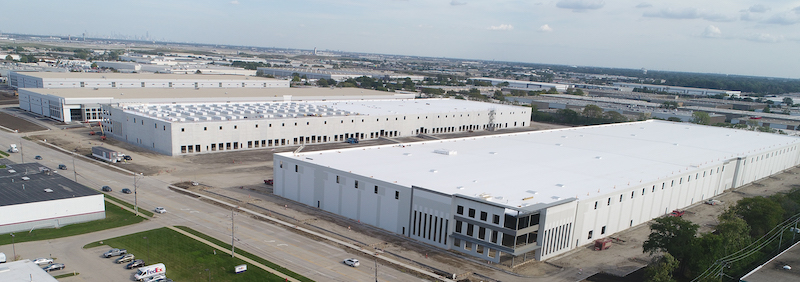
For now, Krusinski has several other projects in the works. The company has recently torn down a subdivision near O’Hare to build a four-building, 1,264,353-million-square-foot industrial park in Bensenville, Illinois, in partnership with ML Realty and Prologis.
The bottom line for construction? Pricing may continue to escalate in the near term, but the pace of the increase will likely begin to decline as production returns to normal. The pipeline for new projects is also expected to remain strong throughout the foreseeable future, regardless of continued challenges.