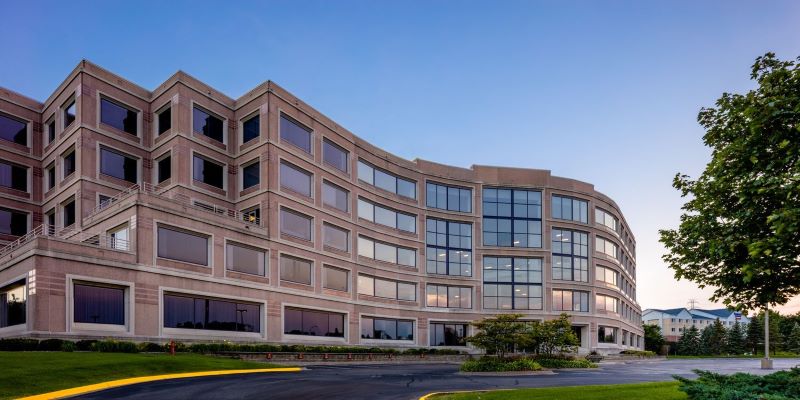
A bit of a rebound? Yes. But plenty of remaining challenges, too. That’s the state of the Minneapolis-St. Paul office market entering the fourth quarter of the year.
Avison Young recently released its third-quarter Minneapolis-St. Paul office report. And the news from the report was decidedly mixed.
But in an interview with Minnesota Real Estate Journal, two CRE professionals with Avison Young said that not all office space in the Twin Cities is performing equally. Newer properties filled with amenities? They are doing well.
It’s why Tate Krosschell, principal and managing director with the Minneapolis office of Avison Young, said that there are plenty of opportunities for developers willing to buck the trend and add new, high-quality Class-A office space to the Twin Cities market.
“The flight to quality is a long-term trend,” Krosschell said. “Companies are looking for ways to encourage their people to come back into the office. Giving them better office space is one strategy.”
Many companies are also leasing a smaller amount of square feet but in higher-quality office properties, Krosschell said. This way, they can provide their workers with more attractive and comfortable office space while not spending much more than if they were renting more square feet in a less expensive property.
“As we mention in our report, there is a clear divide between which office properties are seeing activity and getting leased and which are not,” Krosschell said. “New or recently renovated space is performing better. There is a huge opportunity here for landlords to elevate their buildings to compete and be in contention for more tenants moving forward.”

Tate Krosschell (Photo courtesy of Avison Young.)
A positive sign
Demand for office space in the Minneapolis-St. Paul office market rebounded in the third quarter after a weak second quarter, with leasing activity up more than 58% when compared to the second quarter of 2024, according to Avison Young’s report.
The problem? Leasing volume remains down 28% through the first three quarters of this year when compared to the same period in 2023.
Again, though, not all office properties are seeing the same struggles. An example? When comparing the first three quarters of 2024 to the first three of 2023, office leases of under 10,000 square feet grew from 37.9% to 48.6% of sector transaction activity.
Larger offices are experiencing more leasing struggles today, according to Avison Young. Office leases of more than 100,000 square feet decreased from 22.8% to 11% of transaction activity during the first three quarters of this year when compared to the same period in 2023.
Newer office properties remain in higher demand, too, as Krosschell emphasized. Avison Young reported that Minneapolis-St. Paul office buildings built after 2010 experienced a 16.5% decrease in availability, falling from 37.9% in the first quarter of 2020 to 21.4% in the third quarter of 2024.
In contract, the availability of office properties built before 2010 has increased from 14.5% in the first quarter of 2020 to 22.11% in the third quarter of 2024.
That’s yet more evidence that that the flight-to-quality trend is not only very real but is still happening.
“In our report, it is clear that we are seeing the office sector perform in a segmented manner,” said Joseph Stockman, market intelligence analyst with Avison Young. “The high-quality and well-positioned assets are driving any increases in leasing activity.”

Joseph Stockman (Photo courtesy of Avison Young.)
Stockman said that the Minneapolis-St. Paul market is far from a rarity. This trend is playing out across the country, he said.
“The segmentation of the market is becoming a prevalent theme,” Stockman said. “Companies want to move into higher-quality office space.”
Krosschell pointed to office properties such as North Loop Green, RBC Gateway and 10 West End, all of which are seeing high levels of leasing activity. All three properties are newer and highly amenitized. They are also located in busy areas that feature plenty of restaurants and retail.
“North Loop Green and RBC Gateway had a ton of pre-leasing,” Krosschell said. “By the time they delivered, they were at least half full. They are also getting higher rental rates. It points to that flight to quality. People want to be in the newest buildings.”
And for brokers looking for a bit of hope in the office sector? Avison Young reported that the number of office job postings is rising. Avison Young said that job postings in office-using industries increased in August of this year to 6.7% higher than January of 2023 levels.
What about the older office properties?
But what about those older office properties? What will happen with Class-C office space in the Minneapolis-St. Paul market?
“That is the million-dollar question,” Krosschell said. “What happens with the space that might become functionally obsolete? I believe that obsolete buildings will be taken off the market. There is always a need for true value space for tenants that don’t want to pay Class-B or -A rents. But I do think we will see properties taken off the market if they become obsolete.”
Some older office properties might be converted to other uses. But conversions don’t work for all buildings. That’s why Krosschell says that some older office properties might be razed. Developers can then start over with a new use, such as multifamily, on that now vacant land.
“The land becomes more valuable than the property at that point,” she said.
Krosschell said that while the Twin Cities office market does face challenges, it’s been largely resilient, too. Vacancy rates here could be even higher. Krosschell points to the high number of Fortune 500 companies with a presence in the market as one reason for the sector’s resiliency when compared to other large markets.
Minneapolis-St. Paul features a vibrant downtown, too, with plenty of entertainment, shopping and dining options. This is attractive for companies looking to locate in a metropolis that offers plenty to do for their employees.
“When people move here, they tend to want to stay here,” Krosschell said.
Avison Young has developed a tool to measure how busy CBDs across the country are today, its Office Busyness Index. Stockman says that this tool evaluates cellphone and GPS tracking technology to determine visitation levels in central business districts.
Stockman said that traffic in in the CBDs that Avison Young tracks stands ats about 60% of where it stood pre-pandemic. In Minneapolis-St. Paul, that figure stands at about 50%, above markets such as Seattle and Jacksonville, Florida, but below many others.