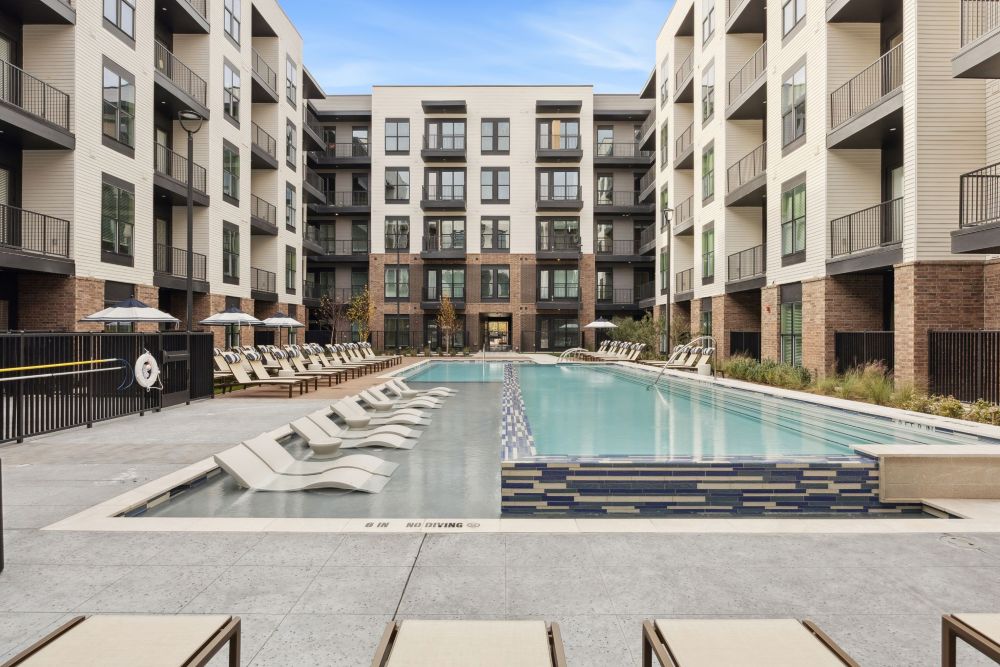

For the first time since the delivery wave crested, Dallas-Fort Worth renters are filling apartments faster than developers can open them. The metroplex absorbed roughly 8,500 units against about 7,500 deliveries in the first quarter, according to Chad Colley, Multifamily & Mixed-Use Partner at Trademark Property Company, and the pipeline of units under construction now sits about 43% below its 2023 peak. The recovery, though, has not reached every corner of the region.
“It’s two different markets wearing the same name,” Colley said. “If you own a stabilized asset in an infill location, 2026 has been a decent year. If you’re finishing a lease-up in a suburb that absorbed 4,000 units in 18 months, you’re still grinding.”
The demand side of that equation is not in question. DFW absorbed nearly 7,000 more units than the second-place U.S. metro in the first half of the year, according to Greg Toro, Senior Managing Director of Capital Markets at JLL, and occupancy is up nearly a full point over 2025.
“There is no lack of investor interest in DFW,” Toro said. “Our population continues to grow faster than any other metro and the local economy has evolved into one of the top places to do business in the nation.”
Even so, lingering supply in certain submarkets, interest rate volatility and geopolitical conditions have the metro on pace for lower transaction volume this year, Toro said.
The dividing line runs through the submarket map. Uptown Dallas, which managed only slightly positive rent growth as of mid-2025, has averaged increases above 4% over the trailing 12 months, Toro said, while intown Fort Worth has swung from years of declines to gains of nearly 3%. Denton, still digesting its share of the supply wave, has posted 6% to 7% rent declines in each of the last two years but is beginning to move in the right direction.
Colley, whose firm is bullish on Fort Worth’s urban core and the Dallas neighborhoods inside the loop, said Fort Worth’s outperformance is structural. The city never took on the construction concentration that northern Collin and Denton counties did, he said, and occupancy in Trademark’s submarkets is running in the low 90s.
Concessions follow the same geography, with six to eight weeks of free rent standard in North Fort Worth and northern Collin County, according to Colley.
“Metro-wide, roughly 60 percent of communities are giving something away, the highest share since 2020, but that number hides more than it tells you,” Colley said. “A stabilized asset running a look-and-lease special is not the same animal as a new delivery handing out two months free.”
In the submarkets that have finished absorbing, he said, the burn-off has begun and net effective rents have stopped falling.
The supply picture explains the optimism. Units under construction across DFW have fallen from about 42,700 entering the year to roughly 30,200, Colley said, with new starts few and far between. Toro expects deliveries, which reached 42,000 units in 2024, to be cut in half again in 2028 and 2029. The construction math leaves little room for a quick reversal: a podium deal in Dallas takes 24 to 30 months from groundbreaking to first units, Colley said, so any project not financed and in the ground by early 2027 will not deliver until 2029.
That scarcity is an opportunity for developers who can get capitalized today, but Colley warned that the window comes with a lesson attached.
“If capital gets comfortable all at once in late 2027, we will rebuild the exact same problem for 2029 and 2030,” he said. “Discipline has to hold on the way up.”
Capital, for now, remains the constraint. Kevin Hickman, Principal with High Street Residential in Dallas, is feeling it most on the equity side.
“What has been most surprising is the extent to which capital availability has tightened compared to expectations coming into the year,” Hickman said.
Securing equity for new developments remains difficult, he said, and project underwriting standards continue to be more restrictive than many expected.
Construction lending carries similar friction. Banks are still in the market but selective, Colley said, with leverage reset from 65% or better loan-to-cost in 2021 to 55% to 60% today, usually with recourse. Agency lending is the healthy end of the market: FHFA raised the 2026 caps to $88 billion each for Fannie Mae and Freddie Mac, up about 20% from last year, with workforce housing sitting outside the cap and quotes starting in the low 5s, according to Colley.
On the investment sales side, lenders are eager and well capitalized, Toro said, which has made refinancing the biggest competitor to the sales market. Owners who have not gotten the outcome they wanted from a marketing effort are taking shorter-term financing with flexible prepayment options, he said.
None of it has stopped the projects already in motion. High Street Residential has five multifamily communities totaling 1,720 units underway, plus a 102-unit for-rent townhome project in Allen, Hickman said. First units at the 425-unit Avina at the Grove in Frisco were delivered the week of July 20, first units at the 434-unit Crestview Heights in Allen are expected Aug. 13, and the 186-unit Lora in Dallas is scheduled to deliver by the fourth quarter. Avina Richardson and Mockingbird Station in Dallas follow in 2027.
Trademark opened The Vickery, a 321-unit community at 700 West Vickery Blvd. in Fort Worth, in June alongside SCOA Real Estate Partners, and Colley said traffic has run ahead of what the firm underwrote. Trademark breaks ground on The Madeleine in Uptown this October.
On the sales side, Toro pointed to Maple Terrace.
“It is the first trophy asset marketed in Dallas in nearly three years and has already attracted immense attention in the first few days of marketing,” Toro said.
The property sits along Maple Avenue, a corridor that has drawn some of the market’s most significant recent development and will house Morgan Stanley’s new campus, he added.
Toro expects second-half transaction volume to outpace the first half, with his team alone hired on roughly $750 million of transactions hitting the market now or in the immediate future. Colley expects metro-wide rent growth to turn positive year over year by the fourth quarter, though he called construction cost the biggest risk, citing steel mill products up better than 20% year over year and tariffs adding $15 to $25 per square foot on steel-intensive mid-rise product.
For a metro that has spent two years working through its own ambition, Colley argues the cycle deserves a kinder read than it usually gets.
“We added over 120,000 people last year, which is close to adding a city the size of Denton every twelve months,” he said. “The correction was a supply story, not a demand story, and supply stories resolve.”