Industrial occupiers continued to build momentum in the first half of 2026, supported by an uptick in new leasing, strong build-to-suit development, and user purchases, according to Colliers‘ September Industrial Tenant Tracker.
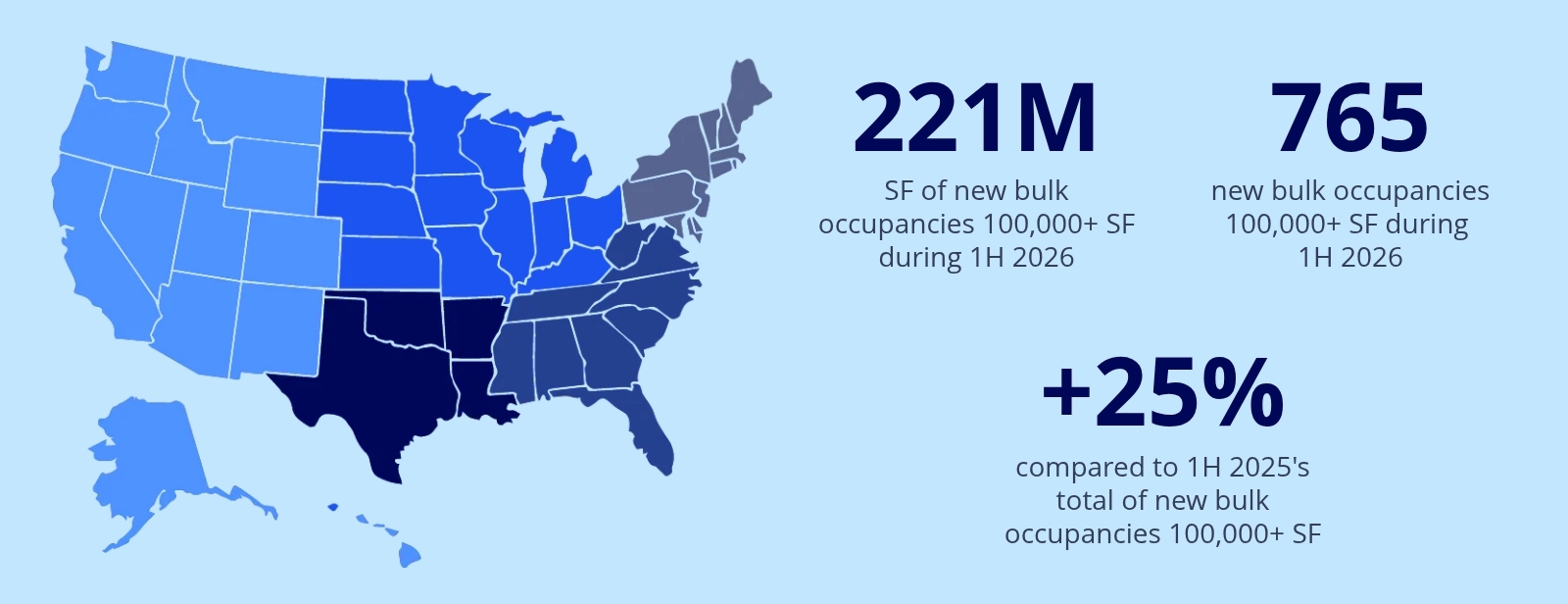
New bulk industrial occupancies of 100,000 square feet increased to 221 million square feet through June, 25% higher than 177 million square feet during the same period last year. Demand, as measured by net absorption, was even more impressive at 108 million square feet, 82% higher than 60 million square feet in the first half of 2025.
Together, these gains indicate that the industrial market has moved beyond the post-pandemic slowdown, with tenants resuming expansion plans and absorbing available space at a faster pace.
Users moved into 26 buildings of 1M SF or larger in the first half of the year, nearly double the 15 new occupancies during the same period last year. More than one-third of these move-ins were build-to-suit facilities or user purchases, with activity concentrated in the West, Southeast, and Southcentral regions. Third-party logistics (3PL) providers, manufacturing, and building materials and construction companies accounted for most of these transactions. The largest included electric vehicle manufacturer Hyundai SK’s move into its $5 billion facility in Kingston, GA; Jabil’s purchase of a 1.5M SF building in the Memphis market to manufacture large-scale cooling systems for data center infrastructure; and Tesla’s occupancy of a 1.5M SF build-to-suit facility in Sparks, NV.
The average transaction size has begun to increase, reaching 288,855 SF for new bulk occupancies during the first half of 2026. This was up from an average of 267,000 SF in 2025, although it remained below the 2022 average of 309,000 SF.
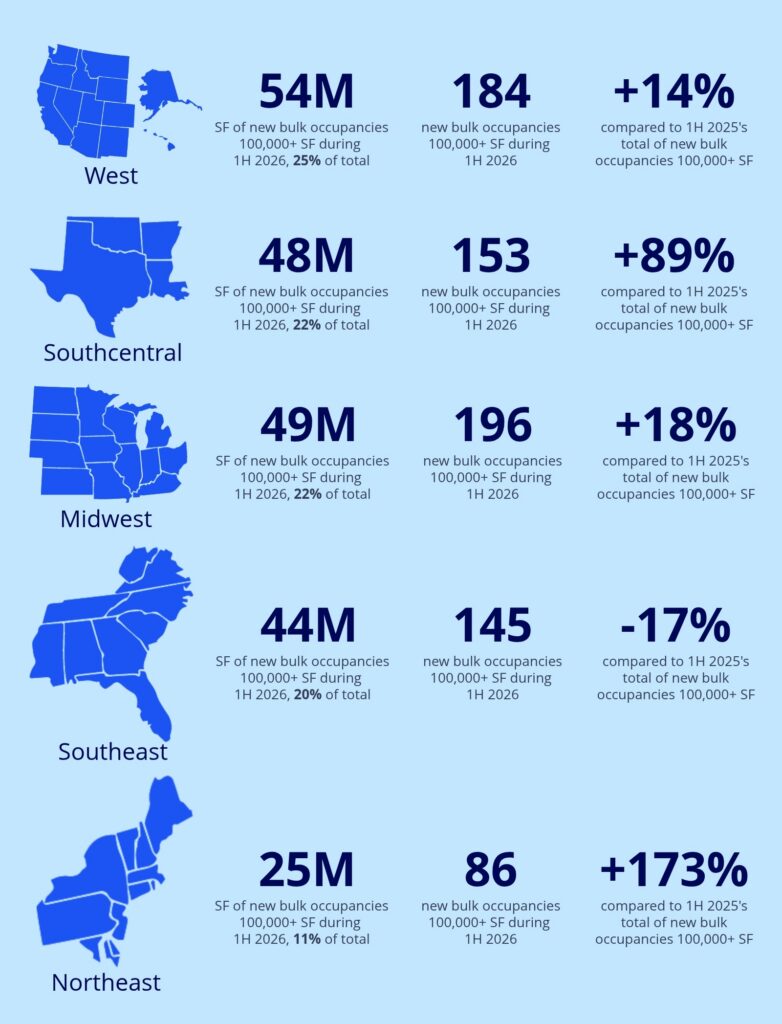
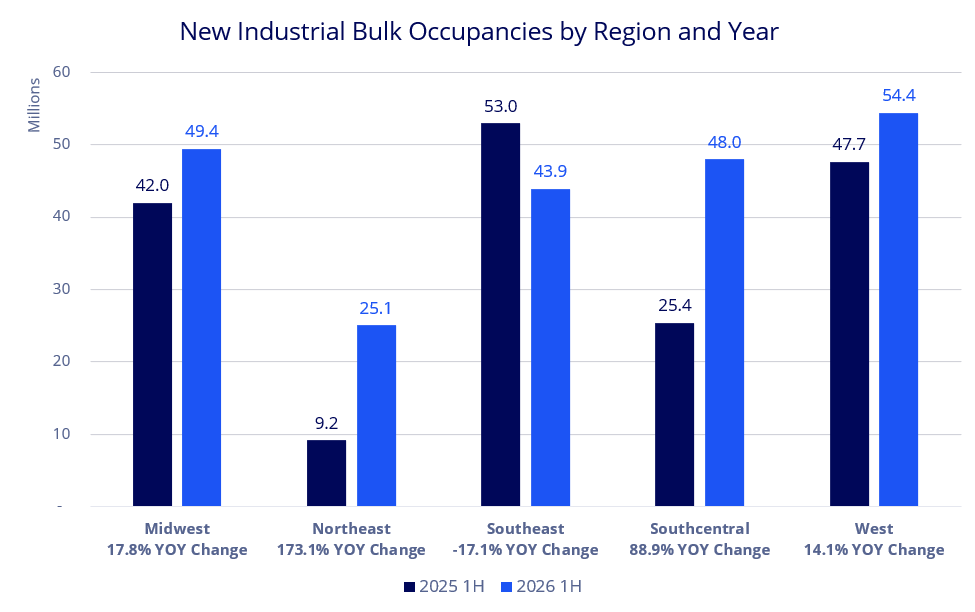
The Midwest recorded the most bulk move-ins during the first half of 2026, with 196 occupancies totaling 49M SF, an 18% increase from the same period last year. The West led in volume, with 184 occupancies totaling 54M SF, up 14% year over year. Growth was strongest in the Northeast, where occupancy volume surged 173% to 25M SF across 86 move-ins. The Southeast was the only region to record a decline, with volume falling 17% to 44M SF across 145 occupancies.
New bulk occupancies increased across every size range during the first half of 2026, led by spaces of 750,000 SF or larger, where volume surged 52% year over year to 47M SF. Occupancy volume grew by more than 20% in every size category above 200,000 SF, but growth was more modest in spaces between 100,000 and 199,999 SF, rising 1% to 54M SF.
The broad-based improvement indicates that big-box demand has returned in earnest following a couple of slower years, particularly among spaces of 500,000 SF or larger. The rebound is consistent with big-box vacancy rates, which have now declined for several consecutive quarters nationally and across most major markets.
3PLs, trucking, and transportation companies have accounted for approximately one-third of new bulk industrial occupancies of 100,000 SF or larger for the past several years, a trend that continued through the first half of 2026. Within that category, Asian-based companies have represented approximately 23% of 3PL bulk occupancies since the beginning of 2024, a trend that showed no signs of slowing in the first half of the year.
The composition of demand has continued to broaden, however. Manufacturing companies accounted for nearly 15% of bulk occupancies in the first half of 2026, down from 17% in 2025. Building materials, construction, power equipment, and HVAC companies increased their share to more than 10%, up from 8% last year. Data center and technology-related occupancies also continued to rise, driven particularly by companies that manufacture, store, and distribute the electrical, cooling, and other infrastructure needed to support data center development. Together, these users represented more than 10% of bulk occupancy activity during the first half of the year.
E-commerce users, particularly Amazon, took up less space during 2024 and 2025, although Amazon has likely shifted back into growth mode after several years of consolidating its logistics network. E-commerce accounted for 4.4% of bulk occupancies in the first half of 2026, and that share is expected to grow over the coming quarters following recent lease announcements.
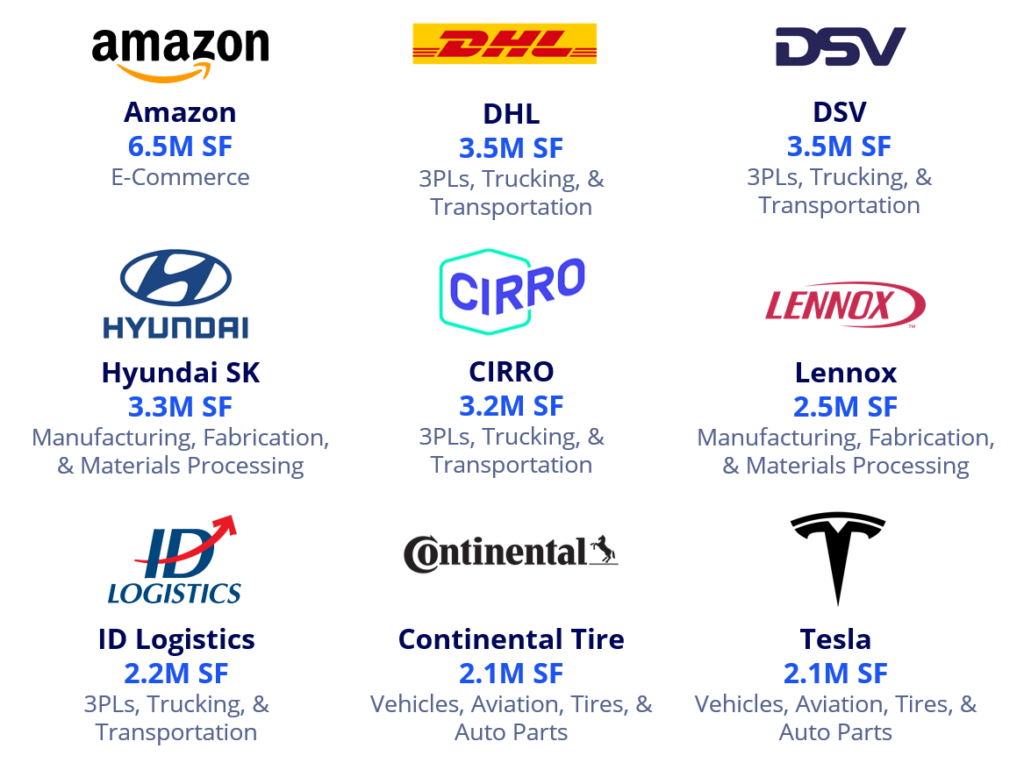
E-commerce giant Amazon was the most active new bulk occupier during the first half of the year, moving into at least 13 facilities totaling 6.5M SF. DHL ranked second, occupying six facilities totaling 3.5M SF, followed by DSV with five occupancies encompassing 3.5M SF.
Looking ahead, stronger leasing activity over the past several quarters is expected to support continued growth in bulk occupancies through the remainder of 2026, as users move into recently leased space and build-to-suit facilities are delivered. With demand now outpacing new supply and the construction pipeline remaining well below its recent peak and pre-COVID levels, the U.S. industrial market is approaching its next growth cycle. Vacancy appears to have peaked and should gradually decline as space is absorbed, tenant move-outs moderate, and new supply remains measured. The pace of improvement will vary by market and region, but demand from an increasingly diverse range of occupiers — including 3PLs, manufacturers, construction-related companies, data center suppliers, and e-commerce users — should sustain momentum into 2027.
Craig Hurvitz brings 20 years of commercial real estate research experience to his role as Director, National Industrial Research for Colliers’ national team. Utilizing his strong background in statistics, analytics, marketing, and real estate development, Craig is instrumental in growing and supporting Colliers’ national industrial real estate business.