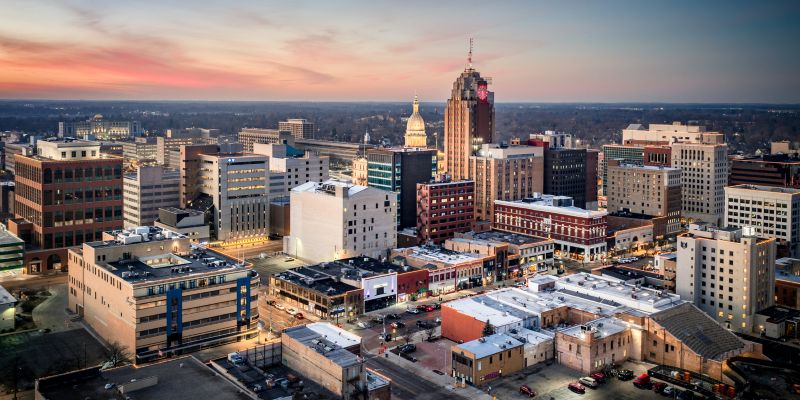
A diversified economy continues to buoy the Lansing, Michigan, commercial real estate market even though some sectors are showing signs of a slight slowdown, according to the latest research from Colliers.
In its first half 2026 Lansing, Michigan, Market Report, Colliers said that the region remains one of the nation’s stronger mid-sized metropolitan areas. The numbers to back this up? Greater Lansing ranks among the top 10 U.S. mid-sized metros for economic growth and among the top 15 regions nationally for workforce education levels, thanks in large part to the presence of Michigan State University and a significant public-sector employment base.
Those economic fundamentals are helping support commercial real estate demand across Lansing’s industrial, office and retail sectors, Colliers said.
Industrial: Solid, but not booming
The industrial market, long a standout in the Lansing market, is transitioning into a more balanced phase. Colliers reported that industrial vacancy rates increased slightly to an average of 2.9% during the first half of 2026. Even with the increase, this figure remains below the industrial sector’s national vacancy rate. Net absorption, though, turned negative during the first half of the year, totaling minus 93,395 square feet, reflecting slower tenant expansion after several years of robust growth.
Even with softer demand, industrial rental rates continued to climb. Colliers said that the average asking industrial rent rose to $7.52 a square foot on a triple-net basis, up from $7.28 at the end of 2025. Construction activity also remained slower, with 546,000 square feet under construction and no new deliveries completed during the first half of the year.
Colliers said industrial tenants are becoming increasingly selective, focusing on efficiency and flexibility in their space requirements. Investors also remain active, though they are concentrating on properties that offer stable income streams and long-term utility.
A challenging office sector
Not surprisingly, Lansing’s office market faces greater challenges. According to Colliers’ report, Lansing’s office vacancy rate increased to 11.4% in the first half of the year, up from 11.1% in late 2025. Net absorption totaled a negative 187,303 square feet during the first half of 2026 as tenant demand remained subdued and occupiers continued to reassess their space needs.
The downtown Lansing central business district and portions of the West submarket experienced the most significant occupancy losses in the first half. But Colliers pointed to Lansing’s East submarket as a bright spot, one that generated consistent leasing activity and achieved more stable occupancy levels.
Despite elevated vacancies, office asking rents have held relatively steady, averaging $17.04 per square foot. No office projects were under construction during the first half of the year, and no new office space was delivered.
A healthy retail sector
Retail fundamentals remain relatively healthy despite some softening in occupancy. Colliers reported that retail vacancy increased to 8.1% during the first half of 2026, up from 6.1% at the end of last year. Net absorption stabilized at a positive 1,466 square feet, while leasing activity remained active with nearly 164,000 square feet transacted across 47 deals.
Service-oriented tenants continue to drive demand, particularly in Lansing’s South and West submarkets. Average retail asking rents increased to $13.84 per square foot on a triple-net basis, supported by limited new supply and steady tenant demand.
Multifamily still strong
The multifamily sector also remains stable. According to Colliers, the Lansing apartment market posted a 93.7% occupancy rate in the second quarter, while average monthly effective rents rose 3.8% year-over-year to $1,311.