The industrial development boom in the northern Twin Cities is showing little sign of slowing, and Oppidan Investment Company is betting that businesses will continue to need flexible space in one of the metro’s fastest-growing corridors.
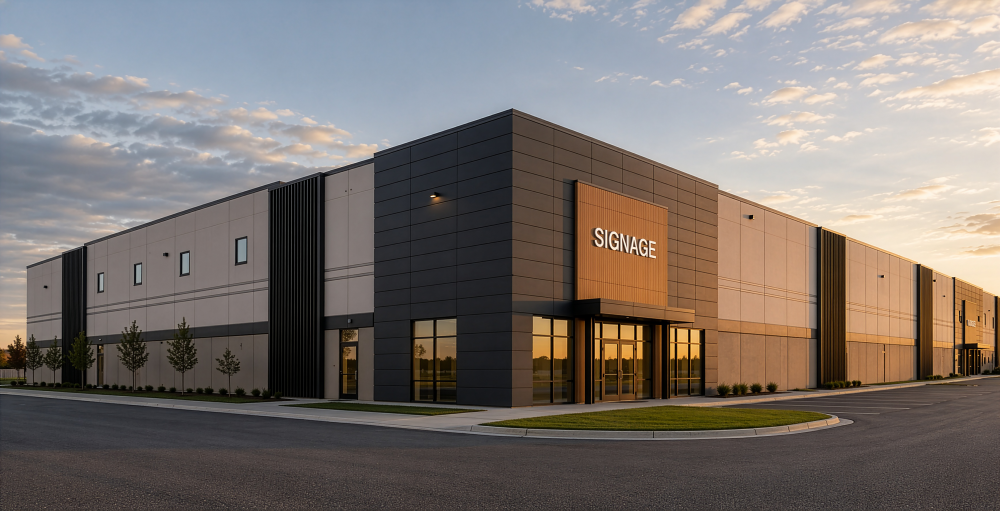
The Excelsior, Minnesota-based developer has broken ground on Rogers Gateway, a 117,000-square-foot speculative industrial project in Rogers, Minnesota. The roughly $15 million development is scheduled for completion in November 2026.
Oppidan is developing the project without a tenant in place, a strategy that gives prospective users an opportunity to shape the space around their operations. Rogers Gateway is designed to serve a broad range of industrial users, including companies needing warehouse and distribution space as well as manufacturers and businesses looking for showroom and office components.
Location is one of the project’s biggest selling points.
“The Minneapolis-area industrial market remains strong, with continued demand for new construction in well-located areas,” said Ryan Durand, developer with Oppidan. “We are seeing particular interest in projects that offer strong highway access, visibility and flexibility for a variety of industrial users.”
Rogers Gateway will have direct visibility and access from Interstate 94, putting tenants along a major east-west transportation route through the Twin Cities. The site also offers access to the northern portion of the metro while providing connections for companies moving goods throughout the region and beyond.
Durand said that Rogers remains a draw for industrial users.
“The northwest Twin Cities is currently one of the strongest submarkets for industrial leasing activity,” he said. “Rogers is particularly attractive because of its access to I-94, growing population and connectivity to the broader metro and regional markets. Those fundamentals were a major factor in our decision to move forward with Rogers Gateway.”
For Oppidan, the project is about more than adding another industrial building to the market.
The development is also positioned as an investment in Rogers, a city that has continued to attract population, businesses and commercial development. Once fully leased, Rogers Gateway is expected to bring new jobs to the community, attract additional business investment and expand the city’s commercial tax base.
The building’s flexibility could be particularly important in today’s industrial market, where tenants have increasingly specific requirements for their facilities.
Rogers Gateway will offer configurations capable of accommodating different tenant sizes and operational needs. That flexibility is intended to allow businesses to customize their space rather than force their operations into a one-size-fits-all building.
The project comes as developers throughout the Twin Cities continue to focus on industrial properties that can serve both local and regional users. Proximity to major highways has become an increasingly important consideration for companies seeking to control transportation costs and reach customers efficiently.
Oppidan has assembled a team of Minnesota-based and regional partners for the development. Alliant is serving as civil engineer, Mohagen Hansen is the architect and Rochon is the general contractor. Park State Bank is providing financing, while CBRE is handling leasing.
Construction is now underway, with completion targeted for November.
Leasing opportunities are available for businesses looking for industrial space in the northern Twin Cities market.
For Oppidan, the project represents a familiar development formula: Find a growing market, secure a location with strong transportation access and build flexible space capable of serving a range of users.
“We expect to see continued industrial development in areas where demand and strong market fundamentals support it,” Durand said. “Rogers Gateway is a good example. Its location in a strong industrial submarket, direct access to I-94 and flexibility for a range of users made it a compelling opportunity for speculative development.”
The key, of course, is to provide industrial space that today’s users want. Duand said that functionality is key. Efficient truck circulation, ample parking, modern loading capabilities, strong clear heights and flexible space are all important, said.
“Location is also critical, particularly access to major transportation routes and nearby services that support employees,” Durand said.