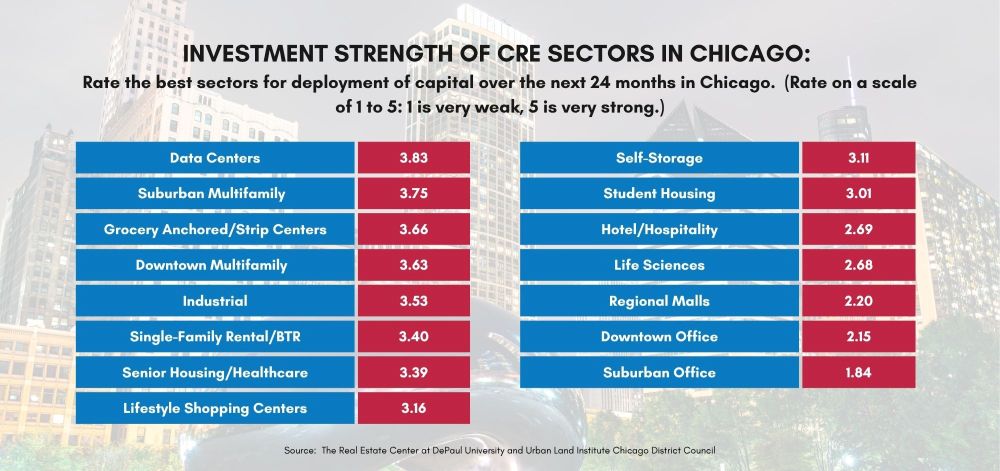
The perceived investment strength of industrial segments in the Chicago market was down in 2025 compared to previous years as the perceived impact of tariffs is stronger in that segment than many others.
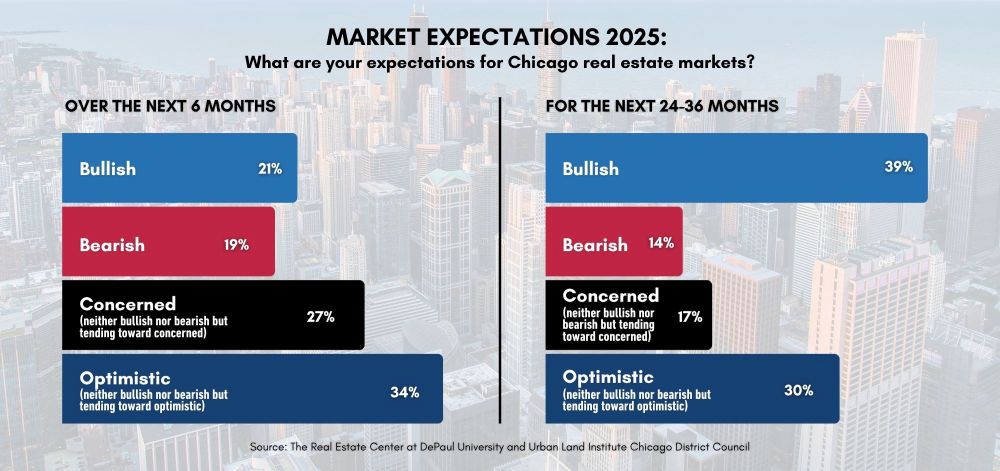
This further speaks to a level of parity in the Chicago real estate market, according to the recently released Chicago Mid-Year Sentiment report from The Real Estate Center at DePaul University.
Data centers, a recent investment darling, led the 2025 rankings, scoring a 3.83. But in 2024, data centers led all other choices with a score of 4.25. industrial, a perennial favorite, dropped from 3.7 to 3.5 and slipped to fifth place behind downtown multifamily.
While the clear interpretation is there are no longer any slam dunks for investors, the 2025 Chicago Mid-Year Sentiment Report by the Real Estate Center at DePaul University in collaboration with ULI Chicago found the Chicago industrial marketplace remains strong, locally and nationally.
Emi Adachi, Heitman, said one of the compelling storylines is how strong fundamentals are in the Chicago market.
“Chicago is outperforming the national averages in the industrial market,” Adachi said. “That continues to be a real positive for Chicago.”
Fundamentals keep local market strong
Among the reasons for the sector’s strength in Chicago as well as across much of the country is the fact that while new supply has been elevated over the past few years, speculative development has not been excessive to the point of tremendous overbuilding.
Laura Hyde, Managing Director of Investments, Central Region, Link Logistics, says the broader industrial market enjoys a healthier position compared to some coastal markets, a position that was evident even before tariffs entered the equation.
“The dynamics on the ground feel really positive,” she said. “There are opportunities for an attractive basis, strong yields and runway to grow.”
She also noted that average rents continue to escalate, at least for now. That is not to say that the macroeconomic backdrop is not impacting current market conditions. Perhaps more than most sectors, tariffs are impacting the industrial sector, at least until there is more data and direction on their impact.
“We’ve seen decision-making uncertainty,” Hyde acknowledged. “Tenants aren’t backing out of deals, but they are delaying decisions. That could set the market up for a strong third and fourth quarter of activity.”
Just as the pandemic mandated a change to supply chain strategies, tariffs could have the same impact. For example, if tariffs result in a greater level of onshoring by US companies it may be good for industrial demand. Many tenants, depending on their size and line of business, are assessing what’s best for their inventories and supply chains with some contemplating stockpiling products and materials to avoid negative consequences of the tariffs.
On balance, industry professionals are bullish on Chicago industrial in the long run. Still, Hyde cautions, much remains to be seen about the level and impact of tariffs.
Because of the size and geographic diversity of the Chicago marketplace, it’s hard to paint a broad-brush picture of the sector. Different markets and submarkets cater to different users many of whom have distinct leasing requirements.
Link’s Hyde noted that in the 100,000 to 200,000-square-foot range, the I-55 market has softened, despite its historical appeal to bulk distribution users. At the same time, the market for space less than 100,000 square feet has been strong with those tenants, that typically are more locally focused.
Outdoor storage sector gains in popularity
Notably investment activity is also picking up in Chicago for the $3 billion national industrial outdoor storage segment.
Tom Barbera, CEO, Industrial Outdoor Ventures, described Chicago’s IOS market as strong with low vacancy, robust tenant demand and narrowing bid-ask spreads, particularly when compared to coastal markets. Like the broader industrial market, pricing in the IOS sector— rental rates and sale prices—have held up better in Chicago than in tier-one coastal markets that have experienced more dramatic peaks and subsequent declines.
“The current trajectory of investment in IOS exceeds expectations,” Barbera said. “It’s exciting to see the sector gain scale and credibility.”
He noted that the sector’s increasing popularity is also evident in the debt markets. It has been buoyed, nationally and in Chicago, by increasing institutionalization. Barbera, one of the early investors in the space, isn’t surprised by its growing popularity.
“An increasing number of lenders are entering the space, as debt tends to follow equity,” Barbera said. “Although debt sources are not as abundant for IOS properties as for generic industrial properties, debt is available, especially for experienced operators.”
But here too, the outcome of tariff negotiations is a significant concern.
“My greatest concern for potential setbacks in the marketplace is a negative outcome in tariff negotiations which could lead to a recession,” Barbera said. “However, I am optimistic that a favorable outcome can be reached.”
Demand for data centers surges
The surge taking place, nationally and in Chicago, is attributed to the rapid rise of AI, high-performance computing and cloud services. While exciting announcements such as CRG/Related Midwest’s Quantum project provide headlines, there is a lot of activity region wide:
- Estates, Compass Datacenters is transforming the former 200-acre Sears headquarter campus into a five-building data center campus development.
- CyrusOne is developing a 230-acre complex in Yorkville, and
- Microsoft acquired a 500-plus acre site for a new development in Plano.
Despite impressive activity, the data center segment in Chicago and Illinois is at a crossroads, and an imbalance between land sites with reliable access to power and outdated legislation.
The Biometric Information Privacy Act (BIPA) is creating real hesitation. Some suggest that if the state doesn’t modernize its laws, it risks losing out on the enormous capital investment, innovation, and job creation potential.
“Some argue the sector is overhyped and overbuilt. I disagree,” said Shawn Clark, CEO, CRG. “I believe AI adoption is progressing faster than most people realize, and the demand for computing, storage and additional use cases will continue to accelerate over the long term.”
Chicago has been a key market for data center users thanks to its central location, access to fiber, and strong infrastructure. “The collaboration between public entities, academia, and private industry exemplifies how states and cities can adapt and thrive in the evolving technological landscape,” Clark said. The hope is that the Quantum project will breathe new life into a site that once symbolized industrial might and is now reimagined as a hub for cutting-edge technology. Nationally, it positions Chicago as a leader in quantum research and development and is expected to attract top talent, significant investment, and innovative ideas.