The cranes dotting Madison’s skyline tell the story.
From downtown high-rises and mixed-use developments to new retail concepts and industrial projects, commercial real estate activity remains robust in Wisconsin’s capital city. Even as developers grapple with elevated construction costs and higher borrowing rates, industry professionals say Madison’s strong economic fundamentals continue to support growth across nearly every property sector.
“Demand for mixed-use development remains exceptionally strong throughout Madison and Dane County,” said Heather Ewing, founder and managing principal of Madison, Wisconsin-based ABSTRACT Commercial Real Estate.
According to Ewing, Downtown Madison Inc.’s development tracker currently lists more than 60 projects in various stages of planning, development, construction and delivery.
“Cranes are visible from nearly every vantage point in the downtown,”Ewing said. “It underscores the scale of ongoing investment.”
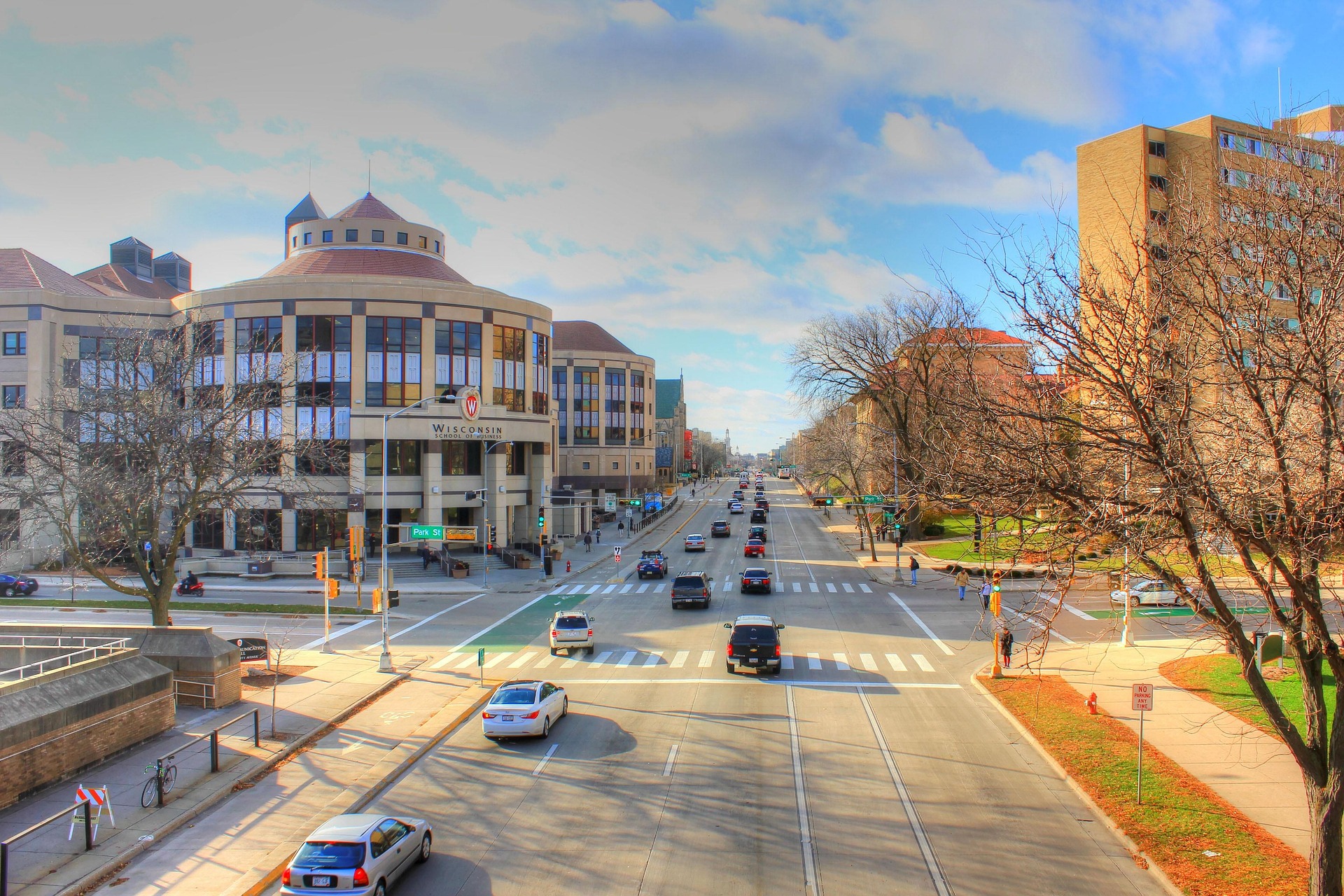
She said developers continue to gravitate toward projects that create walkable, higher-density environments emphasizing community gathering spaces, restaurants, public art and opportunities for social interaction.
That trend is evident in major projects such as the Brayton Lot redevelopment, the State Street Campus Garage redevelopment and several projects surrounding State Street and the Business Improvement District. The former Porta Bella redevelopment site and an adjoining parcel, for instance, have been cleared for a new 16-story mixed-use development.
“A sense of community is a common thread,” Ewing said. “Combine this with walkability, and you have a formula for attracting residents, visitors and businesses alike.”
Mixed-use projects are also benefiting from municipal policies encouraging greater density.
Chris Richards, partner and managing director of the Madison office of Colliers, said mixed-use developments have performed especially well in the city’s most densely populated areas.
“The retail component of these mixed-use projects is most successful when developers have the foresight to include the appropriate infrastructure and parking to allow retailers to thrive,” Richards said.
Retail continues to shine
Among Madison’s commercial property sectors, retail remains one of the strongest performers.
Ewing said preliminary second-quarter data showed Madison’s overall retail vacancy rate at approximately 5.45%, while the market recorded more than 88,000 square feet of positive absorption during the quarter and more than 151,000 square feet year-to-date.
Demand is strongest in grocery-anchored centers, food-and-beverage concepts, experiential retail, wellness tenants and service-oriented businesses.
National brands continue to view Madison as an attractive expansion market. One recent example is North Italia’s first Wisconsin location at Hilldale. Meanwhile, the Madison Public Market has introduced dozens of local food, beverage and specialty retailers.
“The combination of population growth, spending power and quality of life continues to attract both national and local operators,” Ewing said.
Richards agreed, calling retail one of Madison’s two strongest sectors today.
“The strength in the retail sector is due to strong population growth, strong demographics and limited supply,” he said.
Madison’s zoning policies have also played a role.
“The city has created overlay districts in some of its most popular thoroughfares that require density, which has and will continue to limit retail development,” Richards said.
Industrial demand rebounds
Industrial real estate has also regained momentum after experiencing a temporary slowdown.
Richards said tariff concerns and a wave of new deliveries created uncertainty in the industrial market. But demand has since caught up with the new supply.
“We anticipate a fair amount of new industrial development in the near future,” he said.
The market’s long-term growth prospects remain favorable, driven by Madison’s expanding economy and population growth.
Development pipeline remains active
Despite rising construction costs and financing challenges, developers continue to push projects forward.
“Construction costs will always be a topic of conversation,” Ewing said. “The cost of waiting can be greater than the cost of building and may result in lost market opportunities.”
She pointed to projects ranging from the Pumpkin Patch Development in Sun Prairie to high-rise developments around State Street, Hilldale’s Phase 3 and Madison Yards at Hill Farms as evidence of continued developer confidence.
“While some projects move more slowly due to capital constraints, the development pipeline remains active compared to many peer Midwest markets,” Ewing said.
Richards said high construction and borrowing costs have delayed or paused some projects. But, in many cases, those delays have prevented the market from becoming oversupplied.
“Retail and industrial developments have felt the pressure of these costs,” Richards said. “But demand in these two areas has been strong enough to allow projects to move forward.”
Major redevelopment opportunities ahead
Both professionals highlighted several projects that could significantly reshape downtown Madison.
Ewing said she is particularly excited about the redevelopment of 425 North Frances Street, where ABSTRACT Commercial Real Estate represented the seller. The site and adjoining parcel have been cleared for a 16-story mixed-use project.
She is also involved with the Brayton Lot redevelopment team, working alongside JLA Architects, Findorff and other partners.
“The site represents a one-of-a-kind redevelopment opportunity near the Capitol Square,” Ewing said. “It has the potential to further strengthen the connection between downtown Madison and the East Washington corridor.”
Richards pointed to two state-owned downtown sites that are expected to attract significant developer interest: the GEF 2 and GEF 3 properties and the historic 1 W. Wilson building.
GEF 2 and GEF 3 will likely be demolished and redeveloped, significantly increasing density in a prime central business district location, Richards said.
Meanwhile, 1 W. Wilson is expected to be transformed into a mix of hospitality, housing and retail uses, with the possibility of incorporating an Amtrak station.
Office market slowly recovers
The office sector remains challenged but is showing encouraging signs.
According to Sweeney, Madison’s overall office vacancy rate stood at approximately 16.3% in the second quarter of 2026. The market experienced negative absorption during the quarter, though she said much of that activity reflects companies optimizing their space needs rather than abandoning office space entirely.
“Flight-to-quality remains very real,” Ewing said.
Today’s office tenants are prioritizing amenities, collaboration spaces and flexible environments that help attract employees back to the workplace.
“The most successful office buildings are creating destinations rather than simply providing square footage,” she said.
Richards said office demand remains strongest for spaces of 5,000 square feet or less. He also sees tenants continuing to right-size their footprints.
“Companies are eager to find and create spaces that compel their employees to come to the office versus work from home,” Richards said.
As a result, tenants increasingly seek higher-quality space, more walkable locations and enhanced amenities.
A resilient growth story
Ultimately, Madison’s appeal stems from a rare combination of economic diversity, educational resources and quality of life.
The presence of the University of Wisconsin-Madison, state government, Epic, Exact Sciences and a growing healthcare and technology ecosystem has created a resilient economy that continues to attract investment.
Richards said Madison’s growing reputation as a biotech, technology and engineering hub is drawing both companies and young professionals.
“These companies have created a number of high-quality jobs for our local area and continue to poach talent from our larger Midwest counterparts like Chicago, Minneapolis and Milwaukee,” he said.
For Ewing, the city’s momentum extends beyond statistics and development pipelines.
“Strong fundamentals attract investment,” she said. “Culture, creativity and quality of life help sustain it.”