Richmond has spent decades on the far edge of Houston’s retail map. At mid-year 2026, brokers say the Fort Bend County city is where the market’s next chapter starts.
“Richmond is the last piece of the puzzle for development,” said Sarah Thobae, Vice President of Retail Services at Partners. “There are a lot of large, long-held family properties that are finally being sold to make way for growth. Closer-in suburbs run out of land, and it just keeps moving out.”
The pattern extends across the western arc of the metro. Thobae points to Katy, Cypress, Fulshear and Sugar Land as submarkets to watch with activity following the Grand Parkway. Along FM 529, she and her business partner Joan Collum are working on a 12-acre commercial development on land the Freeman family retained after selling 3,600 acres of their family ranch and farm for the Elyson master-planned community, which is named after Ely Freeman.
That outward march is unfolding in one of the tightest retail markets Houston has seen in decades. Metro vacancy stands at roughly 5.7 percent, compared with about 4.6 percent statewide, the lowest levels since the early 2000s, according to Partners research. Partners also tracks roughly 4.2 million square feet of retail space under construction across the region.
“Under construction just means dirt is moving,” Thobae said. “That new space still has to be absorbed, and it’s entering a market where good space is already scarce.”
Chris Burns, Vice President at JLL, sees the same imbalance from the leasing side. He describes an ongoing flight to quality with tenants prioritizing visibility, convenient access and strong surrounding demographics while staying flexible on spaces that may not check every box.
“The limited availability of quality space is keeping rents at healthy levels, while also encouraging more tenants to pursue longer-term leases to secure desirable locations and protect against future rent growth,” Burns said.
Landlords are being selective in return, placing greater weight on tenants with strong financial backing and concepts built for the long term, according to Burns. Rising construction and build-out costs are also steering demand toward second-generation space and owners are investing more strategically in tenant improvement packages to accelerate occupancy, said Lauren Ball, Chief Operating Officer of Westwood Financial.
Ball said leasing demand is led by categories that serve everyday needs or deliver an experience including restaurants, specialty grocery, fitness, healthcare, beauty and childcare, while discretionary soft goods retailers remain more measured.
“Grocery-anchored centers are essentially full and second-generation restaurant space tends to get multiple offers,” Thobae said. “It’s just faster and cheaper for a new operator to get in.”
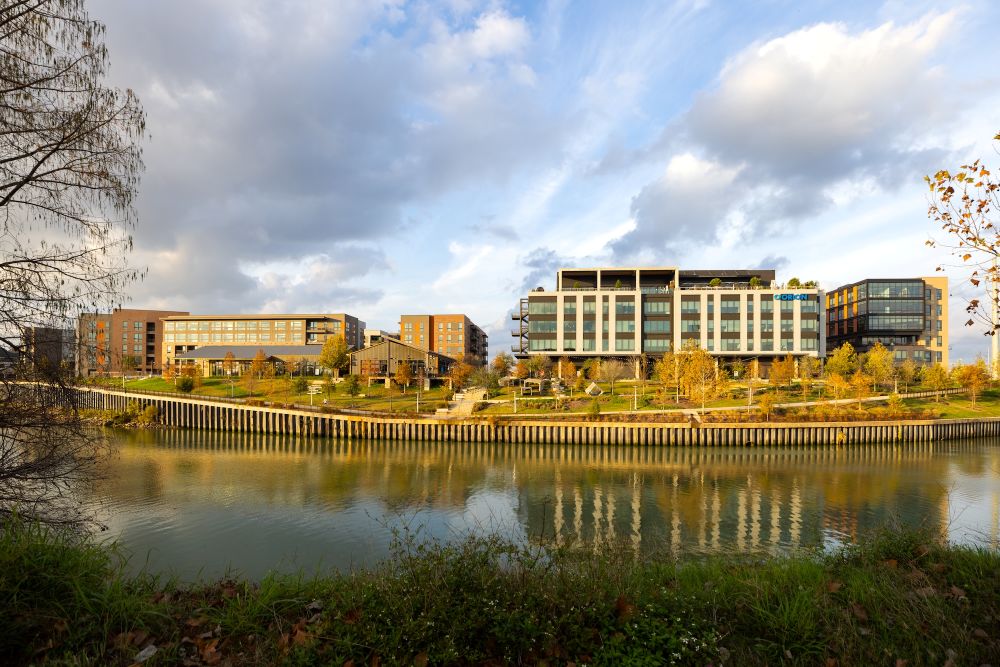
The market’s momentum is most visible in its mixed-use districts. At Midway‘s East River on Buffalo Bayou, the first 26 acres are complete and occupied. Port Houston opened its headquarters there in January, Anton Paar’s building finishes this summer and planning is underway for a second phase immediately east of the first with a partial focus on activating the waterfront.
“Attracting the talent companies need to grow and succeed is paramount and becoming more challenging,” said David Hightower, Executive Vice President of Midway. “An attractive, walkable environment with multiple eating and shopping options is much more attractive in this consideration than a trophy building in a sea of parking.”
Midway is applying a similar playbook in Uptown at Central Park Post Oak, a 17-acre redevelopment of the former Post Oak Central campus that began construction in April 2025 with phased openings of new retail, dining and green spaces expected this winter, according to Hightower. Burns points to Regent Square as another strong performer, noting the district is well occupied and holds an opportunity for a Class A restaurant concept to round out its dining lineup.
“Successful mixed-use retail depends less on the development itself and more on creating an authentic, walkable destination,” Ball said.
Investors are chasing the same fundamentals. Nikhil Dhanani, President of Dhanani Private Equity Group (DPEG), said the firm favors acquiring and repositioning existing centers over ground-up retail development, pointing to recent purchases including Bear Creek Center, anchored by Fiesta, and a Kingwood center anchored by Trader Joe’s. Financing conditions have improved considerably, he said, and DPEG’s long-standing banking relationships have secured rates roughly 100 to 150 basis points below prevailing market levels.
“We believe disciplined underwriting and patience are creating attractive buying opportunities for well-capitalized investors,” Dhanani said.
Burns expects the second half of 2026 to mirror the first with continued leasing, selective construction and a push from tenants and landlords to finalize transactions before year-end.
“Houston may not grab headlines, but it’s a functional market that stays active,” Thobae said. “Low vacancy, tight supply, good population and job growth. It just works.”