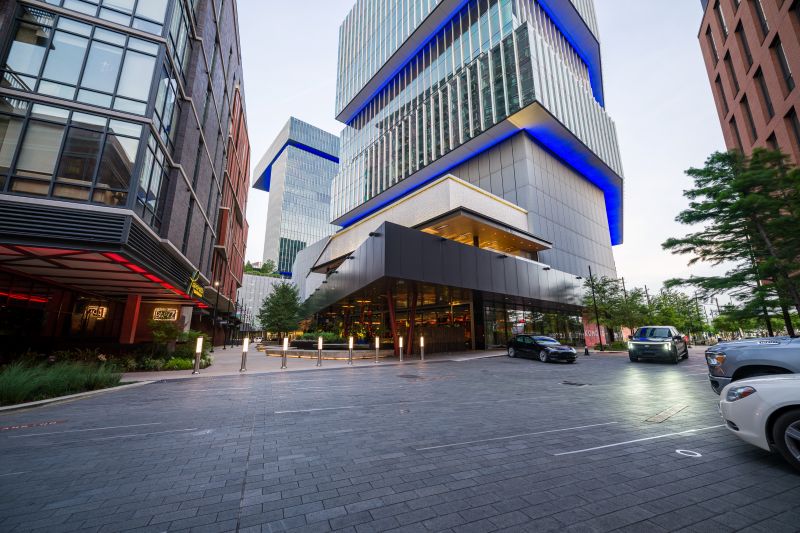
Trophy office rents in Dallas now average about $77 per square foot, more than double the roughly $37 per square foot landlords command in the rest of the Class A market, according to Cushman & Wakefield research. The spread between the two has grown from $25 to $40 per square foot since 2020 and national firms shopping Dallas from gateway markets like Manhattan are calling the trophy product cheap.
“There is currently no ceiling on trophy rents in Dallas,” said Andrew Matheny, Senior Research Manager at Cushman & Wakefield. “National and global firms based in expensive gateway markets such as Manhattan view Dallas trophy space as relatively economical at $110.00 psf or even $150.00 psf or more.”
That pricing power is the clearest signal yet that Texas office has split into two markets running on different rules. Dallas-Fort Worth vacancy improved 40 basis points year over year to 24.5 percent in the first quarter, according to Newmark. Matheny said Cushman & Wakefield’s tracked inventory has now logged five consecutive quarters of positive absorption. Houston vacancy held at a record 25.8 percent with first quarter absorption of negative 287,336 square feet, according to Newmark, though the firm characterized the dip as seasonal rather than structural. Austin’s vacancy dropped 120 basis points quarter over quarter to 22.3 percent, the first meaningful reversal after years of supply outpacing demand. Across all three metros, the buildings winning are the same ones: newest, best-located, most amenitized. Everything else faces hard decisions.
“Options dwindle” in DFW
Cushman & Wakefield’s Quantitative Insight Group forecasts Dallas Class A net absorption will exceed 4.8 million square feet through 2028 while new supply over those three years totals just 638,000 square feet. Demolitions, conversions and user purchases are pulling inventory out of the market faster than construction is replacing it.
“As options dwindle in trophy and top tier buildings, tenants will move down the quality spectrum to the next best options and bolster office fundamentals across the board,” Matheny said.
He offered the example of Jones Day, which recently signed for 76,000 square feet at the Class A Knox & McKinney development, anchoring a building that won’t deliver until 2028, calling it a “prime example of trophy tenants kicking off a new building with a pre-lease to overcome uncertainty around future supply.”
“Fierce competition” in Houston
In Houston, the same dynamic shows up in deal size rather than rent. Class A leasing accounted for 66 percent of the market’s first-quarter activity but only about 30 percent of deal count, according to Newmark. The average Class A lease ran 8,332 square feet against a market-wide average of 3,832 square feet. Tenants are signing bigger commitments in better buildings.
“Tenants haven’t been as price sensitive as they have in previous decades,” said Jon Lee, Executive Vice President of Leasing Services with CBRE in Houston. “There is fierce competition to recruit and retain the best talent and companies are rationalizing a premium office environment as a competitive advantage.”
Return-to-office mandates have layered onto that talent equation. Newmark data showed three of Houston’s five largest first-quarter transactions landed in the CBD, a submarket that has spent most of the past five years on the wrong side of the migration story. Boardwalk Pipeline Partners signed the largest Houston deal of 2026’s first quarter, taking 143,253 square feet at 990 Town & Country Boulevard and leaving 9 Greenway Plaza behind. Crescent Energy committed to 125,000 square feet at 609 Main and is spending $27 million on its buildout before a 2027 move-in.
“Companies have also decided that while mandating in-person work may not be a popular decision amongst many employees, they are trying to offset this by offering newer, more highly-amenitized office spaces in newer buildings,” Lee said.
“A few large deals” in Austin
Austin’s recovery looks different because the market is still working through a wave of speculative deliveries from the tech boom years. Newmark reported NXP Semiconductors signed the quarter’s largest lease, relocating its U.S. headquarters into 225,000 square feet at Champion Office Park. The pipeline behind that headline is thicker than it appears with 13 active requirements over 100,000 square feet and a 41 percent year-over-year increase in tenant demand, according to Mark Harris, Executive Vice President for JLL’s Office Tenant Representation Team in Austin.
“Austin is a small market, so all it takes is a few large deals to land, and it can change the absorption and overall market dynamics,” Harris said.
He noted that tenants are gravitating toward second-generation space because subleases and spec suites carry the lowest capital outlay, but that inventory is thinning fast.
“There aren’t many of those opportunities left, so tenants are having to make longer term decisions to help cover the upfront capital costs,” Harris said.
What those tenants are asking for has shifted.
“The biggest thing we’re seeing now is flexibility and minimal to no up-front capital expenditure,” said Jake Ragusa, Executive Vice President at JLL.
In practice, that means tenants are pushing harder on landlord-funded build-outs, shorter-term commitments, and shells priced to move. Ragusa said true conversion activity in Austin remains rare because the math is still cost-prohibitive on most older buildings, leaving landlords to wait for demand to return rather than reposition aggressively.
“… chasing redevelopment opportunities …”
The question hanging over every Texas market is what happens to the buildings that can’t compete on that quality curve. Capital is sorting itself by both asset and intent, per Matt Murphy, Director of Office Investment Sales at Cushman & Wakefield.
“The buyer profile for Class A buildings in Dallas is largely institutional capital, the bulk of which is value-add in nature,” Murphy said. “The buyer profile for Class B buildings is largely private capital, split between value-add office operators and investors chasing redevelopment opportunities.”
That redevelopment bucket is reshaping submarkets in real time. Matheny said downtown Dallas holds the metro’s most obsolete inventory, with vacancy gaps against Uptown pushing owners toward conversion math. Las Colinas, once dense with back-office and call-center product, is being eyed for industrial and multifamily redevelopment, he said. Texas Senate Bill 840, passed last year, could act as a policy lever to accelerate office-to-multifamily conversions further over the next 18 months.
“… what truly sets it apart …”
Westdale Real Estate Investment and Management took a different bet years ago, anchoring its trophy play in Deep Ellum rather than the conventional flight-to-quality submarkets like Uptown or the Tollway corridor. The firm was founded in Deep Ellum more than 30 years ago and still calls the neighborhood home. The Epic now houses DLR Group, Kimley-Horn, Uber and Westdale’s own corporate headquarters. AI 4Minds recently moved into one of the building’s spec suites. Down the street, The Good E announced its office space was fully leased last month.
Jeff Allen, Executive Vice President of Commercial at Westdale, said Deep Ellum holds its own on the conventional office fundamentals brokers tend to lead with including central location, highway access, structured parking and walkability.
“What truly sets it apart is its character,” Allen said. “The neighborhood has a history, authenticity, and creative identity that cannot be manufactured.”
That thesis sits at the heart of how Westdale evaluates older product across its portfolio. According to Allen, the term “mixed-use” has become shorthand for nearly every new development, but tenants asking for it are really asking for help making the office attractive to employees. They want walkability to lunch, fitness on site, common spaces that encourage people to gather and ownership that stays close enough to the property to respond when needs change.
“Older office buildings must evolve from a traditional view that they are just settings for desks and people, and into highly-amenitized destinations that provide service and convenience for a modern workforce,” Allen said.
Westdale continues to invest in gyms, tenant lounges, micro-marts, golf simulators and rooftop amenities across its portfolio. Properties with shallow floor plates, high ceilings and floor-to-ceiling windows in core submarkets remain viable when ownership commits the capital, according to Allen. The buildings that lack those bones are the ones owners are now evaluating for residential, hotel or storage conversion.
The buildings caught in between, neither trophy nor truly obsolete, are where the next phase of the story plays out. Some will get the capital infusion Allen described and join the winners. Others will trade to the private redevelopment buyers Murphy identified and become something other than office. The middle is shrinking either way.
“We think the race for the premium office space experience is just beginning,” Lee said.