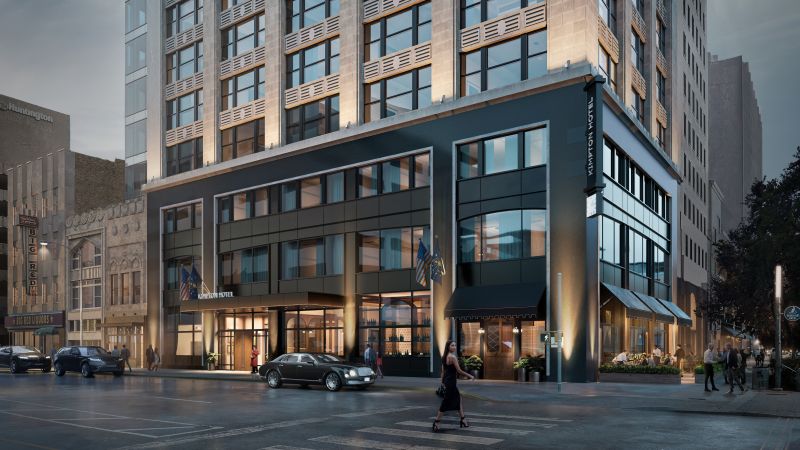
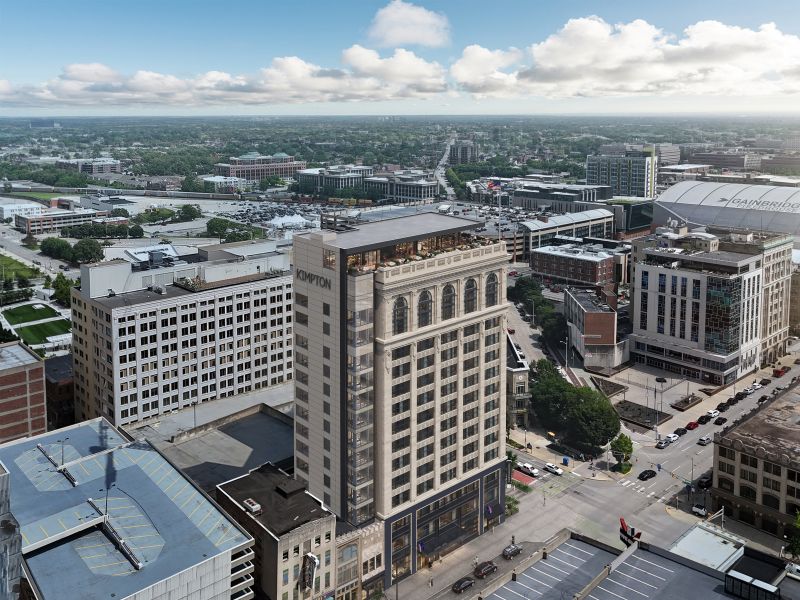
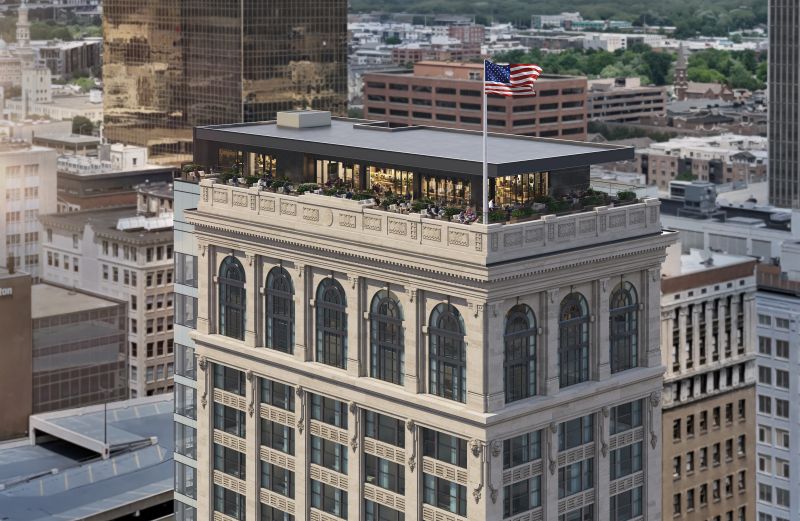
The 16-story neo-classical high-rise at 1 North Pennsylvania St. has been a key part of downtown Indianapolis’ skyline since it was first built in 1908.
The building ranked as the tallest high-rise in Indianapolis when it first rose in the city’s downtown. And locals still call it the Odd Fellows building because it served as the Indiana state headquarters of the Independent Order of Odd Fellows, a national fraternal organization.
This fall, the Odd Fellows building will begin its next chapter thanks to Indianapolis-based developer Silverstone Development.
Silverstone is transforming the building into the Kimpton Hotel Indianapolis, helping to meet the city’s need for more hotel rooms in its downtown core. The hotel is slated to open in the fall of this year.
The Kimpton Hotel Indianapolis will offer 167 guest rooms, a ballroom on its 15th floor and a full-service restaurant. The hotel will also feature a rooftop cocktail lounge providing views of downtown Indianapolis.
Midwest Real Estate News spoke with Dale Johns, founding principal of Silverstone Development, about the challenges of transforming this iconic building and the potential that adaptive-reuse projects have to bring new life to aging properties.
What made the former Odd Fellows Building a good candidate for an adaptive-reuse?
Dale Johns: Part of what made the Odd Fellows Building an excellent candidate for adaptive reuse is the location. The Odd Fellows building sits just a few minutes’ walk from Indianapolis event hubs like Gainbridge Fieldhouse, the Indianapolis Convention Center, Lucas Oil Stadium, and downtown nightlife options.
Another benefit was the building’s inherent suitability for a modern lifestyle hotel. Its historic façade, generous ceiling heights, and large window openings give us the character and natural light today’s guests expect, while the floor plates are efficient enough to support a thoughtful mix of guestrooms and amenity spaces without forcing awkward compromises.
The existing structure was fundamentally sound, which allowed us to invest more of the budget into guest-facing design and experience rather than rebuilding core systems from scratch. It’s the kind of property where you can preserve a sense of Indianapolis history and still deliver a contemporary, high-performing hotel.
How strong is the demand in Indianapolis for new hotel rooms? Is this demand growing as Indianapolis’ tourism industry continues to strengthen?
Johns: Our friends at Visit Indy shared in January at their State of Tourism event that in 2025 Indianapolis set a record for hotel rooms booked and occupied, breaking the previous record set in 2024 of 932,000 hotel rooms booked. It is safe to say that Indianapolis’ tourism industry is growing at a rapid rate, with 30.5 million visitors in 2025, helping bring a strong demand for new hotel rooms.
However, what we’re seeing on the ground is that this demand is not just about more hotel rooms, it’s about the right kind of hotel rooms. Citywide conventions, major sporting events, and a steady calendar of cultural programming are drawing guests who want a higher‑touch, more experiential stay than a traditional one.
A boutique, design‑driven hotel in a historic building helps Indianapolis compete with peer cities by giving visitors a memorable “only in Indy” experience that keeps them coming back and talking about the city long after check‑out. Kimpton Indianapolis is designed to capture that demand while also serving locals who are looking for a new go‑to spot for events, dining, and nightlife beginning in the Fall of 2026.
What were some of the bigger challenges in transforming the Odd Fellows Building into a new Kimpton?
Johns: Any adaptive‑reuse project starts with what you inherit, and Odd Fellows was no exception. Working within a historic envelope meant we had to carefully thread modern building systems, life safety requirements, and acoustic performance through a structure that wasn’t initially designed to be a hotel. Aligning column grids, window placements, and existing floor elevations with Kimpton’s room standards and brand expectations required a lot of upfront coordination between our design, engineering, and construction partners.
We also had to balance preservation with performance. There’s a responsibility to honor the building’s history, but we can’t let nostalgia override guest comfort or operational efficiency. Everything from integrating new vertical circulation to carving out a 15th‑floor ballroom demanded creative problem‑solving so that the finished product feels seamless to the guest. That level of complexity reinforces why early, honest collaboration between owner, brand, designers, and contractors is so critical on projects like this.
What are some of the amenities that you think will set this hotel apart from its competitors?
Johns: In addition to the 167 high-end guest rooms, the mixed-use property will feature a 15th-floor ballroom, perfect for a variety of events, and located in a prime location in downtown Indianapolis. Additionally, a rooftop cocktail lounge will offer an expansive view of the city skyline.
The ballroom and rooftop are being programmed with both travelers and locals in mind, creating a social hub for downtown that can host everything from weddings and nonprofit galas to pre‑game meetups and post‑show nightcaps. Layering that energy onto the backdrop of a restored historic building gives Kimpton Indianapolis a personality that’s distinct from larger convention hotels, while still plugging directly into the city’s growing tourism and events ecosystem.
Are you interested in taking on more adaptive-reuse projects in the Indianapolis market? Are there any projects you are working on now in the market that you are especially excited about?
Johns: We absolutely see Indianapolis as a long‑term market for adaptive reuse and are very interested in taking on more projects here that align with our expertise. The city has a deep inventory of historic and underutilized buildings in walkable, well‑connected locations, and when you pair that with strong tourism trends, it’s a compelling environment for thoughtful hospitality development.