Chicago’s industrial market crossed a threshold in the second quarter that it had never touched before. Average asking net rents topped $8 per square foot for the first time in the market’s history, according to Adam Haefner, Managing Director at JLL, who also tallied roughly 25 million square feet of first-half leasing activity, above-average velocity by any measure.
But Chicago has never been a one-story market. Ask a leasing broker, a tenant advisor, a developer, a capital markets specialist, a global landlord, a value investor and a supply chain strategist to describe the same six months and you get seven distinct answers, each one true and each one incomplete on its own. Here is the view from every seat.
The leasing floor: a reversal worth watching
Ben Dickey, Vice President at Stream Realty Partners, describes a healthy market whose biggest first-half surprise ran against type: small-bay infill product, historically the most resilient corner of Chicago industrial, trailed the big-box segment on net-new demand. Major retailers and third-party logistics firms are absorbing bulk space again, while no single industry has stepped up to drive smaller infill deals.
The divide runs deeper than leasing velocity.
“Class A product continues to see increases in rent on new leasing from tenants who place a premium on quality location and building functionality, while Class B and C product has plateaued in rent and in some cases decreased compared to similar counterparts 12-24 months ago,” Dickey said.
The dynamic he is watching most closely, though, is users buying buildings again. The trend rode the manufacturing and reshoring wave across the Sun Belt over the past 12 months and is now surfacing in Chicagoland, with federal tax legislation giving occupiers with heavy infrastructure requirements fresh confidence to own.
“Occupiers are stepping up to buy at aggressive values, both speculative product in secondary submarkets and second-generation space in primary ones,” Dickey said.
Inside the tenant’s head
Nick Feczko, Vice President at NAI Hiffman, sees the strongest activity in the 50,000- to 150,000-square-foot range, along with renewed momentum among occupiers seeking 500,000 square feet or more in corridors such as I-55 and I-80. Decision timelines have stretched, he noted, but what tenants want has never been clearer.
“Tenants in 2026 are prioritizing one thing above all else: operational efficiency,” Feczko said. “Every requirement ultimately comes back to how a building can help improve productivity, reduce costs and support long-term business objectives.”
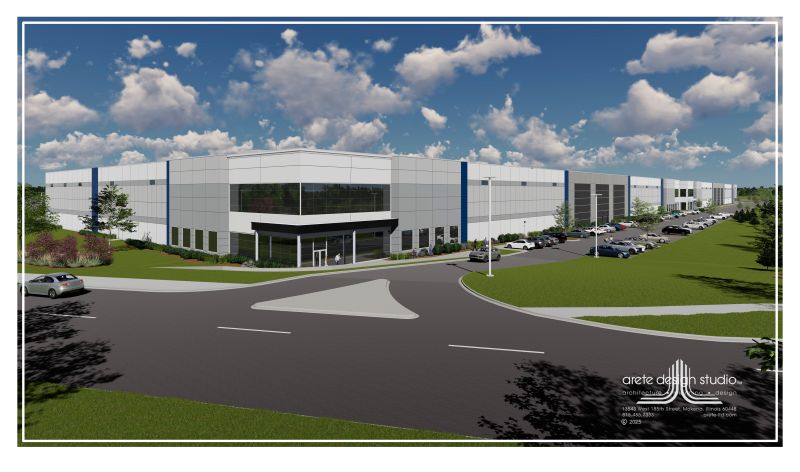
In practice, that means power capacity to feed automation and electric vehicle infrastructure, trailer parking that can decide a competition between otherwise comparable buildings and labor access weighted as heavily as highway access. Feczko points to 390 O’Hare Logistics Park in Schaumburg, a two-building, 443,000-square-foot Class A development he is leasing alongside NAI Hiffman Executive Vice President David Haigh on behalf of Logistics Property Company, as proof that developers still believe in that demand. The project recently broke ground along I-390 and is targeted for completion in the third quarter of 2027.
The developer: proof of concept in North Lawndale
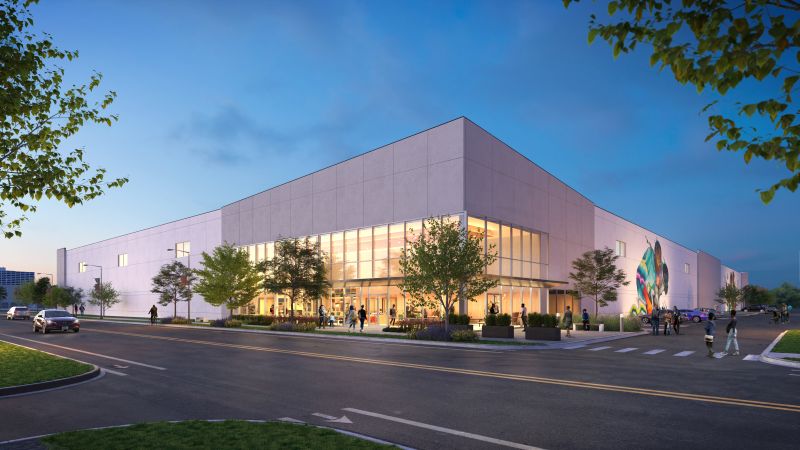
Few projects in the country say more about where urban industrial development is headed than CRG’s The Cubes at Roosevelt & Kostner. Precast is complete on both buildings and Steve Schnur, Chief Operating Officer at CRG, confirms the project remains on track for its first deliveries in the third quarter. The site sat vacant for decades before a partnership with Related Midwest, 548 Development, the City of Chicago and North Lawndale community organizations unlocked it. The finished development will include two donated Innovation Centers operated by Black Men United and the New Covenant Community Development Corporation, a 3-megawatt rooftop solar array delivering discounted clean energy to roughly 500 low-income West Side households and an estimated 125 construction jobs and 250 permanent positions.
“When a community sees a development that delivers jobs, green space, clean energy and dedicated community facilities, the conversation changes entirely,” Schnur said.
He argues that approach will decide who gets to build in the city at all.
“The best infill sites in Chicago sit adjacent to neighborhoods, and developers who treat community benefit as a core part of the deal — not a concession — are the ones who will get these projects entitled, financed and delivered,” Schnur said.
CRG is testing the same infill conviction at smaller scale with The Cubes at Cicero, a speculative project in the underserved 80,000- to 100,000-square-foot segment, and recently delivered and sold the fully leased Cubes at ORD near O’Hare’s South Cargo Area.
Capital markets: the CFO’s calculation
Sale-leaseback volume climbed significantly from 2024 to 2025 and Haefner says 2026 is tracking well against that pace as corporate owners take a fresh look at their balance sheets.
“What’s driving it is pretty straightforward: companies are sitting on assets that have appreciated substantially and their CFOs are starting to ask hard questions about why that capital is tied up in real estate,” Haefner said. “A sale-leaseback lets them unlock it without moving out.”
The buyer pool chasing those deals is deep. Private and 1031 exchange capital remains active, institutions have returned and non-traded REITs have been aggressive on well-structured transactions, per Haefner, a mix of demand that has compressed single-tenant net lease cap rates by about 25 basis points over the past year.
“My advice to anyone thinking about a sale-leaseback: don’t wait for a perfect moment that may not come,” Haefner said. “Cap rates are compressed, buyer demand is strong, and the combination we’re seeing right now isn’t guaranteed to hold.”
The global landlord: betting bigger on bulk
Few vantage points cover more of the market than the one at Prologis. Josh Zemon, Senior Vice President and Investment Officer at Prologis, reports demand improving fastest in the bulk category of 750,000 square feet and up while new supply stays muted, with less than 15 million square feet under construction across the market, and notes the Midwest is generating some of the strongest rent growth in the company’s national portfolio. That conviction is playing out through ground-up development and redevelopment of older assets in core submarkets including O’Hare, Central DuPage, I-55 and I-80, according to Josh Bauer, Vice President and Investment Officer at Prologis.
The clearest recent signal came in Glendale Heights, where Prologis acquired more than 26 acres to develop two Class A logistics facilities totaling 454,000 square feet.
“Unlocking an opportunity of this scale in the Central DuPage submarket is extremely rare, and we look forward to delivering much needed Class A space to the market while also supporting the local community, businesses and the region’s supply chain,” Zemon said.
The demand side is cooperating.
“In general, customer conversations feel constructive and point to a strong second half of the year for leasing,” Bauer said. “We are seeing faster decision making from some customers, as well as more interest in investing in their supply chains.”
The investor: betting on the blue-collar backbone
While institutional capital chases clear heights, Alfredo Gutierrez, CEO of SparrowHawk, is buying the workhorse buildings that keep the regional economy running: multi-tenant and shallow-bay industrial leased to the contractors, distributors, fabricators and service companies that need to stay close to customers and labor.
“Industrial real estate is a lot like an old pickup truck,” Gutierrez said. “It doesn’t have to be shiny. It has to start every morning.”
Scarcity powers the thesis. Infill land is hard to find, zoning is restrictive and replacement costs keep climbing, so every year the existing inventory of functional buildings becomes harder to reproduce. Buying them at the right price is another matter.
“The bid-ask gap has definitely narrowed, but it hasn’t disappeared,” Gutierrez said. “Sellers are no longer living in 2021—but some of them still own a vacation home there.”
Heading into the second half, he describes SparrowHawk’s posture as cautiously constructive, waiting for deals where value can be created at the property level rather than inherited from the market.
“In this environment, conviction matters. So does humility. You win this cycle with a calculator, not a trumpet,” Gutierrez said.
The strategist: why the numbers keep pointing here
Rusty Parris, Managing Director of Operations Improvement at TriVista, advises companies on supply chain networks rather than buildings and, from that vantage point, the first half’s defining shift is that facility location has become a financial decision as much as an operating one. Companies that quantify what proximity to O’Hare, rail infrastructure and the interstate network does for transportation costs, inventory turns and lead times, he says, move decisively when the right building appears.
“At the end of the day, companies don’t choose locations simply because they’re well known—they choose them because the numbers work,” Parris said. “For businesses moving raw materials or finished goods, the Chicago region offers transportation advantages that can directly reduce costs, improve service levels and ultimately strengthen enterprise value.”
Seven seats, seven readings of the same six months. They split on product type, price point and strategy, yet they settle in the same place: quality and function earn a premium, and discipline has taken over where the last cycle rewarded guesswork. For a market clearing $8 for the first time, that may be the most durable signal of all.